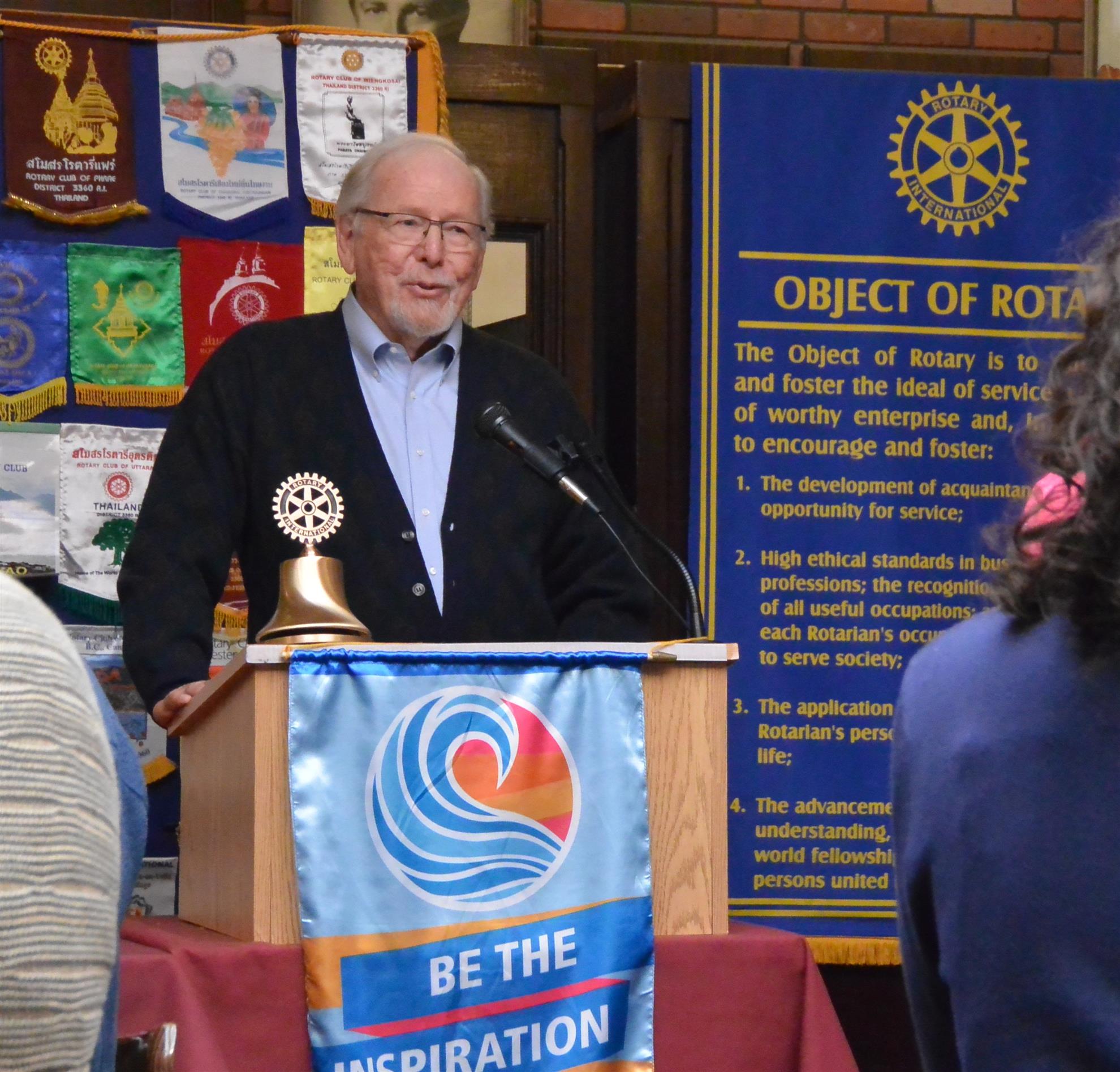
Don George introduced our speaker, Jerry D. Smith. Jerry is a Past President of the Santa Barbara Sunrise Rotary Club and past Director of the Montecito Sanitary District. Jerry was elected to and has been on the Board of Directors of the Goleta Sanitary Water Resource Recovery District since 2008.
Goleta Sanitary Water Resource Recovery District is a publically-owned service (by the residents of the city) that generates about $16 million per year. However all of that money is funneled back into the operation of the treatment plant (which is running 24 hours a day, 7 days a week, 365 days per year).
The treatment plant holds an open house every other year for the public to come by and get a first-hand look at the equipment used and the process used to treat the water. The recycling plant at the Goleta Sanitary District was built in 1992. The Goleta Sanitary District processes used water at this treatment plant, which is then distributed by the Goleta Water District (through a separate distribution system for used water) for use in landscaping/irrigation by such entities as golf courses, schools, and a university. About 3 million gallons of water per day are produced in this way, although there are limitations in how much of this water can actually be used, with the chief hurdle being the cost of distribution (as it necessitates a separate distribution system from the water produced for human use—the water coming out of your tap).
There are a lot of new developments in the in the works in regards to the recycling of “used water”. A recent study commissioned by the Goleta Water District to explore new avenues for securing water in this time of drought came up with an option called “direct injection”. This process basically works by taking water treated at the wastewater treatment plant, sending it by pipeline to a site where it can then be injected into the ground, where it would then be filtered ‘naturally’ through the soil/rock, and having a separate well system pulling the water back out of a well (distant enough, geographically, from the injection site) after that filtration process was completed.
Another option, one being encouraged by the State of California, is called “direct re-use”, which includes multiple levels of water treatment (primary, secondary, and in some cases tertiary processing) and would not need to have a separate distribution system built. Primary water treatment is the separation of solids from the water, which results in about 60% of the total amount of solids being removed from the used water (the rest being either suspended or dissolved in the water itself). Secondary treatment adds biological and chemical processes to the water to remove the remainder of those solids (this is the level of treatment at most municipal water treatment plants). Tertiary water treatment involves taking water that has passed through the secondary treatment process and running that through a water treatment plant. The idea would be to take the water that has gone through tertiary processing and use that for direct injection through the soil/rock, and then the water that would be pumped up from the wells would be at a quality level which would be suitable to go through the processing system for drinking water.
As thorough as our water treatment processing equipment and techniques are, there are some things that cannot be easily removed from used water: grease, oil and pharmaceuticals. Jerry noted that there are studies showing how these substances end up getting released and having detrimental results on the fish and wildlife in the environment. There are many safe places to take your old and unused medications (most pharmacies can take these medications now, not just official disposal sites such as at police departments) that are better than flushing them down the toilet.
New developments include “resource reclamation”, taking the solids from the water recycling process and using “digesters” to accelerate the breakdown of this material, with a by-product being methane. This methane can then be combusted and used in a generator to produce electricity (which can help offset the energy requirements of operating the water processing facility). By adding food (table scraps) to the digesters, the process can be accelerated even further. Goleta Sanitary District is looking into partnering with UCSB to collect food waste from the university and bring it to the Goleta Sanitary District wastewater processing facility, which would help both entities.
The Goleta Sanitary Water Resource Recovery District produces a newsletter about four times a year, with information on the new technologies and developments of the work being done at the treatment plant, which goes out to all residents of Goleta. Be on the lookout for these newsletters for more information!