While touring the city of New York in a trolley car on a snowy day in the early 1900s, Mary Anderson conceived her idea of a windshield wiper blade that could be operated from the inside by the trolley driver.
Anderson observed that streetcar drivers often had to open their windows in order to see during inclement weather, sometimes even stopping the streetcar to go outside to clear the window. Her idea consisted of a lever inside the vehicle that controlled a spring-loaded arm with a rubber blade. The lever, with a counterweight to keep the wiper in contact with the window, could move the blade across the windshield, removing rain or snow. With her 1903 patent, Anderson's invention proved to be the first windshield-clearing device to be effective.
As driving became more and more common, the windshield wiper was eventually adapted for automotive use. In 1922, Cadillac began installing the wiper as a piece of standard equipment on its cars.
During her lifetime, Anderson established herself as an entrepreneur. In addition to building and managing an apartment building in Birmingham, Alabama, she operated a cattle ranch and vineyard in Fresno, California.
U.S. Patent No. 743,801 / Inducted in 2011
Margaret E. Knight
American, 1838–1914
Many examples of good design have become so ubiquitous that we tend to gloss over the innovations they embody. Flat-bottomed grocery bags—humble objects incorporating design principles fundamental to the way we inhabit the modern world—are a case in point. The bag’s standardized, geometric form and economical use of materials are defining features of industrial production and distribution. The folded bag can be stored flat; when open, its groundbreaking flat bottom creates a sturdy, stable container. The use of paper, an organic and recyclable material, resonates strongly with contemporary environmental concerns.
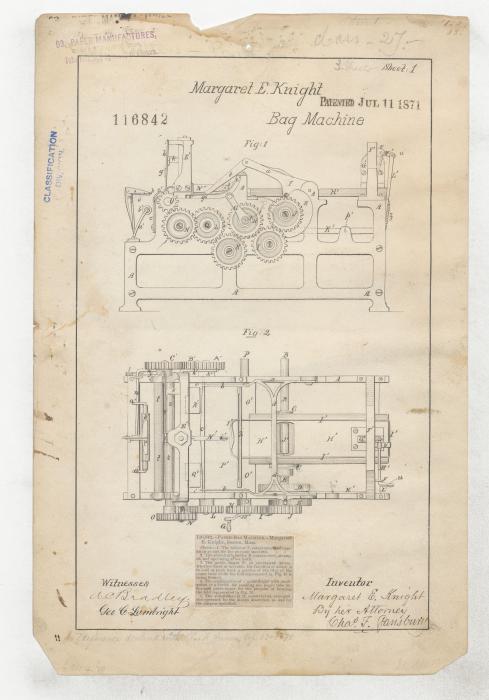
An industrially produced object is the culmination of numerous small yet complex design decisions and can involve many different individuals as it progresses from concept to prototyping and then finally to manufacture and distribute on a mass scale. Details of this process are often difficult to unearth, particularly when the design is produced over a long period. For the flat-bottomed paper bag, however, legal documents lead us back to Knight, one of the first women to obtain a US patent, in 1871. Her patented machine produced flat-bottomed bags that were a great improvement on the earlier, structurally weaker envelope style. With only minor modifications, such bags remain in production today, making this one of the oldest and most enduring designs in the Museum’s collection.
MORE: Margaret E. Knight (1838-1914) was an American inventor best known for a machine that mechanized the manufacturing of flat-bottom paper bags, which had previously been produced by hand. Flat-bottomed paper bags transformed retail commerce and became indispensable to workers and students carrying a “brown bag” lunch, yet its ubiquity makes it easy to forget—along with the name of the person responsible for its production.
As a child, Knight was more interested in tools than dolls and frequently made or improved toys for her brothers and other children. She also began working with machinery at a young age. Born in Maine, her family relocated to Manchester, New Hampshire after the death of her father so that her mother and two brothers could work in the cotton mills. Knight claimed that her first invention came soon after she began working in the mills at age 12. After witnessing a steel-tipped shuttle fly out of a loom and seriously injure a worker, a common hazard in the mills, she devised a shuttle-restraining device. The device was placed on all the looms in her mill and before long other mills in the area adopted its use.
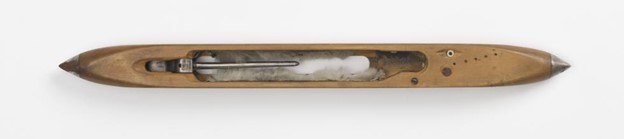
PHOTO:
Example of a steel-tipped shuttle from the 19th century. Courtesy Cooper Hewitt Smithsonian Design Museum, Gift of Mrs. DeWitt Clinton Cohen.
Knight left the mills in her late teens due to poor health. As an adult she gained valuable experience working in upholstery, photography, engraving workshops, and home repair. She developed skills and gained a deeper understanding of processes with each new experience. Around 1867, Knight began working for the Columbia Paper Bag Company in Springfield, Massachusetts and soon began developing a machine that could cut, fold, and paste flat-bottom paper bags, eliminating the time-consuming labor otherwise required to make them by hand.
Knight worked on her machine for over two years, eventually perfecting a prototype in wood before hiring a machinist to fabricate the working model needed to apply for a patent. While under construction, another machinist, Charles Annan, stole Knight’s design and submitted it as his own to the U.S. Patent Office in Washington D.C. Upon learning of the fraudulent claim, Knight initiated a patent interference suit against Annan and hired a lawyer to defend her work. Knight produced substantial evidence to support her claim including drawings, notes, entries from her personal diary, and testimony from her landlady, former employer, and machinist. Knight refuted Annan’s weak argument that as a woman she was incapable of understanding the complexities of the machine by describing the components of the machine and their function in extensive detail. The judge awarded Knight the patent.
Pairing her technical skills with business savvy, Knight founded the Eastern Paper Bag Company of Hartford, Connecticut with a partner and then licensed her machine to the company. She negotiated an upfront payment of $2,500 with royalties accumulating to $25,000. Satisfied with the income, Knight became a full-time inventor. By the end of her life, she claimed 89 inventions and held over 20 patents in a variety of fields, including shoe manufacturing and engine design. Knight never concealed her gender when promoting her work, which won her acclaim among women’s rights activists. Although not wealthy, she was able to live independently until her death in 1914 at the age of 76. Her last patent was awarded posthumously in 1915.
Further Reading:
“A Lady in a Machine Shop,” The Woman’s Journal, December 21, 1872, p. 463.
“Career of Boston Woman Inventor Disproves Old Libel on the Fair Sex,” Boston Daily Globe, April 6, 1913, p. 70.
Anne L. MacDonald, Feminine Ingenuity: How Women Inventors Changed America, 1992.
Henry Petroski, “The Evolution of the Grocery Bag,” The American Scholar 72, no. 4 (Autumn 2003): 99-111.
"Rock Music and Social Awareness: an Author's Perspective"
April 2 Lisa Torem will present a program "Rock Music and Social Awareness: an author's perspective" to our club! Lisa chronicles her path in journalism and discusses how seminal songs by artists Tori Amos, Billy Joel and Suzanne Vega have inspired social movements and activity. Lisa is a journalist author based in Chicago and has interviewed hundreds of music industry professionals, including rising stars and legends and has written features and reviews for local and international outlets. She has written books about the discographies of several artists.
About Lisa Torem
Author/journalist/musician Lisa Torem analyzed the studio work of triple-threat artists: Tori Amos, Billy Joel and Suzanne Vega for the Sonicbond On Track Series and co-authored Through The Eye of The Tiger and All That Glitters: The Ava Cherry Story.
Beyond interviewing, among others, members of Yes, The Animals, The Zombies, The Kinks, Cream, Thin Lizzy, Wings, Jethro Tull, plus Dave Brubeck, Darlene Love, Donovan, Buffy Sainte-Marie, Judy Collins, etc., she crawled through a window to talk to Jimmy Webb without breaking one bone. The native Chicagoan critiques music books for pennyblackmusic’s Raging Pages, where she is a staff writer.
Lisa comps in a big band which features her latest jazz ballad. Several original compositions grace indie films. American Women Composers orchestrated tracks from her multi-cultural collection, Singlish. Her one-act Dog Sharing, appeared at NY’s Love Creek Theater.
Articles, Reviews & Features Published in:
The Chicago Reader
New City Magazine
The Big Takeover
American Blues Scene
Windy City Times
Grateful Web
Popmatters
Inside Publications
Chicago Parent Magazine
The War Horse
Penny Black Music.
PHOTO CREDITS: Lisa with Dweezil Zappa Photo cred: Phillip Solomonson; Lisa with Vintage Trouble Photo cred: Phillip Solomonson










.png)