Join us this coming Tuesday at Jameson's Charhouse Restaurant 9525 Skokie Blvd. Skokie, IL 60076 - located next to the North Shore Center for the Performing Arts and Doubletree Hotel - Phone: 847-673-9700
Luncheon features:
Salad: Mixed greens, cabbage, carrots, and tomatoes. Accompanied by your choice of dressing; Balsamic, House, and Ranch
Entrée: The menu is rotated weekly with following entree - Artichoke Chicken, Crusted Tilapia, Broiled Cod and Chicken Marsala. To find our today's entree call Jameson's Charhouse at 847-673-9700
Dessert: Assortment of Chocolate Chip Cookies or Brownies
Alternative Selections:
Hamburger or Cheeseburger with French Fries
Caesar Salad with Chicken
Pasta Primavera
Lunch is $18 for members, visitors and guests.
Meetings begin at 12:15 PM & end at 1:30 PM every Tuesday.
Prospective Members:
Prospective members are invited to attend their first two meetings at the Rotary Club of Skokie Valley free of charge. Advance reservations are not required.
CLUB MEMBERS, CHECK BELOW TO VIEW WHEN ITS YOUR TURN TO PROVIDE THE SPEAKER AND FUN & FROLIC
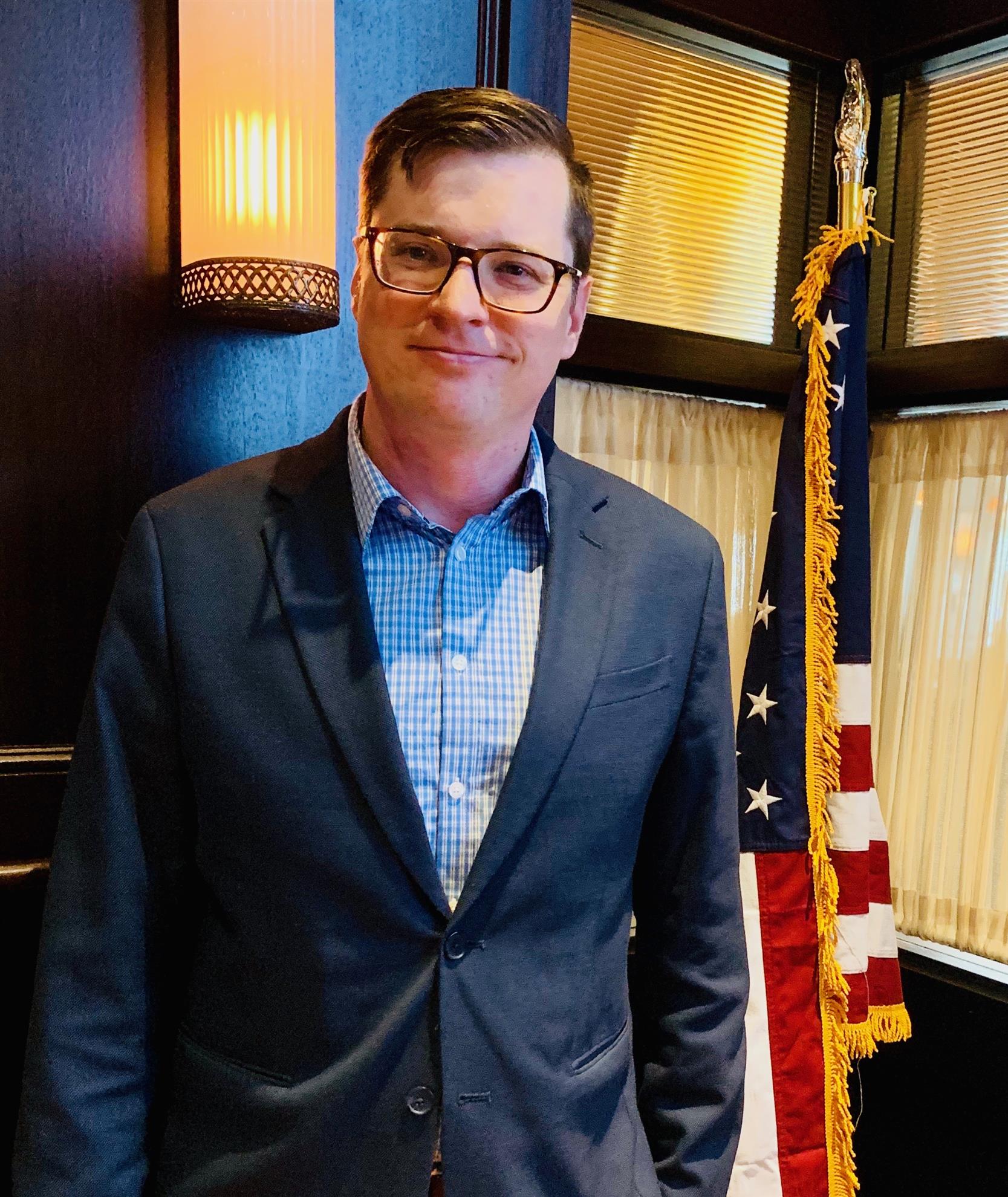
Guest Speaker David McEllis, Illinois Government Affairs Representative.
David McEllis is a Government Affairs Representative working on current Illinois energy legislative issues. He recently served as Senior Legislative Counsel in the Office of the Illinois Senate President John J. Cullerton. He was the lead Senate Democratic staffer for the Senate Energy and Public Utilities Committee, and the Senate Labor Committee.
The Environmental Law & Policy Center of the Midwest is a leading public interest environmental legal advocacy and eco-business innovation organization. We develop and lead successful strategic advocacy campaigns to improve environmental quality and protect our natural resources. We are public interest environmental entrepreneurs who engage in creative business deal-making with diverse interests to put into practice our belief that environmental progress and economic development can be achieved together. ELPC’s multidisciplinary staff of talented and experienced public interest attorneys, environmental business specialists, public policy advocates and communications specialists brings a strong and effective combination of skills to solve environmental problems.
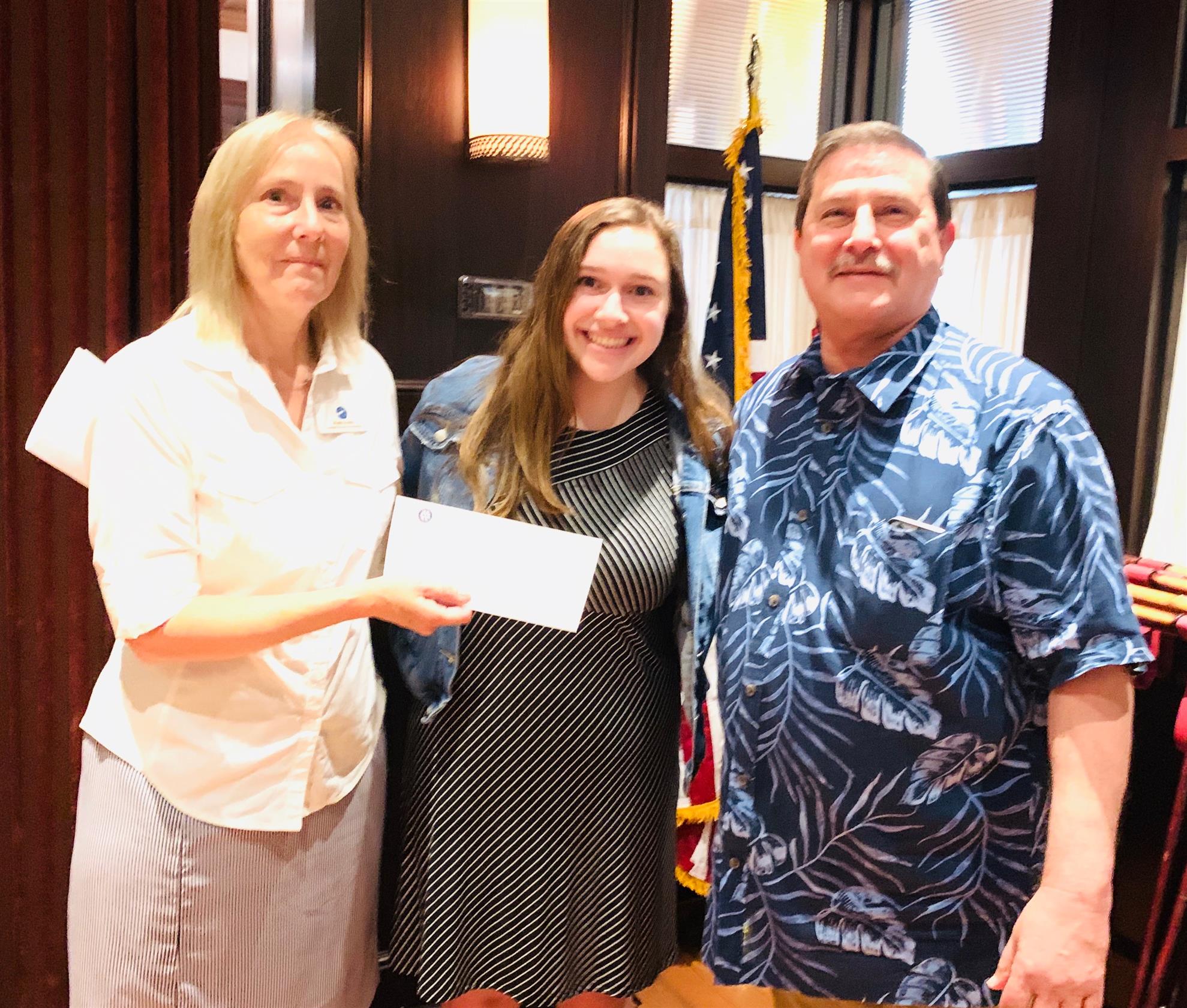
From left to right: Phyllis Nutkis, Audrey Brenner and club president Ralph Klein.
The above ARK representatives, received a donation check from the Skokie Valley Club President Ralph Klein for the Rotary calendar year of 2018-2019.
The following essay was written by Audrey Brenner:
A Worthwhile Pause
On the North Shore, it’s almost expected that college students such as myself spend their summers working in an internship. My peers and I are often asked, “What is your major?” followed by, “What will you do with that degree?” In order to be able to answer this question, my main goals this summer included developing new professional skills, making connections with my colleagues, and having something new to add to my resume. Most of all, I was concerned in figuring out what kind of career I want to pursue. However, for now, I still answer with a shrug, a smile, and “I’m not sure yet! Still exploring.”
As an intern at The ARK this summer, I’ve had the opportunity to participate in meetings, conduct research, partake in social media design, and get a taste of the 9-5 work life. I’ve learned more about The ARK, becoming more and more impressed with just how much this organization provides to the Chicagoland Jewish community. While the (now closed) thrift shop and food pantry are a large part of The ARK’s reputation, the 4,500 clients here also receive financial assistance, physical and mental health care, transitional housing, employment services, legal aid, and more. The ARK truly has the power to completely turn someone’s life around when they’re at their lowest point.
However, just last week, it was made clear to me that this is not the internship experience I had expected. Instead of heading home at 5:00, I stayed here to volunteer at Café ARK and serve free meals to clients. My responsibilities of opening hamburger buns, serving salad plates, and filling fruit cups may have been simple but I found myself overthinking everything I was doing. Inspecting fruit cups for the perfect ratio of pineapple to melon, not knowing when to collect plates, and afraid to interact with clients, I asked “Am I doing this right?” maybe ten times. Finally, the Director of Volunteers said, “This is like any other family dinner. You can’t do anything wrong here.”
I realized that I had been treating Café ARK like a job and the clients like, well, clients. I looked around the dinner and noticed one man patting another on the back with a, “Hey, buddy, how you doing?”, a group of ladies deep in conversation in the corner, and an ARK employee animatedly chatting and laughing with a client as if they’d been friends for years. I didn’t feel like I was at a nonprofit organization as much as I felt like I was in someone’s home. Beyond all of the fundraisers and services The ARK provides, I finally understood the overall theme here: community.
The staff and volunteers at The ARK feel a commitment not only to the organization but to each other. While The ARK could easily provide its services and still make an impact on someone’s life, they go the extra mile by valuing compassion and close knit relationships, setting this organization apart from any other. Money provides the physical materials needed to assist our clients, but our community is fueled by heart, preserving the dignity of each and every individual who turns to The ARK. When you contribute to The ARK, you’re not only funding its programs; you’re also keeping this unique, meaningful community alive. You are giving individuals the support system we all need at some point.
I had been so focused on this internship and wanting to graduate college as an impressive, hire-worthy applicant. I’m extremely grateful that I paused to understand the magnitude of The ARK and its work. Whether you are an intern, young adult, parent, or senior citizen, I highly encourage pausing to evaluate the power of community and reflect upon those who make up the foundation of your identity. Only then will you begin to understand the beauty of The ARK’s mission.
Our Annual Club Picnic will be July 30th at 4:30. All you need to know is on the above brochure. Food soft drinks and bottled water is provided by the club. Bring your own alcohol (and maybe a little more for a friend, or two).
Oh.. by the way, if you're a vegetarian bring your own veggie burgers to be grilled. Unless you're happy with salad and munchie.
Club Officers, Directors and Chairs will be installed at the picnic.
Bring your spouse or significant other and prospective club members.
False rumors that children are fainting or dying have led parents to turn away vaccinators, threatening the campaign to eradicate the disease.
A health worker gave polio vaccine to a child in Kandahar Province in Afghanistan in March. Polio immunization is compulsory in the country, but distrust of vaccines is widespread and the programs are difficult to enforce, particularly in rural regions.
The global drive to eliminate polio, which has gone on for 31 years and consumed over $16 billion, has been set back again by a surge of new cases in Pakistan and Afghanistan.
As of July 10, there were a total of 42 polio paralysis cases in the two countries. They comprise a single large outbreak, because most cases are in the tribal areas along the border, where local people easily cross back and forth.
Pakistan had 32 of the cases, compared to only three by the same date last year, and the situation is expected to get worse because hot summer weather favors the virus. There were only 12 cases in the country in 2018 and eight in 2017.
For each paralyzed victim — usually a child below age 5 — there are about 200 others who are infected and shedding the virus in their stool, the World Health Organization estimates.
About 20,000 children are born each day in Pakistan. In cities with open sewers, and where other pathogens may attach to the same intestinal receptors that the vaccine does, it can take many doses to fully immunize a child.
Last year’s hotly contested national elections temporarily threw the program off track as local officials were replaced, said Aziz Memon, head of Rotary International’s polio campaign in Pakistan. Cases have typically spiked during elections and moments of political turmoil, according to an article in The Diplomat, a current affairs magazine focused on Asia.
Earlier this year, Pakistan announced that it would streamline its national vaccination drive in June in order to make the campaigns faster and less intrusive. Teams would try a friendlier approach and gather less data on the families they visited, the prime minister’s office said.
But false rumors spread on social media saying the vaccine had triggered fainting spells — or even that it had killed dozens of children — and many families locked their doors to vaccinators or hid their children.
The issue has split families; The Times of London recently described a Pakistani man returning from work and divorcing his wife on the spot after finding their children’s fingers marked with the indelible ink used by polio vaccinators. Islamic law allows a man to end a marriage by merely saying “I divorce you” three times; he threw his wife and children out of the house.
As in other countries, like Italy, vaccines have become politicized, with opposition parties spreading anti-vaccine rumors.
Babar bin Atta, the prime minister’s special assistant for polio eradication, said in a letter to the Dawn newspaper that population movements and increasing numbers of refusals were hurting the effort.
The country, he said, would try to fix continuing problems with routine immunization, safe water and sanitation, and the high incidence of malnutrition.Eradicating polio from Pakistan “may take longer than we hoped for," he said.
A further threat to the eradication campaign is that a few countries — mostly in Africa — have been unable to eliminate some mutated strains of the polio viruses used in live vaccines. Those strains have reverted back into forms capable of causing paralysis.
In the last two years, there have been outbreaks of “vaccine-derived polio” in Angola, the Democratic Republic of Congo, Ethiopia, Indonesia, Mozambique, Niger, Nigeria, Papua New Guinea and Somalia.
Last week, a sewage sample in western China tested positive for a vaccine-derived polio strain, meaning the virus must be circulating there although no cases of paralysis caused by it have yet been detected.
Xinjiang, the province where it was found, borders on both Pakistan and Afghanistan.
Historically, such outbreaks have always been eliminated by the use of injectable killed vaccines, which cannot mutate, and live vaccines that protect against the mutated strains. But the outbreaks in some countries have gone on for many months.
This weekly electronic bulletin is intended to keep club members, friends of Rotary and bulletin subscribers up to date with weekly luncheon meetings and other club activities. Feedback, (positive or negative), is welcome!

.jpg)
.jpg)