Fast Facts Language and Symbols
Fast Facts Danish and French Languages and Alphabet (cont’d)
Danish (Dansk, in Danish) is spoken in Denmark and the Faroe Islands. In Germany and Greenland it is a recognised minority language.
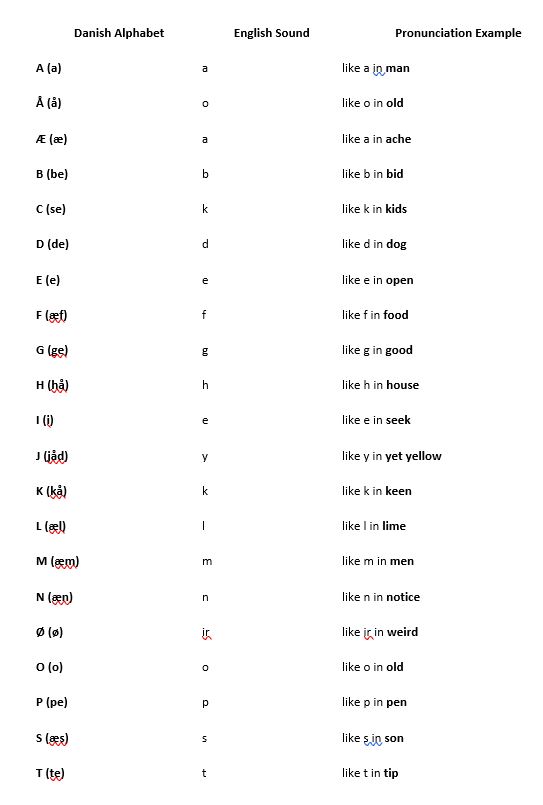
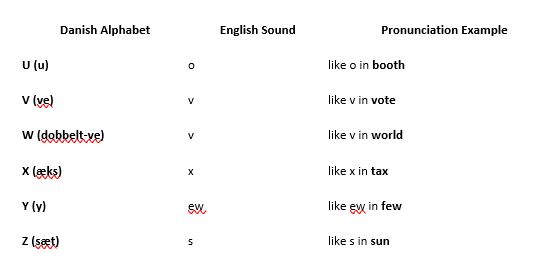
Learning the Danish alphabet is very important to speaking Danish well. This is because the structure is used in every day conversation and without it you will not be able to say words properly, even if you know how to write them. The better you pronounce a letter in a word, the more understood you will be in Danish. The following table seems to be a more useful pronunciation guide for English speakers. Note also the use of ‘o’ as the primary diacritic used in Danish.
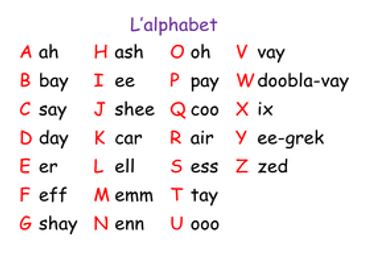
Moving on to French, the French alphabet has 26 letters; these are the same as English, but pronounced as follows.
Interestingly, French has 5 diacritic symbols to indicate variations in pronunciation and to distinguish between similar words, but
Accute accent (l’accent aigu ) is used only on the letter “e” to indicate a change of pronunciation. Two examples are La santé and Le café
Grave accent (l’accent grave) (pron: “grave” like “grahve”) is used on the letter “e” to indicate a change of pronunciation. For example Le Père (father); Le problème (problem)
It is also used on the letters “a” and “u” to differentiate words that sound identical. For example, Il a faim (he is hungry) and Il va à Paris (He is going to Paris).
The verb “a” (to have) in the first sentence becomes a preposition “à” (to) in the second sentence
Circumflex accent (L’accent circonflexe) can be used on all vowels to indicate a change of pronunciation or as a sign that there was previously an additional letter (often an “s”) in the word.
Words with a circumflex accent are often words that are similar in French and in English. For example, La forêt (forest), L’hôpital (hospital)
Umlaut (Le tréma) indicates that a vowel that’s normally pronounced as part of a group of syllables should be pronounced separately, or that a normally silent letter isn’t silent. For example, Égoïste, Noël
The cedilla (La cédille) indicates that the letter c should be pronounced “s” and not “k”. For example: Leçon, Français, Ça
If you forget the cedilla in “leçon” (lesson) you are saying “le con” (the idiot). An good example of how the diacritic is important to the meaning of what is written.
A cédille is never before ‘e’, ‘i’, or ‘y’, because “c” before these letters is always pronounced “s”.
Congratulations if you have read this far! Your reward is a heads up! Namely that Danish and French pronunciation challenges are proposed for future Club meetings!