|
President David welcomed all to Rotary on a cold and windy night.
Our guests———-Mary and Ricky Tuck from the Rotary Club of Smithton, Tasmania, they
haved moved to Warrnambool.
Associate Professor John Sherwood, -guest speaker for the night
Margaret Ross and John Patterson
Mr Nishiyaka from the Kyushu Electric Company Japan.His company sponsors the student
exchange / visit program to Brauer College.
MEMBERS ANNOUNCEMENTS Ian Cairns
Father of the Year
Volunteers to pick up school entries Monday 5 & Tuesday 6 July.
Tuesday 13 July Volunteers needed at 5pm @ the Footy club for initial screenings of entries.
Father of the Year Breakfast Wednesday 28 August —— NO Rotary Meeting Tuesday 27 August. Graham
Next weeks guest speaker will be Anthony Ledden from Plant Breeders without Borders.
Svet has jam to sell this week in support of this project and next week there will be biscuits to
buy. Steve
Our exchange student from Germany - Johannes Frantz - is arriving on the weekend. We will
have the opportunity to meet him next week at Rotary. Robbie
Coffee morning @ Wines Pattissery Saturday 3 August 10.30am. Louise K
If anyone needs to update their R.S.A (responsible serving of alcohol) you can now go on
line and do it there for free. You will need your certificate number. If you can’t find your
number check with Gerry. Fines
Was in the form of a quiz for each table.
Learnt some fun facts! Thanks Lou Robbies Swindle
Mary had the chance of a $166 win but chose the 3 . Alan Bowes introduced our guest speaker for the night Associate Professor John Sherwood. John joined Warrnambool Institute of Advanced Education as a Lecturer in 1979,moving to
Warrnambool from Sydney with his family. Following the formation of an expanded Deakin
University in 1990, he was promoted to Associate Professor, a position which was made
Honorary on his retirement in 2010. John has a strong environmental research interests and
is actively involved i environmental management through his memberships of the Victorian
Marine and Coastal Council and the Board of Glenelg-HopkinsCMA. Previously he has served
on the Western Coastal Board, Victoria’s National Parks Advisory Council & Victoria’s
Fisheries Co-management Council. He has also served as a National President of the
Australian Marine Science Association. His work has been recognised by Warrnambool City
Council(Australia Day Awards 1988 & 2017), Glenelg-HopkinsCMA (Individual in Business
Award 2005) and the Victorian Coastal Council( Lifetime Achievement Award 2005) 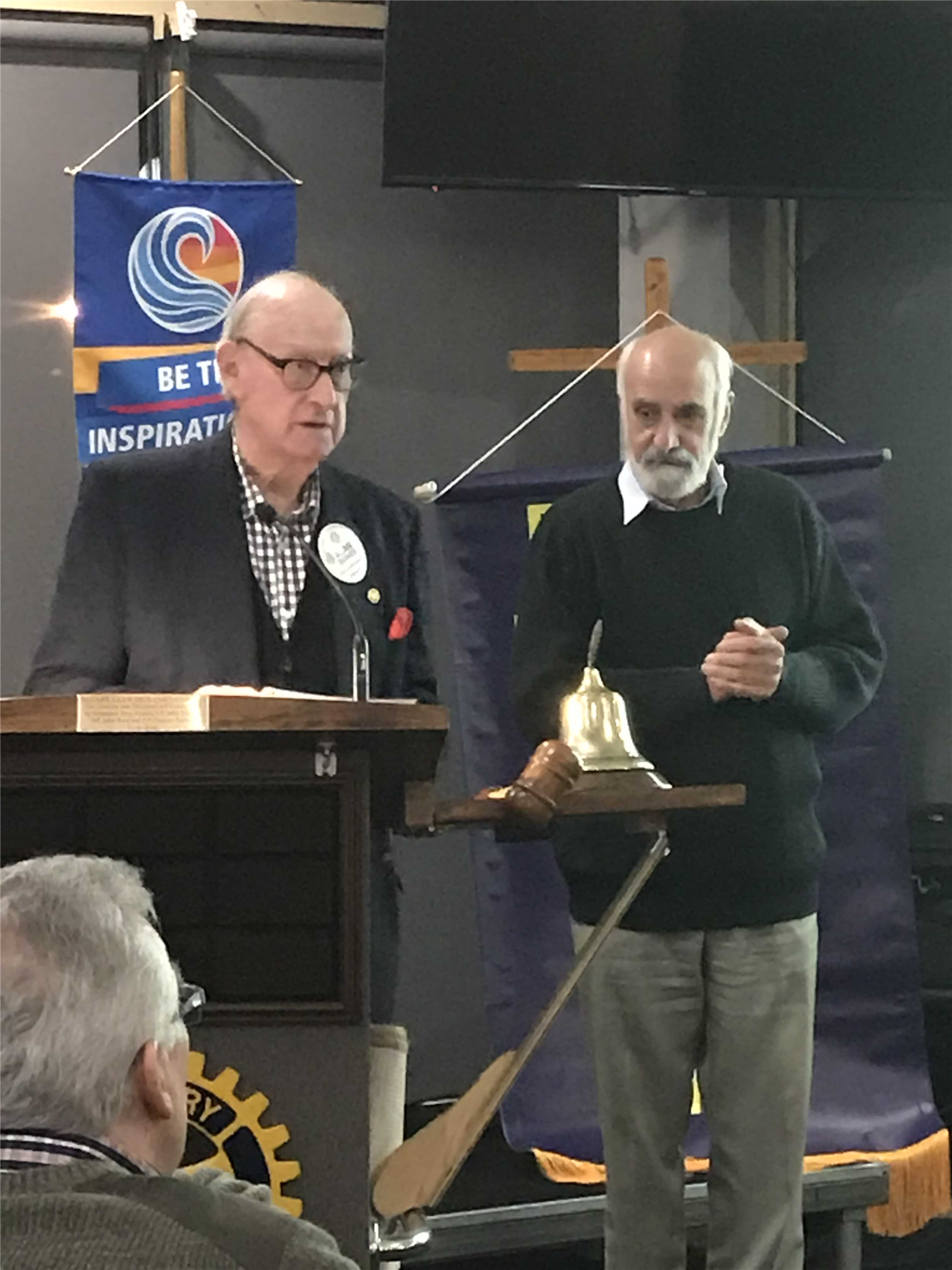 John’s talk was on the Moyjil project.
The team, which includes Dr John Sherwood from Deakin
University, has spent more than 10 years investigating the Moyjil
site in Warrnambool, Victoria, searching unusual shell deposits and
burnt stones for evidence of human origin.
Researchers believe the site could contain "middens" created by
Aboriginal people during the period known as the last interglacial
age – which was roughly 115,000 to 130,000 years ago.
Dr Sherwood, an earth scientist and Honorary Associate Professor
within the School of Life and Environmental Sciences at
Deakin's Warrnambool Campus, said Moyjil could confidently be
assigned as a remnant of the last interglacial age, well beyond the
currently accepted ages of the oldest known human sites in
Australia and New Guinea. "The site contains the remains of shellfish, crabs and fish in
cemented sand, together with charcoal, blackened stones and
features which resemble fireplaces," Dr Sherwood said.
"What makes the site so significant is its great age. Dating of the
shells, burnt stones and surrounding cemented sands by a variety
of methods has established that the deposit was formed about
120,000 years ago. That's about twice the presently accepted age
of arrival of people on the Australian continent, based on
archaeological evidence."
"A human site of this antiquity, at the southern edge of the
continent, would be of international significance because of its
implications for the movement of modern humans out of Africa."
Along with Dr Sherwood, the core investigatory team includes the
University of Melbourne's Professor Jim Bowler; Professor Ian
McNiven of Monash University's Indigenous Studies Centre and the
ARC Centre of Excellence for Australian Biodiversity and Heritage;
and Dr Stephen Carey, an earth scientist from Federation
University. Dr Sherwood said researchers had strived for years to rigorously
test the hypothesis of a human origin for the site, but the findings
were not yet conclusive, because the team had not discovered
material such as stone artefacts or human remains which would
provide absolute proof of human origin.
"The unusual shell deposit at Moyjil has been subjected to a degree
of scrutiny rare if not unprecedented in Australian archaeology," he
said.
"We recognise the need for a very high level of proof for the site's
origin. Within our own research group the extent to which members
believe the current evidence supports a theory of human agency
ranges from 'weak' to 'strong'. But importantly, and despite these
differences, we all agree that available evidence fails to prove
conclusively that the site is of natural origin."
"What we need now is to attract the attention of other researchers
with specialist techniques which may be able to conclusively
resolve the question of whether or not humans created the deposit." The team's findings have been published in the Proceedings of the
Royal Society of Victoria, in a series of six papers reporting on the
suite of techniques used to investigate the age and origin of the
Moyjil shell deposit. The project has been overseen by the Moyjil Project Committee
comprising the region's Traditional Owners, Eastern Maar,
Gunditjmirring and Kuuyang Maar, as well as government agencies
and researchers.
President David thanked Associate Professor John Sherwood for
his interesting talk, and thanked all our guests for the night
He finished the night with the quote “ Many receive advice…….very
few profit from it."
|




.JPG)