Remembrance Day 2018 in Cumberland
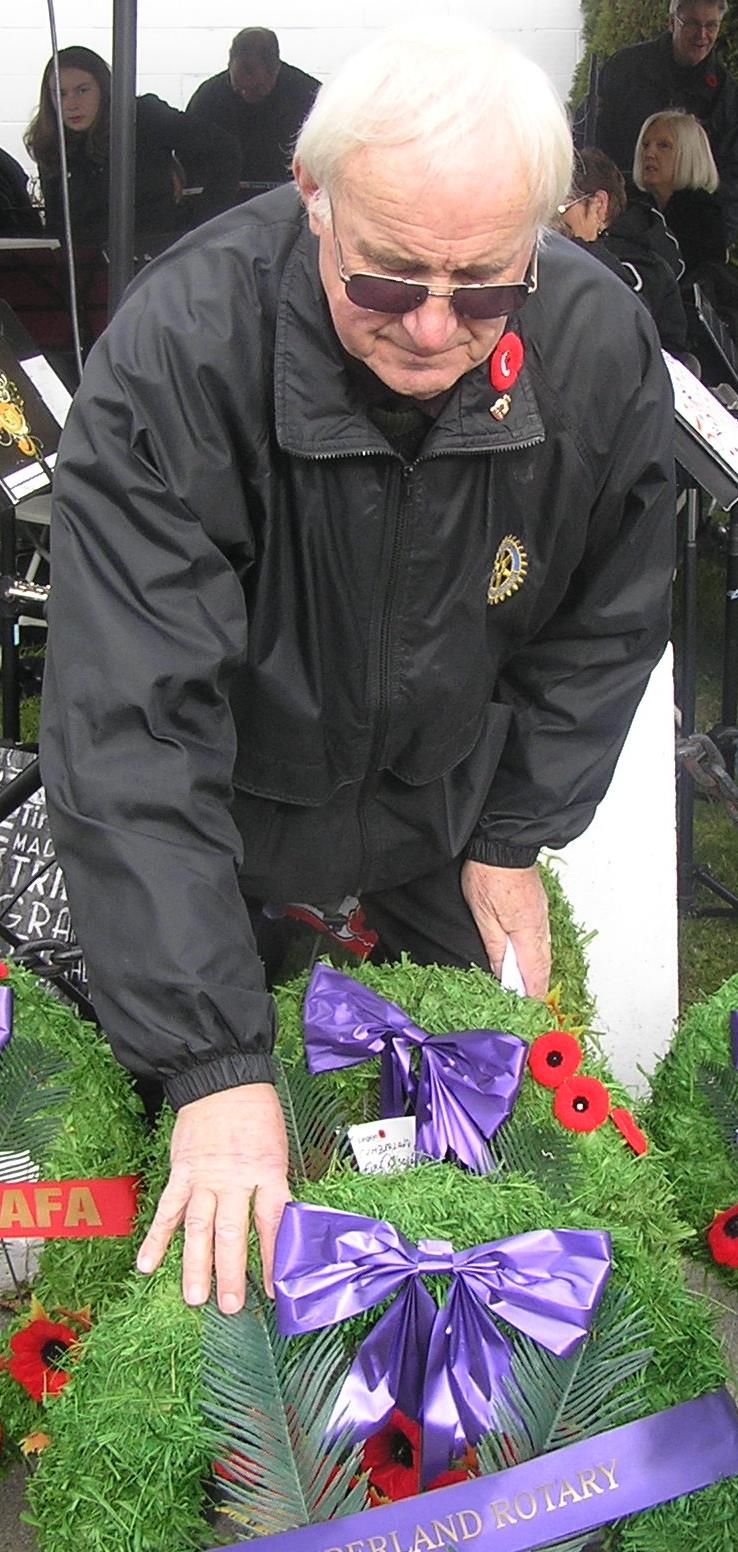 A Past President and current club Treasurer John Jones lays a wreath on behalf of Rotary Club of Cumberland Centennial. | 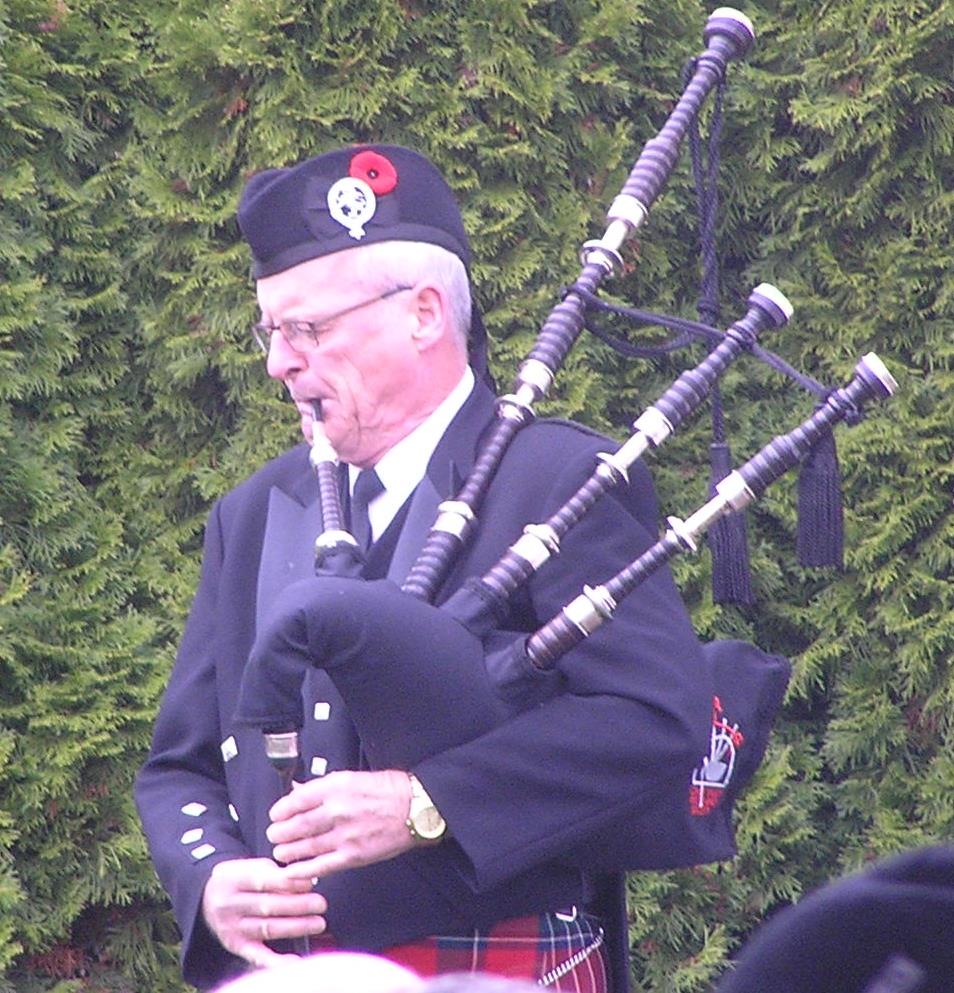
|
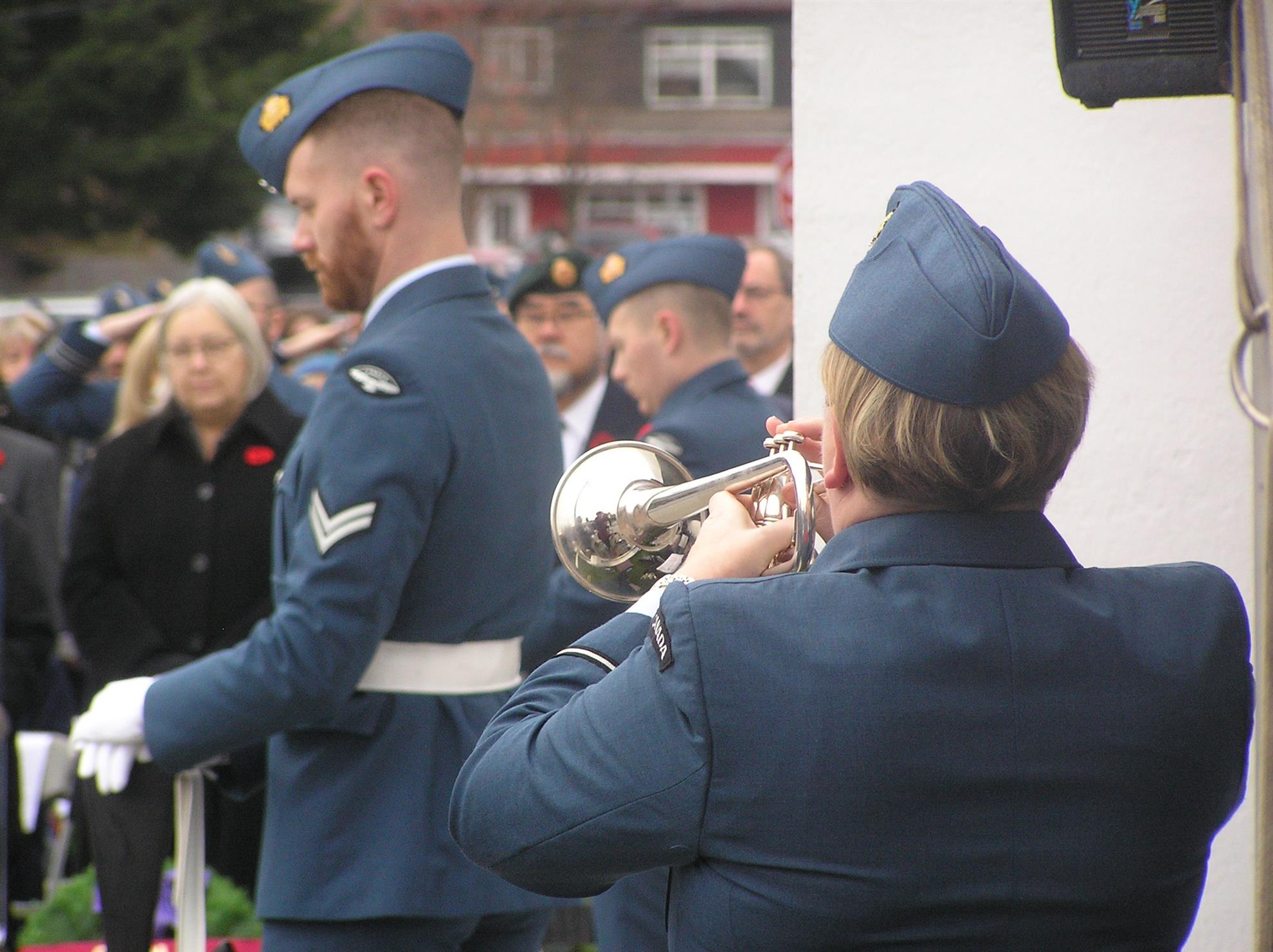 In military tradition, the Last Post is the bugle call that signifies the end of the day's activities. It is also sounded at military funerals to indicate that the soldier has gone to his final rest and at commemorative services such as Remembrance Day. | .JPG) There was a large turn out for the Remembrance Day service at the War Memorial on Dunsmuir Avenue in Cumberland. The writer estimated the number of people attending was over 300. Click on the Read More button for a bit of history of the Cumberland War Memorial. |
In 1997 the Village of Cumberland has made the arch and the front 14 bollards and chain a historic site. Later that year, the Canadian Scots Regiment from Victoria, British Columbia, placed a tablet in memory of local men and women who served with the Canadian Scots.
Great War Veterans' Association (GWVA)
On 11 November 1918, the day Armistice was signed in France to end World War I (WWI), Cumberland was in the middle of the Spanish Influenza epidemic. All public places were closed by order of village council. However, at two o'clock in the morning, the church bells and fire bell began ringing, and the whistles of the locomotives in the WCR round house began blowing. The phones rang throughout town, the city lit up and, by five o'clock, the citizens of Cumberland were celebrating in the streets and decorating Dunsmuir Avenue.
On the first anniversary of Armistice Day in 1919, the citizens celebrated with a masquerade ball, which was hailed as the "first annual". Although the balls continued for several years on another day, by 1920 it was felt that it would be more fitting to commemorate 11 November with a memorial ceremony to the dead rather than with a celebration.
In 1919, the city showed its appreciation to the men who had gone overseas to fight by giving a lot to GWVA so they could build a Memorial Hall. The hall, designed by William Arthur Owen and built by H. Trehearne of Courtenay, was officially opened in October 1920. A dance hall, added in March 1922, was used by many organizations for banquets and formal functions.
In 1921, the GWVA built a Memorial Arch in front of the Hall. On this Arch, they placed tablets with the names of 28 local people, including two Japanese-Canadians, who lost their lives in the service of their country during WWI. This Arch was also designed by Owen, and the bronze tablets were manufactured by Henry Birks and Sons, Montreal.
Following WWII, the names of the 15 locals who died in that conflict were placed on the Arch, as was a later plaque honouring all local Korean War veterans. Those who died have a maple leaf beside their names.
The Tudor-arch shape of the main structure of the Memorial Arch is echoed in three inset panels at the top and long panels down the front sides. The Arch, in turn, echoed the front entrance and window shapes on the Memorial Hall. The original roughcast stucco gave much more definition to the recessed forms than the modern flat-coloured stucco.
The poured concrete bollards linked with heavy chains which outline the property are contemporary with the arch, although the ground level around them had risen.
The GWVA became the Royal Canadian Legion of the British Empire Service League in 1926, and Cumberland Branch was instituted as No.28. When the original Memorial Hall was gutted by fire on 17 April 1962, it was replaced by a smaller, one-story concrete block building.
Exerpt from Cumberland heritage: A selected history of people, buildings, institutions and sites, 1918 -1950 by Jennifer Nell Bar;
As an aside note - It was my father who represented the Korean Veterans Association in the dedication of the plaque. Retired CWO Gordon Bohnert - Debbie Lemire's dad.