Rotary Club of Burlington Central Breakfast Meeting
Holiday Inn, January 9, 2020 President: David Roscoe.
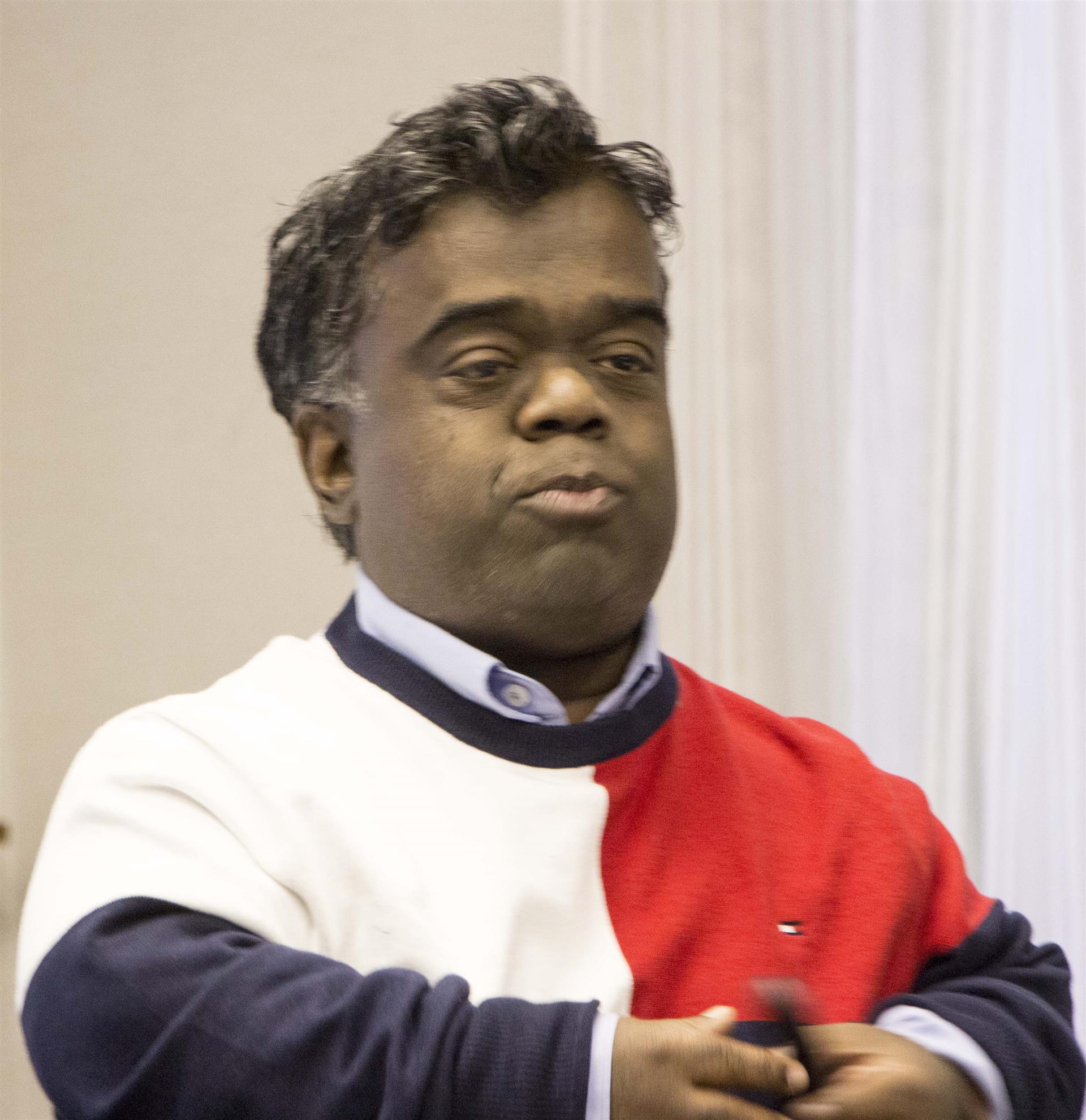
Guest speaker Tim Muttoo.
Our exchange student, Yahel.
David Roscoe welcomed back Jim Brindle after his recent surgery.
Peter Thoem is looking for volunteers to lead the Seniors’ Breakfast on 8 February, the second Saturday. There is a need for a leader for six people. Eric Anderson and David Roscoe both volunteered on the spot.
David Roscoe is looking for speakers for the month of February.
The board will be meeting at 7 PM at Karmel Sakran’s home or office, stay tuned.
Yahel described her extremely busy time over the holidays and recounted many of her experiences thanking the numerous people who had given her hospitality. She had many dinners, presents, field trips, a concert, parties, a Christmas market, skiing day, curling, Rock and Jump, movies, a visit to Niagara-on-the-Lake.
Rod Collard, Sergeant at Arms had a straw poll questionnaire examining the nine reasons for, perhaps more for not moving from the golf club to our new temporary breakfast meeting place at the Holiday Inn. There seemed little doubt as to where his preferences lay. This said, we were given a very warm welcome by the manager of the Holiday Inn and provided with an excellent breakfast with numerous choices and excellent quality and quantity.
The new Outbound Student has been selected and will be visiting soon.
Tim Muttoo was introduced, our speaker for the day. Tim is a co-founder of a charitable organisation H2O 4 All an NGO that is looking to provide sustainable clean water and sanitation for the Third World. It was founded in 2008 in Oakville. Tim lives in Mississauga. He has a degree in engineering and a Masters in Public Health. A motto of Tim's organisation is making a different difference at a drop at a time.
Koffi Anan was quoted as saying there will be no defeat of AIDS, TB, malaria et cetera until there is safe drinking water in the Third World. There is without question a World Water Crisis.
Some extraordinary statistics:
- 800 million people have no access to safe water.
- More than 2 billion people have no adequate sanitation which leads to disease.
- 11 million children die of preventable causes around the world each year.
- There are 500,000 deaths every year from cholera dysentry, typhoid, and polio.
- 650 million children live in abject poverty with a family income less than one dollar per day.
- it takes the average family four hours to collect water each day and that water is compromised more often than not.
- 1600 children less than five years of age die every day. Five years is a critical age beyond which if a child survives they stand a somewhat better chance of living to maturity. It is the young who are most vulnerable.
- Last decade there were more children who died of diarrhoea then all the deaths due to armed conflict since World War II,
- more children died of diarrhoea than AIDS and malaria combined.
- More than half the children in the world have an inadequate water supply and sanitation.
Poor nutrition, poor sanitation lead to malnourishment and poor health. Inadequate management of waste and industrial contaminations are highly prevalent in the Third World who are the casualties of this unsafe environment. Imagine the daily compromise of your family due to the above and it's not difficult to know why people cannot move forward towards improving their lot or ending poverty. They cannot even feed or support their families. Farmers cannot provide the food required to feed themselves. Women and children are the most vulnerable. Education is a key to individual progress and ultimately to community development.
Education is invariably affected owing to the time it takes to collect water. The school attendance drops because of the multiple illnesses associated. Girls have to leave school once they reached menarche as there is no running water or any way of maintaining hygiene.
There are charities all over the world for many different aspects of human disadvantage but water is a basic problem common to virtually all Third World countries.
H2O 4 All aims to create sustainable socio-economic growth in developing communities. Having water and sanitation is a human right.
Why not join a large organisation? Tim feels it's better to be small and to help large organisations through local engagement, collaboration, and provision of, and maintenance of technology. There's always a tendency not to include locals in the conversation, not to respect the locals and their local knowledge. We clearly don't have all the answers; poverty and illiteracy notwithstanding, the locals are in a better position to answer many questions.
Tim has been working in eight African countries along with Haiti, the Dominican Republic, Cuba, Colombia, and South America. He describes his work as "working in the mucky middle". Organisations that work top-down cannot comprehend what's going on at the bottom. Not all technology however great will be appropriate "on the ground"
He has 65 partners around the world. Haiti was given $1 billion but no one checked what would actually work there and there was no partnership with the people just many NGOs going in and doing their own thing to very poor effect.
A more recent project is the Rwanda Project in "the land of 1000 Hills" where there are 11.2 million people, one of the smallest countries in Africa.
- 57% of the population has access to drinking water;
- 64% have access to sanitation;
- 1.5 km each way is not unusual for collecting what is often unsanitary water.
Tim's project is to provide high-tech, efficient, German made solar powered pumps and to bring water up into a tank to provide gravity feed. He can provide safe water for 3000 people for drinking washing and cooking, and a separate supply for irrigation. Health and education are also fostered in their connection with the people. The water is naturally clean coming from a deep well but with mineralisation, disinfection, ultraviolet therapy treatment, water can be made very safe. Maintenance is key and his organisation has a supply chain to ensure this. It is all run by local people.
They are welcomed by local government. In Cuba for example the provision of clean water is considered to be a social right and especially in that political environment this was strongly welcomed.
Finances for H2O 4 All comes only from local generosity. Rotary has been involved in a number of places and we heard that Joe Chalklin’s wife, Lori, joined one of the projects in Sierra Leone along with Ebbe Marqueson and in the past. Partnership with Rotary is critical.
Tim was thanked for his talk and the meeting adjourned until next week.
Anthony Ford-Jones