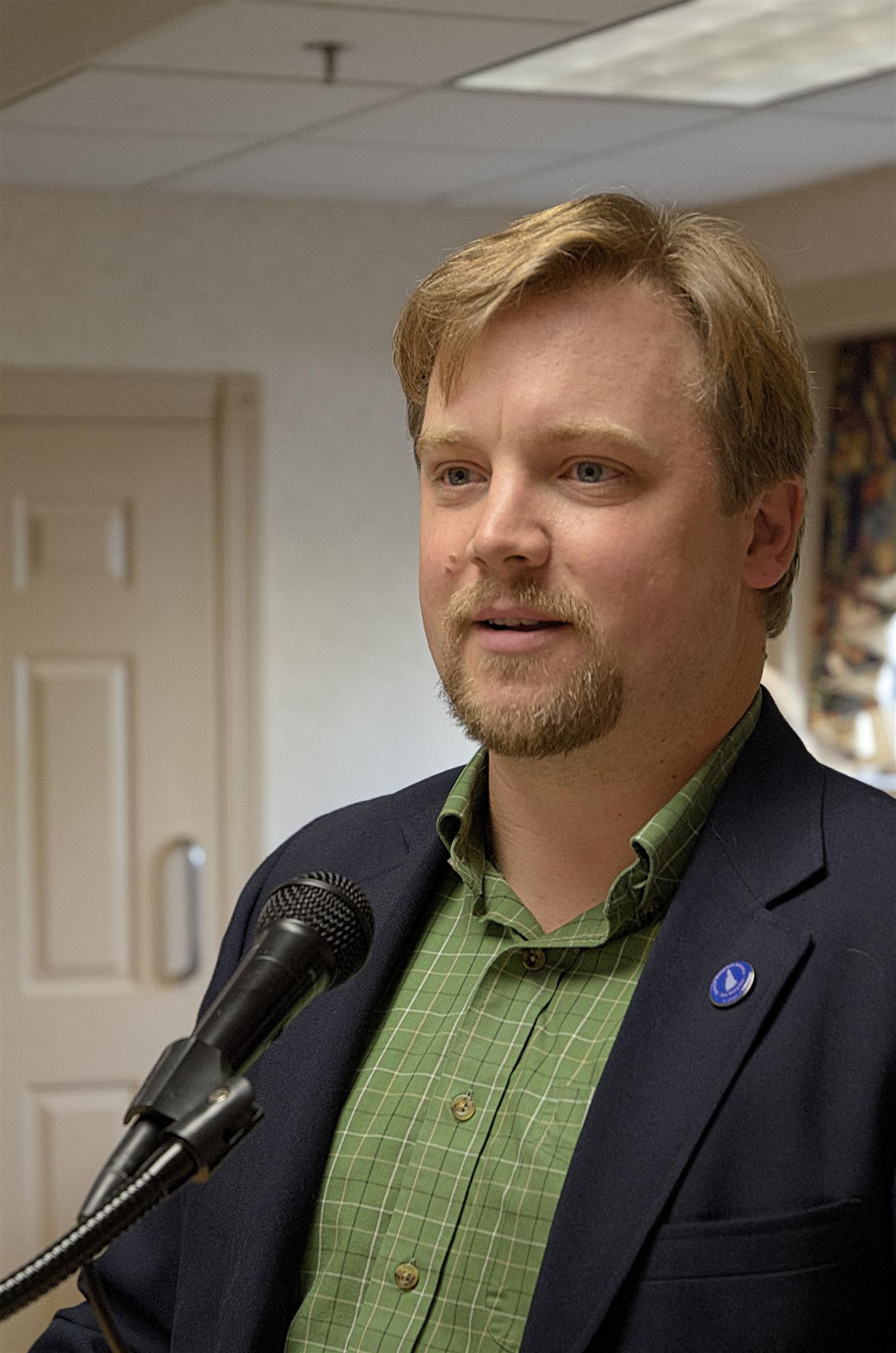
John Yacavone introduced today’s speaker, Enfield Town Manager Ryan Aylesworth.
Ryan grew up in western Maine, graduated from Cornell with a degree in natural resource management, and obtained a master’s degree in public administration from UMass Amherst while working as a natural resource specialist for the U.S. Fish and Wildlife Service.
He then began work on a PhD in environmental policy at the University of Minnesota while heading up the government affairs program in the U.S. Fish and Wildlife Service’s Midwest Region. He and his wife Laura moved back east to western Massachusetts after she had finished her DVM program and began practicing veterinary medicine.
Ryan worked as the executive director of a non-profit environmental group and eventually became the first town manager ever for the town of Hinsdale, Massachusetts. After the birth of their second child, Ryan and Laura decided they wanted to relocate to northern New England. When the town manager position opened up in Enfield, they made the jump, and Ryan has now served as Enfield’s town manager for slightly over two years.
His professional and community activities include serving as the vice chair of the Upper Valley Lake Sunapee Regional Planning Commission.
Ryan, Laura, and their two young children live on a small hobby farm in Enfield with two horses, two dogs, and two cats.
Ryan Aylesworth.
Ryan began his talk by noting that he has been a member of Rotary in the past and is eager to apply the Four-Way Test to his dealings with Shawn Mulholland regarding Lebanon’s sewer development surcharge. (No comment heard from our stalwart city manager at the head table.) Ryan commented on how much he enjoyed the friendly barbs and banter at his previous Rotary meetings.
When Ryan began his tenure as Enfield’s town manager, the town had not completed any previous strategic planning. After six months work, every town department had a strategic operational plan. These plans contained citizen-oriented goals that were not based on inputs but upon things to be accomplished (e.g., reducing accidents, not hiring personnel). The town also purchased three acres of DOT lakeside property within walking distance from downtown and the Rail Trail, while acquiring a Northern Border Regional Commission grant for developing community gathering spaces.
Ryan has also implemented some governance changes, integrating the fire and ambulance departments. The consolidated department will provide cross training for volunteers while making an effort to address declining volunteerism and holding off fulltime hiring for as long as possible.
One of the challenges Enfield faces is to attract businesses to the Route 4 corridor. Ryan expressed appreciation to Bruce for the opening of the attractive new Jake’s Market in the town center. The town has suffered several losses over the past two years—the roller rink, a video store, and a family pharmacy. One step to be taken is the development of a new master plan, the present plan having been completed in 1995.
Procedures need to be developed to allow for cluster zoning, affordable housing, and support for aging in place, while keeping the rural character of the town. Connected with that focus is the need for the expansion of public transit. Rob Taylor in his new position in Enfield is working on ways of marketing the town.
Like many towns, Enfield has put off for decades any effort to update its municipal facilities. The youngest municipal facility in town is the DPW garage built seventeen years ago. The public library was built in 1903, and the town hall and fire station are not only old but were originally designed for other uses (the fire station was a creamery). The town is presently working with structural engineers and architects to address these issues. Other problems to be addressed include the extension of water and sewer lines along the Route 4 business district and the upgrading of aging water mains (three miles of the present water system were constructed in 1903).
Roads have been a source of pride in Enfield (well maintained and plowed), and the town has begun a comprehensive road assessment program to ascertain road use and wear and the best use of budget allocations.
Another “highway” that Ryan hopes to upgrade is the fiber optic network available to homeowners. An earlier program (Fast Roads) designed to serve 700 homes has engaged only 150. Enfield’s rural nature would be very attractive to people with a need for fast Internet access. Ryan has a planned luncheon meeting with New Hampshire Governor Sununu to discuss this issue next month.
Dan Nash asked Ryan a question relating to the difficulty people with the cost for home upkeep and maintenance. Ryan noted that there are few resources available to homeowners, who are also faced with town ordinances. Legislation has been introduced in the New Hampshire House, but its status is now unknown. Some steps towards rectifying some dilapidated structures (such as the Baltic Mill facility) might include the modification of land maps that presently identify a flood plain along Route 4. That designation hampers business development, and the removal of the dam would facilitate a change in the land map.
Ryan’s talk ended with club members encouraging him to becoming a Rotary member again—and noting that we could use Enfield’s community building for some of our meetings!

.jpg)