Rotary Club of Lebanon, NH
Thursday, January 15, 2026
Lebanon Rotarians present: Ron Bedell, Marilyn Bedell, Bruce Pacht, Bill Chabot, Hank Clarke, Ernst Oidtmann, Angela Nelson, John Yacavone, Tim Guaraldi, Jim Damren, Brian Davis, Dean Cashman, Steve Grant, Phil Rentz, Steve Whitman, Bruce Bergeron, Ron Michaud, Tyler Hagan, Phil Bush, Nick Gaffney, Dan Nash.
Visitor and Member attending via Webex: Jimmy Brock from Bermuda!; Jane Mason from wherever she was!
Others present: John Stalvey who, one of these days, will be settled in Canaan.
- MCTO by President Marilyn at 12:00 p.m. (She is PRECISE!)
- Recitation of the “4-Way Test of the Things We Think Say or Do” was led by Steve Grant.
- Ernst’s song selections: “Rotary Welcome Song”; “Silver Threads Among the Gold.”
- President Marilyn’s Thought of the Day:
January is Vocational Service Month. Paul Harris wrote “Rational Rotarianism” in 1911 defining Rotary life as a balanced blend of business, civic duty, and strong fellowship, emphasizing tolerance and focusing on areas of agreement rather than disagreement.
- Lebanon Rotary Anniversaries: Jim Damren joined in 1992.

SPECIAL EVENT: EVENING TOUR OF THE NEWLY RENOVATED HOPKINS CENTER AT DARTMOUTH COLLEGE, MONDAY, JANUARY 19, at 7:00 p.m.
NOTE: There will be NO Salt hill gathering that day.)
Aaron Rivkin, PhD, Manager of Impact and Community Alliance for the Hopkin Center at Dartmouth arranged this tour for us. Rotarians and guests are welcome at no charge.
Tour begins at 7:00 pm and lasts about one hour. Enter the building’s main entrance on the south side of East Wheelock St. (across from the Hanover Green, next to the Hanover Inn).
Aaron said, “Guided by members of the Hop team, the tour takes you throughout the Hop. We'll share the architectural inspiration, behind-the-scenes stories of the building process, and discuss how design and technology can partner to create 21st-century spaces for creation and performance. Each tour culminates in a unique experience that gives you a feel for our new venues in action.”
PROGRAM:
Bill Chabot—COM Sports Car Club
Bill grew up in Pennsylvania. He and Elizabeth have lived in Canaan for 20+ years.
The Backstory: Bill’s first car club was BMW’s, of which Bruce Bergeron is a member; he was with that club for ~20 years driving a 2986 BMW 86 MR2.
Here are some tidbits from
Bill’s talk:
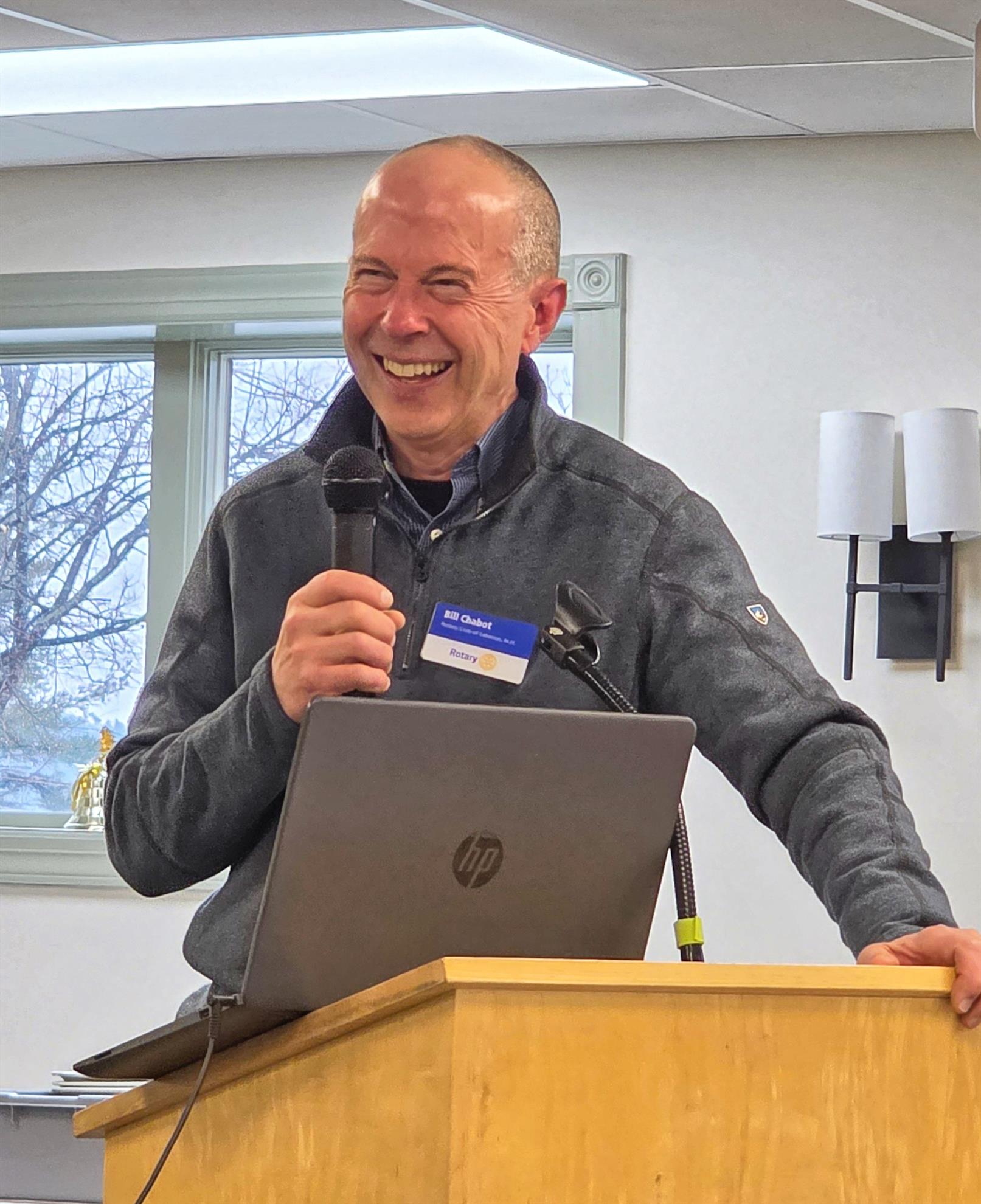
The great racer Sterling Moss once said, “If God had meant for us to walk, why did he give us feet that fit car pedals?”
- Bill has raced at Watkins Glen’s (NY) Long Track (3.5 miles), Lime Rock Park (CT ~1.5 miles but built on a hill), Pocono, North Course (PA).
- “Wheel-to-wheel” racing is when all cars start at the same time; Bill races in “time trials” in which individual drivers compete against the clock without the danger of other vehicles at the same time.
- Bill belongs to the COM Sports Car Club. In 2004, he and Elizabeth took Tim O’Neil’s winter safety school up in Dalton NH. While there, an instructor invited him to come out on the club’s track and he was hooked.
- In 1958, the Sports Car Club of North America was organized, originally just for Chevrolet Corvettes (first introduced in 1953).
- COM offers instruction:
- Situational awareness;
- Finding and following the racing line;
- Proper and smooth use of acceleration and braking;
- Comfort in both learning to pass other cars and in pointing faster cars to pass you;
- Smoothness of vehicle control = quiet hands.
- Ride along with instructor to get the feel of the event:
- Sign up as member for $35/year;
- Hot Lap Ride-Along ~15-20 minutes with a Com instructor;
- Bill currently races at Watkins Glen; Palmer Motorsports Park (Warren, MA); NH Motorsport Speedway in Loudon; Thompson, CT; and even up in Canada!
- Typical event schedule:
- You must be at least 18 years old to participate.
- Day 1: Arrive, sign waivers, get car inspected, review schedule and get assignments to “grid” (group of cars) for 15-20 minute runs on the track.
- Day 2: After several runs, turn in your expected time so you get grouped with others estimated around the same time; run two sessions before time trials.
- Time Trial: One fast lap to warm yourself and your car; three timed laps and then pull into the pit. There are four to five cars in each grid group; they are started at 20-second intervals and are not racing wheel-to-wheel.
- Results are tabulated; winners get bragging rights; there are end-of-year awards.
Summary: the COM Club’s aims:
- To make faster, safer drivers;
- To provide a logical intermediate step to move from open lapping track days to timed competition in a safe point-to-pass environment;
- To offer a positive learning environment for those hoping to move toward other forms of wheel-to-wheel racing;
- To focus on camaraderie in our paddock. Members pitch in to help with mechanical issues, trade advice and analysis, commiserate with each other;
- To share in a pot luck dinner at the end of the first day.
Bill recommended that interested folks also seek out the following:
QUESTIONS/COMENTS
- Fewer drivers come with standard shift cars; automatic seems quicker, especially using paddle shifters.
- No need to wear a fire suit, though most wear flame-retardant gear. Drivers should wear long pants and long-sleeved shirt.
- Generally, race drivers get out their need for speed on tracks, not on public roads.
- There are race simulation machines where children can get an idea of what it’s all about. (Your editor found this place in Burlington VT: https://burlyaxe.com/product/one-hour-sim-racing-experience/.
- Bruce Bergeron has seen more and more EVs in the safety schools and tracks. Some are very fast indeed.
- Jimmy Brock reported that Bermuda has a cycle track, mostly for young people. It’s associated with a US cycle club and most of the top Bermuda guys go to the states for bigger tracks. Jimmy bought his property in Quechee 33 years ago and hopes to get up here this summer. He said that Beverly likes to drive on our long highways “with a heavy foot.” Now that she’s been experiencing some vision issues, she says, “If I can’t drive on the highways, I don’t want to go up there.”

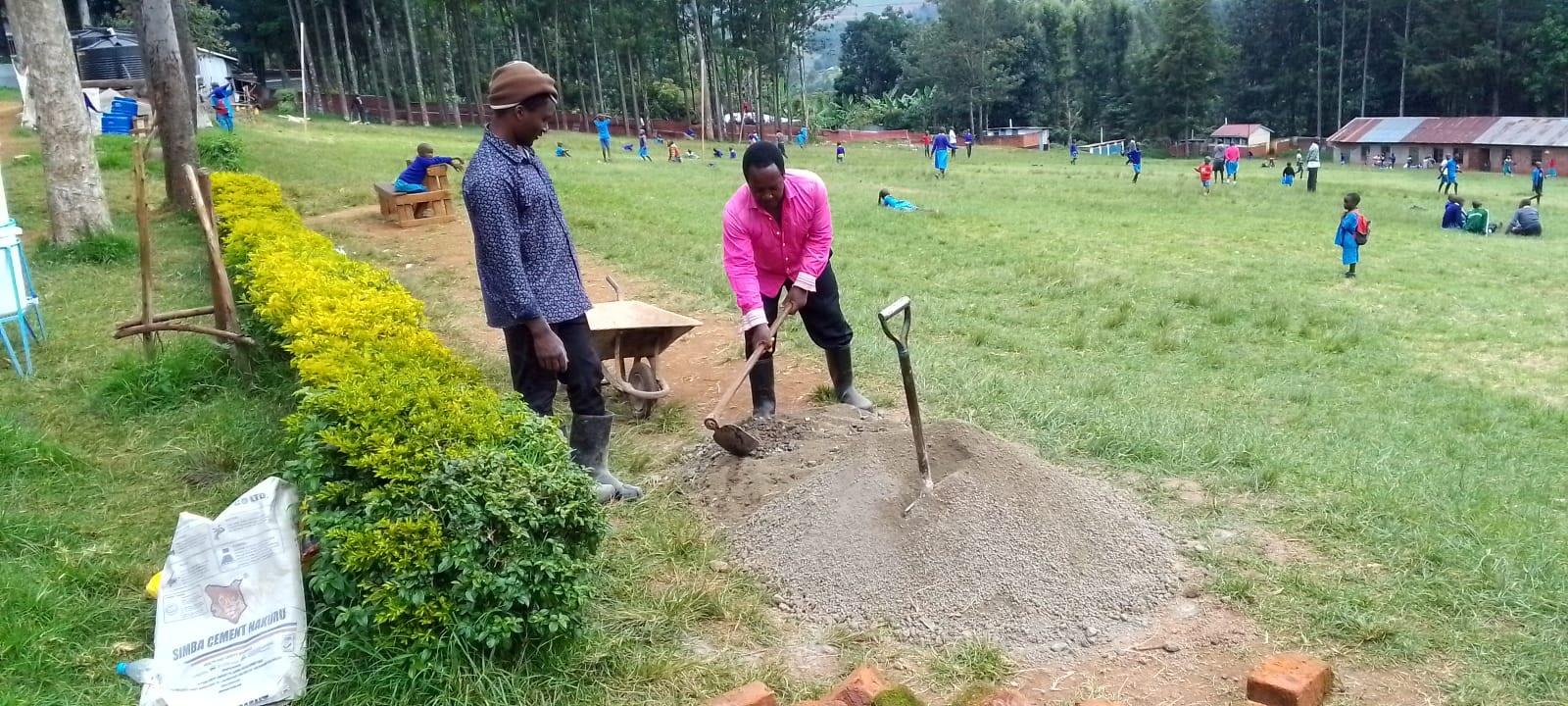
Dedication of Lebanon Rotary's Water Project
in the Village of Nyandoche Ibere
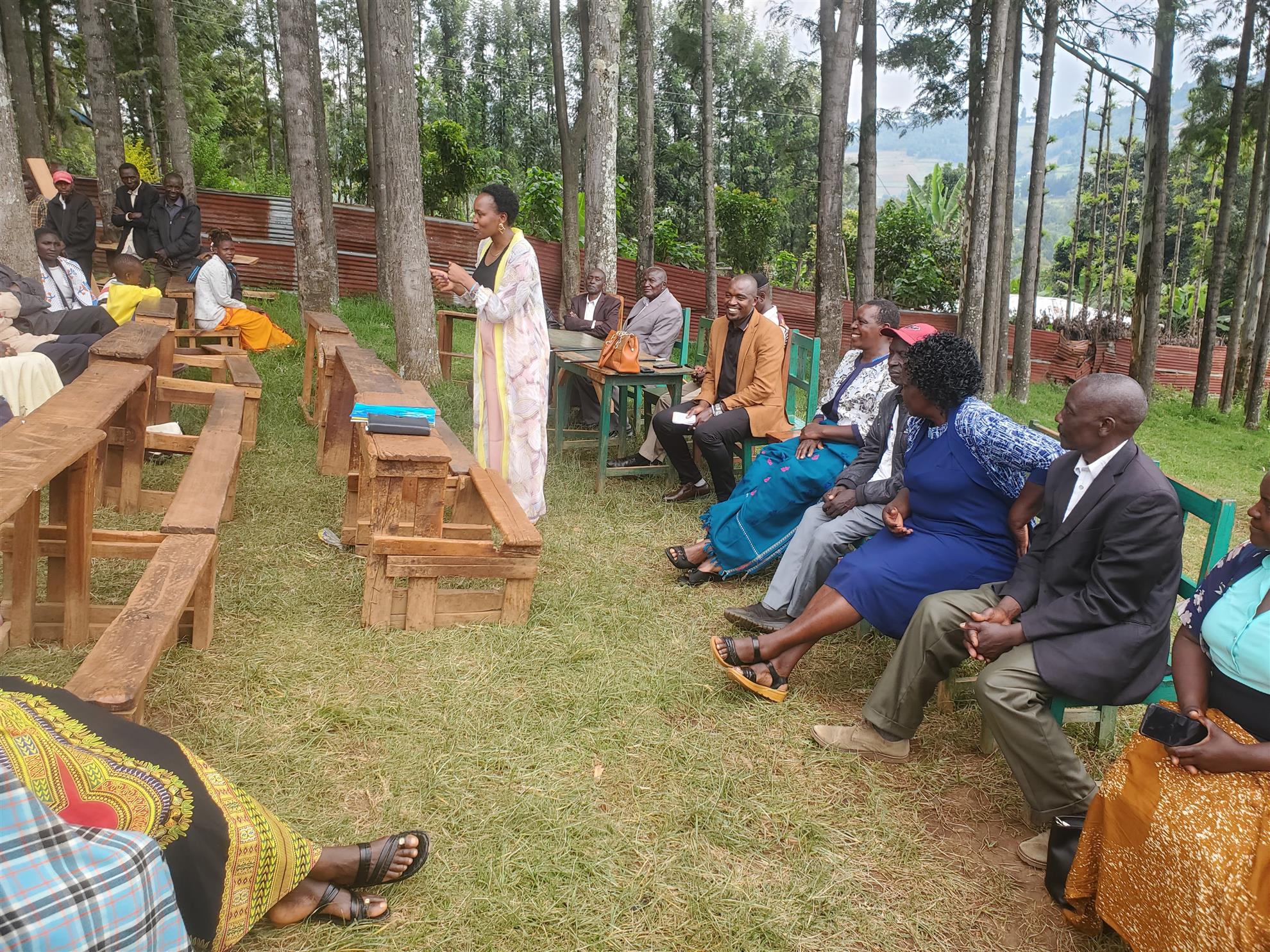
Alloys Nyakundi and his sister Emmah join hands with the head teacher of the elementary school in Nyandoche Ibere at the dedication of the sanitary water tank funded by Lebanon Rotary.
Emmah speaks to the village at the dedication ceremonies of the sanitary water system.
The Future of Family in Nyandoche Ibere:
A Quiet Transformation in Rural Kisii
By Alloys Nyakundi.
Much of the global discussion on demographic change focuses on countries facing dramatic population decline, such as China and Japan. Kenya, by contrast, is often described as a young and growing nation, seemingly distant from such concerns. Yet in villages like Nyandoche Ibere in Kisii County, a quieter transformation is unfolding—one that rarely features in national debates but is reshaping family life at its core.
For generations, family life in Nyandoche Ibere revolved around land, kinship, and continuity. Large families were not simply cultural ideals; they were practical necessities. Children worked on farms, cared for livestock, and ensured that aging parents would not be left alone. Extended families lived close together, and daily life was organized around shared labor, church activities, clan ties, and mutual support. Old age was cushioned by proximity—to children, grandchildren, and neighbors who knew one another well.
[Below] Work begins on the sanitary water project
That model is now under strain.
Land in Nyandoche Ibere has become increasingly fragmented as it is divided among sons and, more recently, daughters. What once sustained a household can no longer support multiple families. Small plots struggle to provide sufficient income, especially as soil fertility declines and weather patterns become less predictable. For many young people, farming no longer offers a viable future. Migration—to Kisii town, Nairobi, or even further afield—has become not a choice, but a necessity.
As young adults leave, fertility patterns are changing quietly but decisively. Couples are marrying later, often after years of wage labor in towns. Some return home with one or two children; others return alone, marriage postponed by unstable income and rising living costs. While families in Nyandoche Ibere are still larger than those in Nairobi, they are noticeably smaller than those of their parents’ generation. The sound of many children playing in homesteads is becoming less common.
Economic pressure sits at the heart of this shift. A young person who secures work—whether as a teacher, boda boda rider, shop assistant, or casual laborer—rarely supports only their nuclear family. School fees for siblings, medical bills for parents, church contributions, funeral expenses, and daily household needs all compete for limited income. In practice, one wage supports many lives. Under such pressure, starting a large family feels risky, even irresponsible.
These changes are transforming the village’s social fabric. Elderly parents increasingly live alone or with one grandchild left behind when adult children migrate. Remittances help, but money cannot replace presence. Illness, loneliness, and insecurity weigh heavily on the elderly, particularly widows. Traditional expectations—that child will care for parents in old age—remain strong, yet the ability to fulfill them is weakening.
At the same time, children growing up in Nyandoche Ibere today experience a different childhood from that of earlier generations. Schooling is more intense and expensive. Play time is limited by chores, safety concerns, and academic pressure. Many children grow up with parents who are absent for long periods, working in towns or cities. Emotional bonds are maintained through phone calls and occasional visits, reshaping what family closeness means.
Churches and community groups continue to play a stabilizing role, offering moral guidance and practical support during crises. Yet even these institutions feel the strain as contributions become harder to sustain and attendance fluctuates with migration and economic hardship. Social life remains, but it is thinner, more fragile than before.
Nyandoche Ibere’s experience highlights a broader national challenge. Kenya’s demographic transition is not only an urban story; it is deeply rural. Fertility remains higher in villages than in cities, but the logic of large families is weakening everywhere. Rural families are being asked to do more with less: less land, less time together, and fewer reliable economic opportunities.
This raises difficult questions. What happens to villages when young people cannot return permanently? How will elderly parents live with dignity when family support is stretched thin? Can small-scale farming remain viable without serious investment, or will rural life continue to hollow out slowly?
Kenya may not face an immediate demographic crisis, but in places like Nyandoche Ibere, the transformation of family life is already tangible. The extended family, once the village’s strongest institution, is adapting under pressure from economic reality, migration, and changing aspirations. The challenge ahead is not to preserve the past unchanged, but to find new ways of sustaining care, connection, and responsibility in a world that no longer supports old assumptions.
In Nyandoche Ibere, the family is still central—but it is quieter, smaller, more stretched across distance. The future of the village, like that of Kenya itself, will depend on how well this new family reality is understood and supported.

SERVICE AND OTHER ACTIVITIES
- Monday, January 19th Social Gathering—Hopkins Center Tour; 7:00 p.m.
- Committee Meetings:
- Board of Directors—January 20, 2026, at 4:00 p.m.
- Charities Trustees—January 21, 2026, at 12:00 Noon.
- Our REVO dates are January 21–30, 2026. Please help with promotion by sharing social media posts and going to REVO with friends.
Marilyn spoke with Ahmad who sends his greetings; Chris is doing well, and, at the moment, his relatives in Iran seem to be getting along OK.
HAPPY DOLLARS
- Ron Bedell: Spent a night at the Comfort Inn in WRJ with his honey. “Yesterday morning our home was chilly and the radiator wasn’t working well. Irving Oil arrived to find water on the floor, at which the technician said, ‘Oh crap!’ Since we were still 2 months shy of the end of our warranty period, we will be sent a brand new unit.”
- Hank—Good to see Jimmy.
- Ron Michaud—Memories: I was a spy for the ASA in Germany. After a night of drinking, I decided to drive to Munich in a Renault that cost about $1,000. On the back road I was feeling great until I lost control and leapt over a stone fence. The car kept rolling as did I inside without a seatbelt. The car ended up on its wheels with the roof collapsed.” Ron drove back to the base hunched over so he could see through the windshield. Very lucky.
- Phil Bush: (a) Phil has had double vision and has gone through lots of prescriptions with prisms and nothing has really worked. Finally went to DH for a full workup. He received a pair of dedicated reading glasses and THEY WORK! (b) Last Saturday, Phil heard from his daughter in Maine that granddaughter Lida at Carlton College in Minnesota was heading to Minneapolis to join demonstrations protesting the ICE killing of a motorist. Phil is glad she returned to her college in one piece, continued her grandfather’s legacy of political advocacy.
CARD AND CAR WASH RAFFLE
#380 was Jim Damren’s number; he drew the King of Clubs.
#392—Tyler Hagan won the Enfield Car Wash.
Future programs:
- 1/22 Club Assembly;
- 1/29 Epilogos update on El Salvador;
- 2/5 Youth Service Day: Interact, Take Flight, Speech Contest.
Marilyn appreciates Will Koppenheffer, who took minutes for the first 5 months of this Rotary year.
President Marilyn rang the bell at 1:18 pm to close the meeting with our motto:
“One profits most who serves best.”