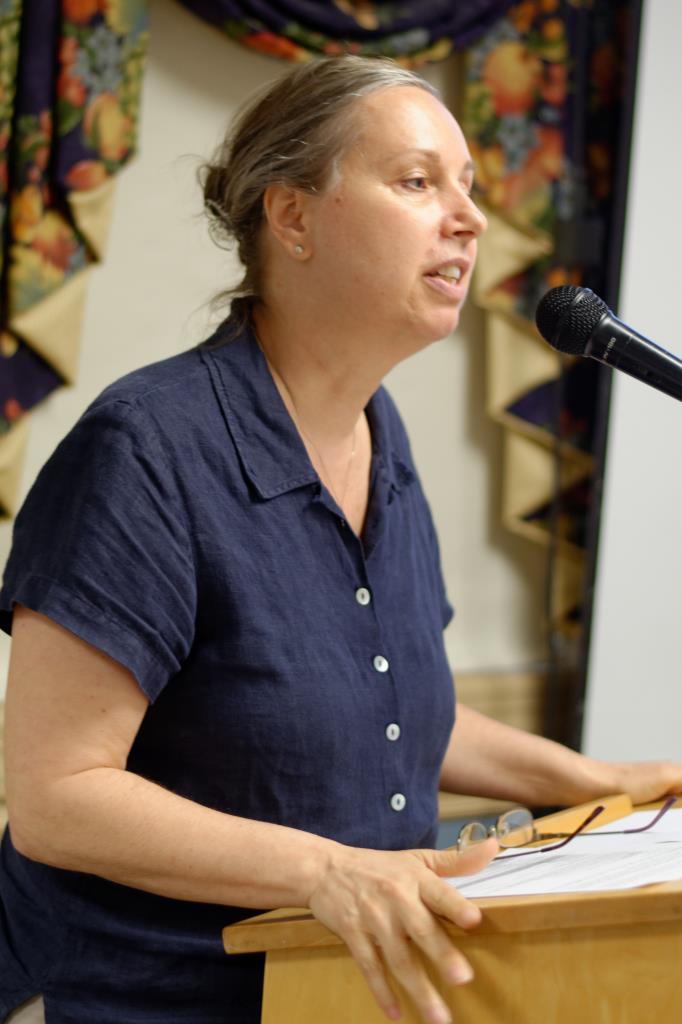
We heard from Lisa Green, and advocate for Visions of Housing.
From the Visions for Creative Housing Soulution’s web page:
"The mission of Visions for Creative Housing Solutions is to provide residential options, services and support designed to meet the needs of adults with developmental disabilities and similar disabling conditions. We are dedicated to fostering growth and independence through vocational, social, and recreational opportunities. Our goal is to proactively address an orderly transition of care for adults with developmental and similar disabilities from their aging parents to a stable, reliable and caring environment. We provide each individual with surroundings that are conducive to long term friendships and a sense of well being and self worth. Visions is a 501c3 non profit organization headed by Executive Director Sylvia Dow and our Board of Directors. We have a house manager, personal mentors both full and part time, overnight staff in the main house 24/7, a registered nurse on call, and a property manager."
Director Sylvia Dow is a true visionary, and had developed a model that the State of NH would like to replicate throughout the state. Sylvia has been asked to develop a tool kit to help others replicate the program other properties. It is remarkable that after the initial funding is found to update or build a multi-person housing unit, the property will become be able to be operated with each individuals NH Medicaid allotment for a disabled persons.
We learned that the vast majority of adults with developmental disabilities live at home and that aging parents often worry about what will happen issues, such as the illness of a parent or their death can cause huge disruptions for the entire family and in particular the person with a disability.
Visions of Housing Solutions hopes that by developing residential housing options, the individual can live more independently in a very supportive, structured environment that provides comprehensive oversite and management of each person’s needs. The goal is to balance independence with the appropriate level of support.
The first residential housing property was opened on an 80+ acre parcel of land in Enfield. It now houses 12 individuals. There is a large waiting list to move into the house.
A second house is in the process of being established in downtown Lebanon at 12 Green Street. Once established it will have 12 residential units, and one respite bed for an individual whose family is dealing with a crisis that prevents them from supporting their family member.
A purchase and sales agreement has been signed. The organization is in the process of raising money to renovate the apartment, and to cover initial campaign expenses. The property will be purchased via a Community Development Block Grant (CDBG). $750,000 is need to cover the renovation of the two building apartment property. Less thatn 10% of funds raised will be dedicated to campaign costs.
The following is a quote from Lisa Green that was published in the summer issue of Image Magazine, “ Once people learn about visions and what it does, the people of the upper valley should be impressed that there’s this organization working to solve the problem of housing and care for adults with developmental disabilities. They should get on board to help. Just a little bit can make such a difference in so many people’s lives. The impact is bigger than just the residents. It will provide great jobs and allow residents the independence and dignity they deserve.”
Exciting news for Tim Gauraldi. He is going to be a grandfather again...a baby girl! He shared that his sister and brother in-law, who is a member of the Salem Rotary Culb, have a daughter going on a Rotary Youth Exchange to Germany.
Marilyn Bedell let us know that Ron is at home waiting for Irving to come to check the furnace...we didn't mean to schedule it on Rotary day...oops...but it happened. She continues to celebrate many trips she took this summer to Germany, Spain, Gibraltar, France, Italy, Montenegro, Greece and the then the Friendship Exchange to Alberta Calgary. She thanked Bill Secord for filling in as the newsletter creator too.
Hank Clarke celebrated the life of a veteran he met through his driving for the VAH. He was a WWII Vet. His name was John Andriopoulos. He lived to be 94. From his obituary, "He was inducted into the United States Army on June 16, 1943. He served with the 168th Engineers Combat Battalion, Headquarters Company. Throughout his military service, he served in battles and campaigns of Normandy, Northern France, Rhineland, Ardennes and Central Europe and liberated the concentration camp Ohrdruf. In defense of St. Vith, his unit was awarded the Distinguished Unit Citation and the Belgian Croix de Guerre." Hank shared that he enjoyed getting to know him and will miss him.
Bruce Pacht shared that he and his son, Jessie, took a motorcycle trip to Quebec, going to Sherbrooke, then headed north to drive along the St. Lawrence River, to Quebec City, then back to New Hampshire with a stop at Polly's Pancake House in Sugar Hill. Jessie is now getting ready for Trans-America Drive that will take him on may dirt trails across America. His brother Simon will drive the chase car, and then help transport Jessie and the Motorcycle back from Oregon.
Steve and Carolyn Whitman are home from a river cruise that took them from Lucerne, Switzerland to Amsterdam. He reflected on both the cold weather going up on a cog railway 7,000 ft, and then the historic heat in Europe > 104 degrees. It also sounded like has some great photos of the trip.
Ernest Oidtmann is happy that Steve Whitman decided to come home. In adidtion, he is celebrating his birthday, and made a donation to the Mollica Fund in honor of his birth.
Cindy Jerome reflected on her memories of Amsterdam including the number of bikes in the city, and the red-light district.
Steve Whitman gave us an update on sponsors. We have $8,000 confirmed and we are on track to get over $10,000. He thanked Jim Damren for getting 5 confirmed, and Ernest has confirmed 4! Please help us get more sponors.
Bruce Bergeron is working on confirming brewers and will have a confirmed list soon.
Work to sell tickets by getting paper tickets from Marion or directing folks to our events web page via the clubs Facebook page. Click here
Valley news ads start today. There will be radio ads too.
Farmers Market Booth
Every Thursday in Colburn Park
We have a booth at the Farmers Market from now until Brew Fest. It will be an opportunity for us to showcase Rotary in Lebanon and to promote the Brew Fest. Farmers Markets are on Thursdays from 4:00 p.m. to approx. 7 p.m. Two to three Rotarians are needed each market. See Don MacMeekin to Sign Up.
Nigeria is on the brink of eliminating polio, thanks to women
UNICEF and volunteers, mostly young mothers, have spearheaded vaccination efforts that many experts believe will soon lead to a polio-free Nigeria
By Shamard Charles, M.D.
KANO, Nigeria — Amina Anas wanted more information before getting her baby boy vaccinated against polio.
Anas, who lives in a village in northern Nigeria, spoke to other women in the community about her concerns. Ultimately, Aisha Shuaibu Mohammad, a UNICEF-trained volunteer, was able to convince her.
Mohammad is one of hundreds of Nigerian women who have spearheaded the country’s fight against polio by becoming vaccinators.
The women are close to being able to declare victory: Aug. 21 will mark three years since Nigeria's last case of polio, said Dr. Anis Siddique, UNICEF's chief of communication for development who led the polio team. In the northern state of Kano, where Anas lives, there hasn't been a case in five years, Siddique said.
Siddique is cautiously optimistic that the country will receive World Health Organization certification for polio eradication in October — a country must go three years without a case, and the WHO routinely waits two months after the three-year mark to make an official declaration, he said.
To eliminate polio, women — mostly young mothers — have gone door-to-door, slipping drops of polio vaccine under the tongues of as many as 30 million Nigerian children. The volunteers work with UNICEF and the Bill & Melinda Gates Foundation and have received clinical training to properly administer the vaccine.
In Nigeria, the vast majority of vaccinators are women. That’s crucial to ensuring that vaccines reach every child, because men — with the exception of husbands and close male family members — are prevented from entering households. This rule is strictly enforced in the northern and middle belt regions of Nigeria, where Islam predominates.
A group of volunteer community mobilizers, all women, getting trained by a senior member of the team.Shamard Charles / NBC News
Mohammad, the UNICEF-trained volunteer, admitted that it's impossible to convince every woman to vaccinate her children, but said that she sees successful cases every day.
“Once we talk to women like Amina, they usually open up. We not only give vaccines ... we discuss their fears about the medicine, proper hygiene and sanitation, and even prenatal care,” Mohammad told NBC News.
She said that with the help of volunteer community members, “we send reminders every Monday to all new mothers in the community that there will be a vaccine clinic the following day. We are here every Tuesday.”
Aisha Shuaibu Mohammad, a vaccinator trained by UNICEF volunteer community leaders, discusses vaccine safety with, Amina Anas.Shamard Charles / NBC News
As in the United States, there’s some skepticism surrounding vaccines in Nigeria. But the similarities end there: Some anti-vaccination myths in Nigeria are put forth by the violent militant group Boko Haram, and volunteers may be the target of violence. In 2013, two Kano vaccination teams were murdered.
But Michael Galway, deputy director of the Polio Team at the Bill & Melinda Gates Foundation, said that opposition to vaccines is no longer as a big a challenge as it once was. Now, only 1 percent of people are not getting vaccinated because they refuse the vaccination, Galway said.
More challenging is simply reaching people. Large nomadic populations live along Nigeria's borders. Last year, the WHO renewed efforts to vaccinate children regularly crossing into and out of the country by supporting the government in an initiative to improve vaccination efforts in the northwest region of the country.
Alasan Isa, the village head of a small rural community in Minjibir, Nigeria, said that seeing the devastating effects of polio has led him to encourage women to become volunteers and vaccinators.
Alasan Isa, the village head of 1,200 households in the Malam Meladi Minjibir community in Kano, Nigeria.Shamard Charles / NBC News
“I have seen how even one case of polio can devastate a community. I don't ever want to see polio again ... a child with paralytic polio cannot move and often they cannot work in the future. It's not a way to live,” Isa said.



.png)

 A group of volunteer community mobilizers, all women, getting trained by a senior member of the team.Shamard Charles / NBC News
 Aisha Shuaibu Mohammad, a vaccinator trained by UNICEF volunteer community leaders, discusses vaccine safety with, Amina Anas.Shamard Charles / NBC News
 Alasan Isa, the village head of 1,200 households in the Malam Meladi Minjibir community in Kano, Nigeria.Shamard Charles / NBC News