“The DEI committee is seeking to engage Lebanon Rotarians emotionally and intellectually in the experience of Americans whose history and current stories have not been visible to most of us in our upbringing and current lives. Our chosen vehicle for this exposure has been the exhibition of short films.
“While the particular film being shown today does not portray the current circumstances of every Native American, it does offer a visual depiction of the consequences of certain decisions made over centuries in the name of the American people—us.
“We acknowledge that those of us in this room (in person and attending virtually) did not ourselves make these decisions. The question for us is this: “How do Rotarians today react to this information?”
“We hope that some of you will be willing to share your feelings and thoughts at the film’s conclusion.
- We ask everyone to create a safe space for the discussion.
- Everyone will be allowed to speak. Our purpose is to hear and listen to each other.
- This conversation is not a debate—we will not be challenging individual reactions to the film’s story.
- No one will be interrupted.”
Showing of the YouTube TED Talk:
The film itself is a 2010 TED Talk (TEDxDU) by Aaron Huey entitled, "America's Native Prisoners of War": "Aaron Huey's effort to photograph poverty in America led him to the Pine Ridge Indian Reservation, where the struggle of the native Lakota people—appalling, and largely ignored— compelled him to refocus. Five years of work later, his haunting photos intertwine with a shocking history lesson in this bold, courageous talk from TEDxDU."
COMMENTS AFTER THE FILM
John Yacavone: Providing an example of the long-lasting effects of the betrayals suffered by Native Americans at the hands of the United States government, John narrated an experience he had working in New Mexico with a non-profit helping to develop job descriptions for Native American Pueblo governance. In a formal meeting with eight pueblo governors where John presented his recommendations, two of the governors stepped out of the meeting circle in refusal to reach a consensus on signing the plans that were written by John. John approached the two governors and asked them why they wouldn’t agree to signing the governance proposal. The dissenting governor, in a reflection of past negative experiences, stated, ”We don’t sign anything anymore unless we read it.” Part of the reason for their attitude goes back to having the United States government take their lands as recently as the 1940s when their lands were confiscated for the Manhattan Project at Los Alamos without compensation to this day.
Ron Michaud: The question that haunts Ron is “What would I do? In the face of the injustices perpetuated against minority groups, would I be silent? During all the genocides in the world? I don’t say, ‘I wouldn’t do that.’ Who knows the situation?” We must consider the media and the other influences, for example, affecting Germany under Hitler. What about Cortez? People were offered money for each Indian scalp in the American West. What about the Northern Ireland situation? I don’t become bitter because of all this history; I’m still hopeful. But 37% of the American people believe Trump.! What the hell is going on?"
Hank Clarke: "Are Native Americans now prospering on the reservations with their casinos? The Blackfeet in Glacier National Park are turning down development offers from Big Oil and Gas. The tribe will produce electricity on their own."
Ed Friedman: "What are we, in 2023, to make of previous atrocities?"
Bruce Pacht: "As Ron stated, I think it is an accumulation of decisions that leads to egregious situations. With the way our economy is structured, money flows in one direction. Before we make quick decisions, we must think about the context: where will this choice lead to?"
Angela Nelson: "We must be cognizant of history: where will the decision we are making lead us?"
Bill Secord: "It’s ironic that we’ve come to the point where it’s the wisdom of the Indigenous people that might save the world all from ecological collapse. Black Elk, a leader of the Sioux nation, had a vision from the peak of Mount Harney (now Black Elk Peak) of the unity of the whole world. The mountain was sacred and Black Elk stated that the Sacred Mountain is anywhere we cause it to be."
Bruce Pacht: "My thinking about the next DEI program is to focus on "legacy." I'm trying to come up with both a short film and an appropriate introduction."
Rotary Club of Lebanon, NH
Thursday, August 17, 2023
Recorder: Bruce Pacht
12:02 pm: President Dave rang the bell to open our meeting.
In attendance today: Hank Clarke, Will Koppenheffer, Richard Wallace, Jim Damren, Ahmad Haidari, Marion Steiner, Phil Rentz, Bill Secord, Dave Crandall, Ron Michaud, Paul Tierney, Rich Wallace, Bruce Pacht
Bruce Pacht couldn’t get WebEx to handle both remote Rotarians, a PowerPoint presentation, and interactive sound. Only a few more weeks before Marilyn returns. . . .
No songs today—Ernst not around. Ahmad led a recitation of "The 4-Way Test of the Things We Think Say or Do." Dave treated us to the following facts about this day in history:
- Miles Davis’s seminal 1959 album: Kind of Blue
- Conclusion of the 1969 Woodstock concert
- 1982 first CD was commercially available in Germany—ABBA
And in the coming week:
- Curtis Payne finishes his first year in Rotary tomorrow.
- Next Tuesday is Bruce Pacht’s birthday.
Jokes of the Day
- Do you want to hear a construction joke? Yes. I’m still working on it.
- Doctor, I think I’m a moth. Well, you should see a psychiatrist. I would have, but your light was on.
-
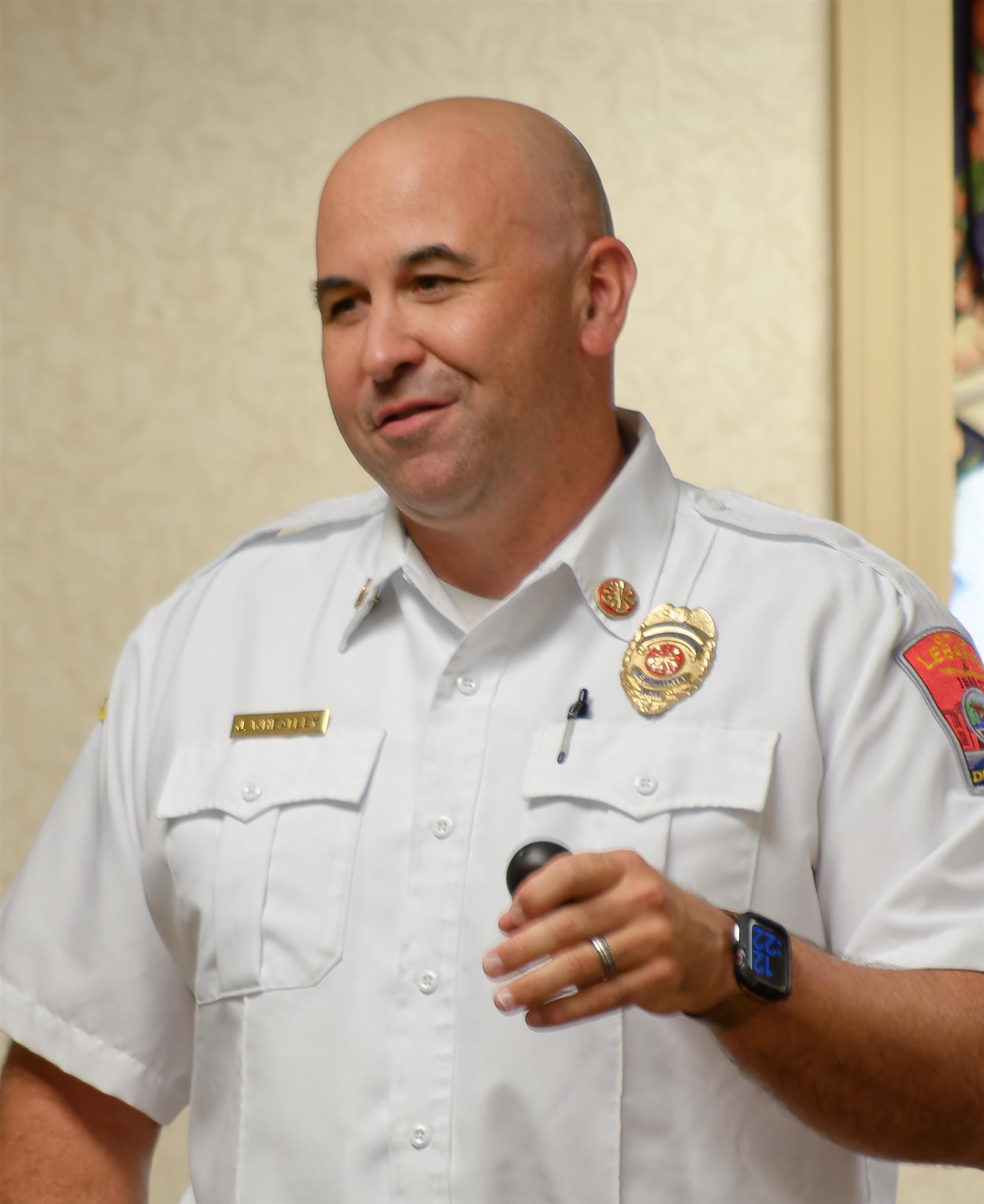
SPEAKER: Jim Wheatley, Fire Chief, City of Lebanon
Ron Michaud introduced Jim, who served in Hartford for four years and for sixteen-and-a-half years in Lebanon. Various members of his family have served as firefighters. Ron noted that Lebanon firefighters helped him several times while he was caring for his wife, Hilary.
Jim’s married and has a 15-year-old son at Hartford High. His wife is administrative assistant for Hartford’s fire chief. Jim is open to conversation any time at his office, via email, etc.
[Jim offered a PowerPoint presentation with many facts and figures. If you would like to see it in its entirety, please send an email request to Bruce P.]
Lebanon’s fire department focuses on three areas:
- Risk reduction to community, businesses, citizens, and visitors in advance of emergencies.
- Education—community CPR, school visits, “stop the bleed” program.
- Integrity, accountability, open and honest
Here are some interesting highlights:
- Lebanon operates four shifts—Each firefighter is 24 hours on, 48 off, 24 on, 4 days off. They work 48 hours a week. Because of staffing, they are required to work additional hours, perhaps exceeding 300 overtime hours a year.
- Lebanon’s current fire alarm system (those big red boxes in buildings) works well but is old and should be replaced. It’s now getting hard to find parts.
- LFD has a community paramedic and two community nurses. They work to prevent readmissions, getting people into their homes and helping them stay there in order to reduce the number of 911 calls. Lebanon is the first fire department in New Hampshire to have a community health program with nurses. These services are provided at no charge to the patient.
- Lebanon now has one emergency shelter at Lebanon High School. Jim said that the City is working on a plan to expand our ability to care for citizens during an emergency.
- “Technical rescues” from swift water, using rope, from ice and confined spaces, and from hazardous materials. Everyone is trained in these areas, but individuals have individual talents within the rescue format.
- Call volume has more than doubled from the year 2000 with 2,025 calls to 2020 with 4,090. By ratio of staff divided by call volume, Lebanon is the busiest in the state with 163 calls per member; most municipalities are in the 90-100 range.
- Recruitment and retention are difficult. Jim noted, “Our work is hard, and we see a lot of bad stuff. We have a new mental health and wellness program now.”
- Cardiac arrest: 1/3 of all persons experiencing non-breathing cardiac arrest cases die immediately; if help arrives within 6 minutes, there’s a 33% decrease in mortality.
QUESTIONS:
What about AEDs?
Jim said the libraries and CCBA have them, but they are not as widespread as he’d like. CPR is great, but electricity makes the biggest difference.
How do you deal with drug overdoses?
We have them, but not as big a problem in Lebanon as in other locations. We bring Narcan, and “Narcan Leave-Behind Kits.”
What is your response time?
Not where we want it to be. National standards say that an ambulance should arrive within six minutes, 90% of the time—One minute for the call, one minute to get into the building, four minutes inside.
We meet this standard 40% of the time—some of that shortfall is because of station locations. The City comprises 41 square miles, our two stations simply aren’t within six minutes of everywhere. Also, our low level of staffing may mean that when a call comes, we are responding from locations other than the station.
What about mutual aid?
When a call comes in, Hartford and Hanover are notified. We have mutual aid agreements with Canaan and Enfield, which have volunteer departments and a longer response time. If we know an emergency is a fire, we notify all immediately. Simultaneous incidents decrease our ability to respond.
- 900 of the 2000+ calls have been at the same time as another call.
- One call for an ambulance takes four people out for one-to-two hours.
- Of the 900 overlapping calls, 187 were three calls at once. If we handle three ambulance calls at once, there’s no one left to ride the engines if there’s a fire. When Jim arrived today there were two ambulance calls in effect and one fire activation.
WHAT DO WE NEED?
Jim’s desired future:
- Full staffing plan
- Replacement of both facilities
- Deployment plan to meet response standards
- National accreditation.
Our biggest project is replacement of the stations. The main station was built for a volunteer force answering 100 calls in 1954. The building is a health hazard and doesn’t have room for the additional staff we need.
The current building has no elevator and doesn’t meet ADA requirements. The City is working on a new proposal for a replacement building.
- We recently spent $1.7 million on a ladder truck that had to be custom-made to fit into the firehouse. New firetruck orders take three years to deliver.
- There were no female firefighters in the past; they need appropriate facilities.
- Storage and de-contamination of protective clothing requires more room.
- Diesel trucks are next to offices with no separation. Firefighters suffer from cancer at higher rates than the general population.
- A station on the Hanover border would increase response times. We can get to Etna Road but not to Mt. Support within time standards—we really need a third station with all the new residential units up that way. Jim said that a study back in 2008 said we’d need four more firefighters per shift—those additional personnel never materialized.
Jim will soon present the City Council with a proposal to tear down and replace the Park Street station; operations would relocate to the Armory for 18 months.
QUESTIONS:
Will: Has a formal study been done about daytime population?
Jim: No. We transport ~2100 people/year to hospital, and they are 88% Lebanon residents.
A 50-unit apartment house generates 15 calls/year. The City charges for ambulance service based on the type of service provided. Our department budget is $5.3M and we generate $1.8M in revenue, of which $1.2M is from ambulance services.
Ahmad: How can Lebanon Rotary help educate the community?
Jim: When you have bigger events, let me come and present. Start conversations with your friends and others.
Jim Damren: Does D-H contribute at all?
Jim: We get impact fees when they build a new building. The impact fee from the last building was $10,000. In lieu of taxes, D-H makes payments that cover 100% for the full-time paramedic and 90% of the salary of the nurses.
Bill Secord showed Jim the book we are donating in his name to the Kilton Children’s Library: Anglerfish: The Seadevil of the Deep—a book about dangerous fish to honor a man practicing a dangerous profession—written by Elaine M. Alexander, illus. by Fiona Fogg.

Deep in the darkest part of the ocean, visit a primordial, fierce-toothed fish that draws in prey with its own bioluminescent lure.
Dive thirteen thousand feet below the ocean’s surface, where no ray of sunlight can penetrate. Resources are scarce, and fellow inhabitants scarcer. This is life in the midnight zone—life for the anglerfish, known as the Seadevil of the Deep. Still largely a mystery to scientists, the deep-sea anglerfish is a true source of fascination and awe. To some, the fish resembles a prehistoric creature forgotten by time; to others, she is the embodiment of power, grace, and grit, using her remarkable physical attributes and a talent for deception to survive one of the harshest environments on the planet.
In Anglerfish, author Elaine M. Alexander and illustrator Fiona Fogg shine a small light on this mesmerizing, unforgettable creature. A captivating text paired with stunning artwork complements not only STEM but also language arts and history curricula. More facts about the anglerfish—from how it hunts to the surprising way a female mates with far tinier males—await curious readers in the back matter.
HAPPY DOLLARS:
Marion—my daughter will be starting her junior year soon at Franklin College, where she’s going for a doctorate in PT. Over the summer she became a licensed LNA.
Paul Tierney—We’ve signed a sales contract on our house and will move to Denver where son/daughter and three grandkids leave. We have an awful lot of work to do before closing on September 28.
Card and Car Wash Raffle
- JOHN PULLED THE QUEEN OF HEARTS!!!
- Phil won the car wash.
Other announcements not made during the meeting:
- Lebanon Rotary’s “Beautification” sign has been installed on a garden island at the intersection of North Park Street and Campbell Street.
- We responded positively to a proposal from the Lebanon Youth Baseball Association for magnetic safety bases as part of major refurbishing at Logan Field, the land for which was donated by Howard Logan, deceased former longtime Lebanon Rotarian and community pillar. The bases are movable, which will allow the field to accommodate leagues playing with both 60’ (younger players) and 70’ (older) basepaths.
As President Dave had to leave the meeting, Hank took over, closing the meeting with the bell and Rotary Motto:
One Profits Most Who Serves Best.
FUTURE MEETINGS:
***************************
August 24 Jenny Chambers, New England School for the Arts
August 31 Phil Roberts, Lebanon Chief of Police
September 7 Susan Cherry, District Governor (Rotary 7850)
September 14 Kevin Keller, Marketing Professor, Tuck School
September 21 Club business
September 28 RYLA student presentation
October 5 Amy Allen, Lebanon Superintendent of Schools
October 12 Rico Castenada, Lt. Commander US Navy
October 19 Cindy Heath, gardening presentation
November 1 Jim Schachter, CEO/New Hampshire Public Radio
November 30 Carl Gross, Manager/Lebanon Municipal Airport
.png)