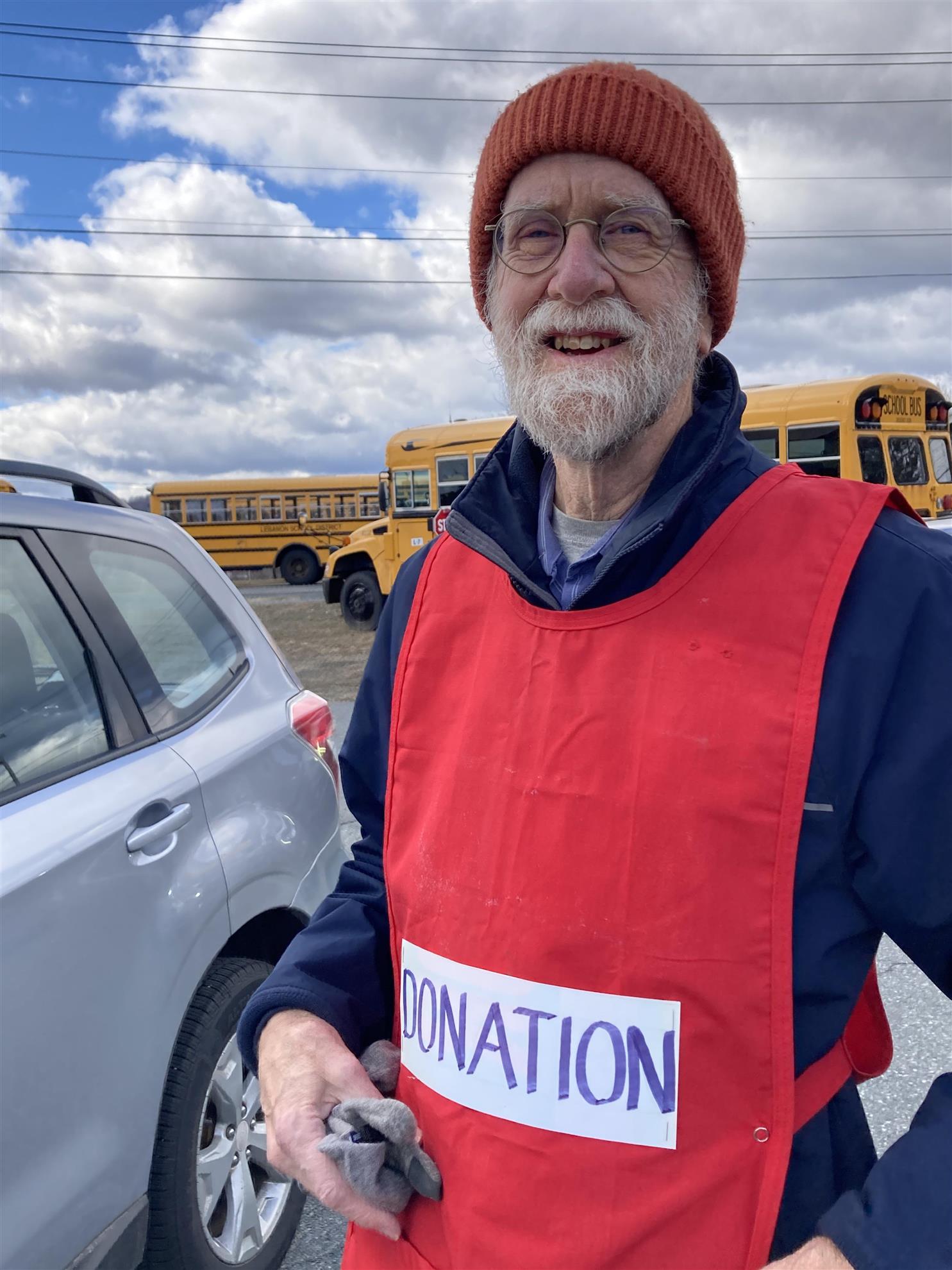
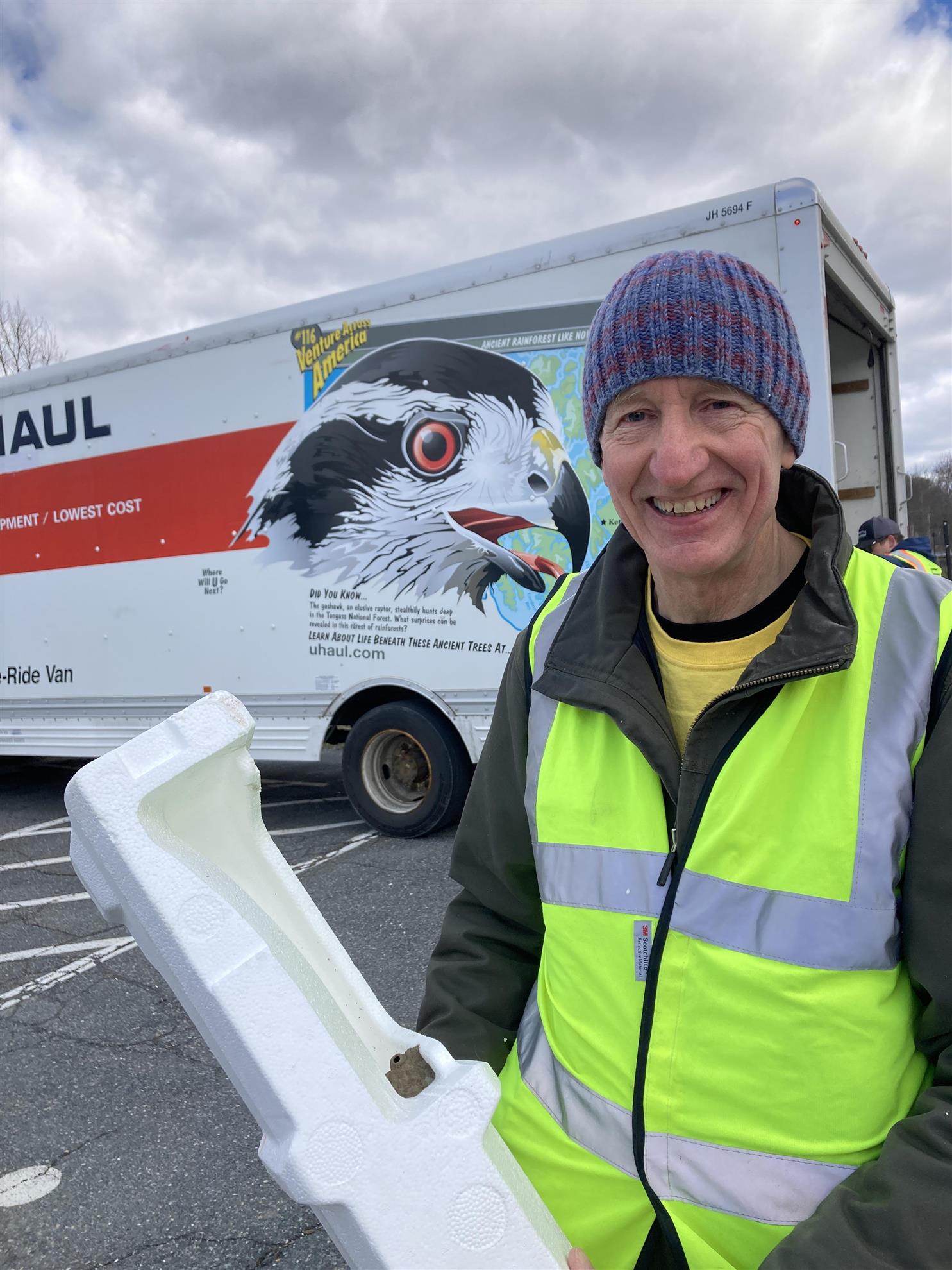
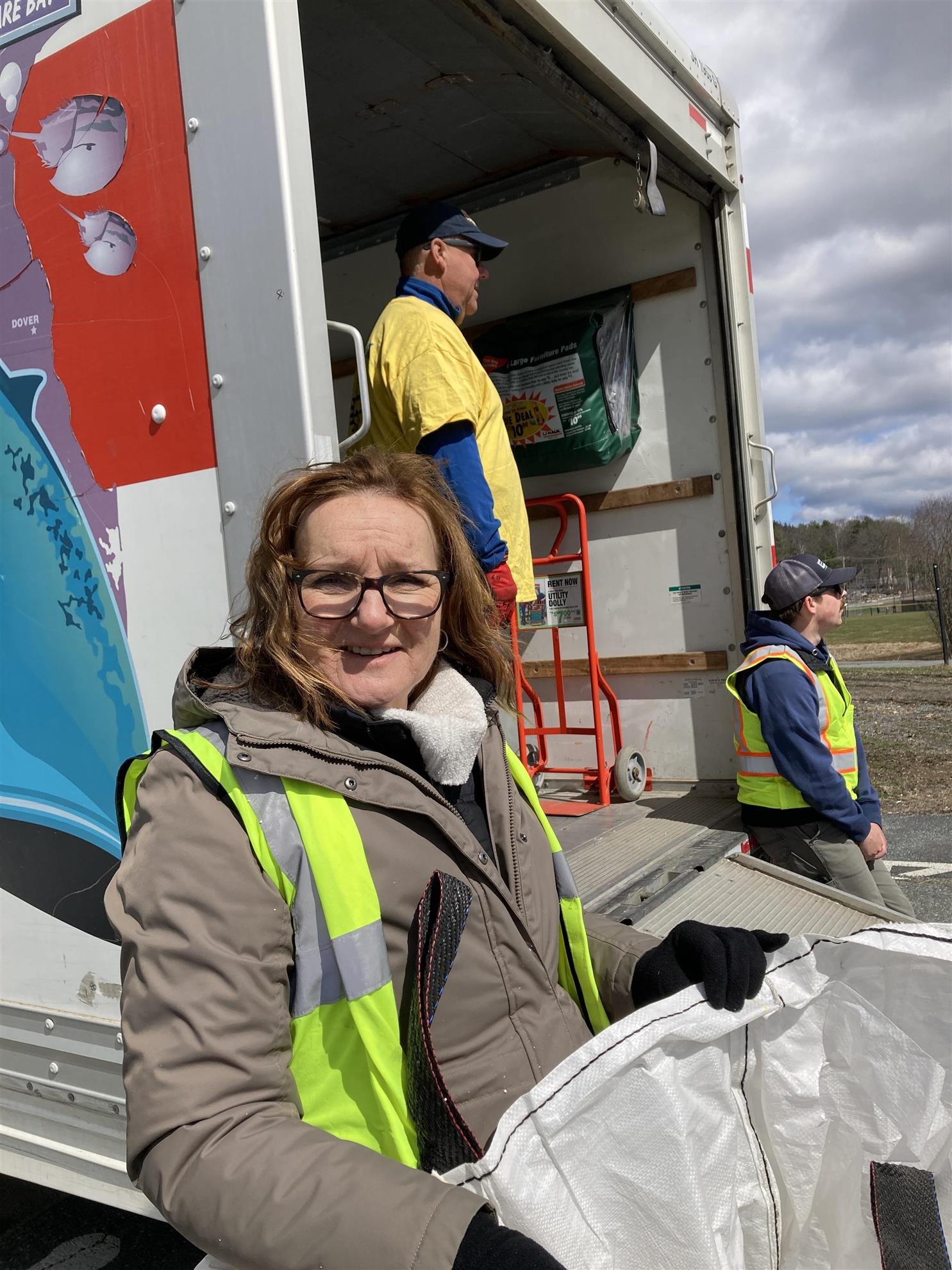
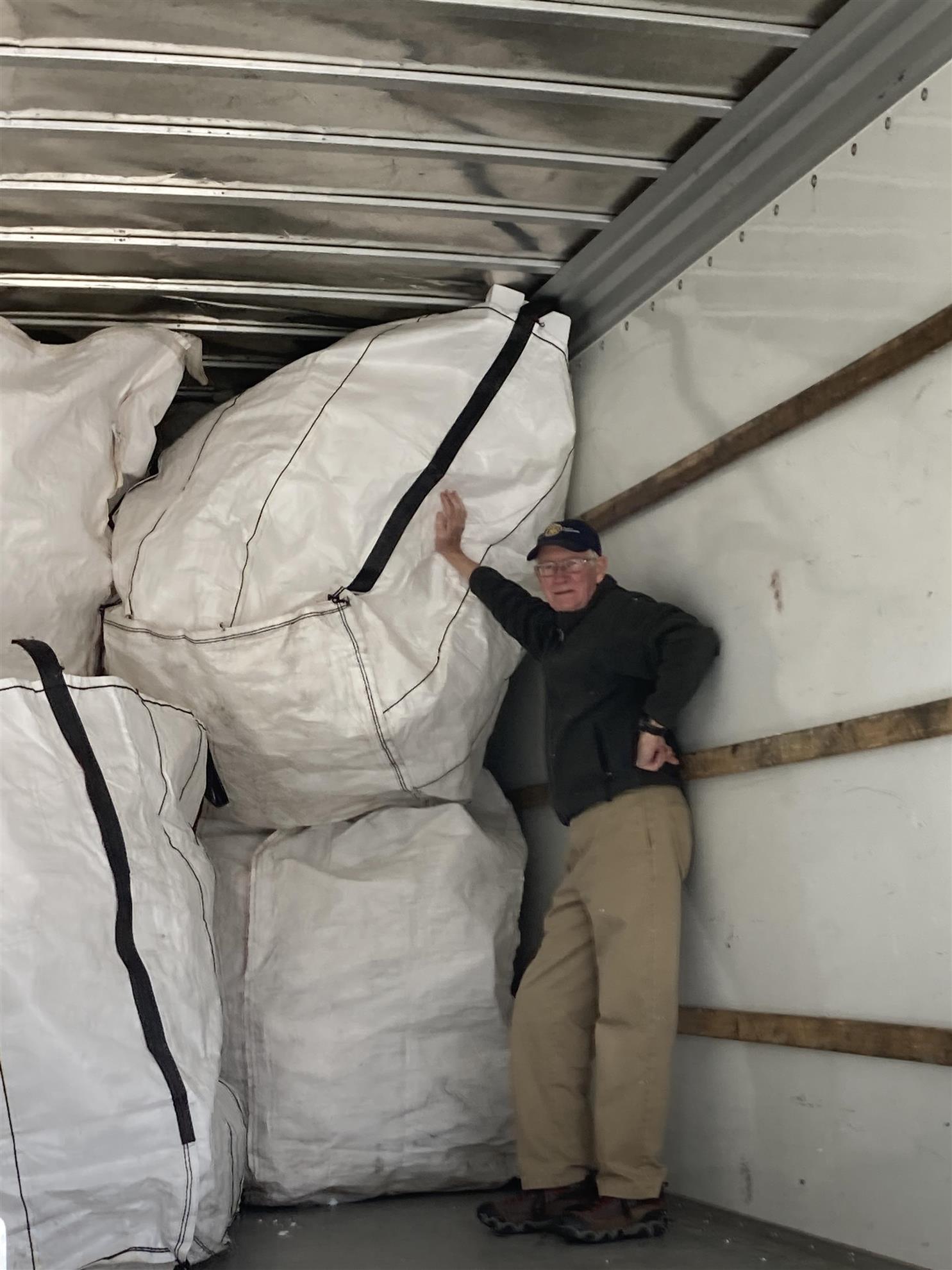
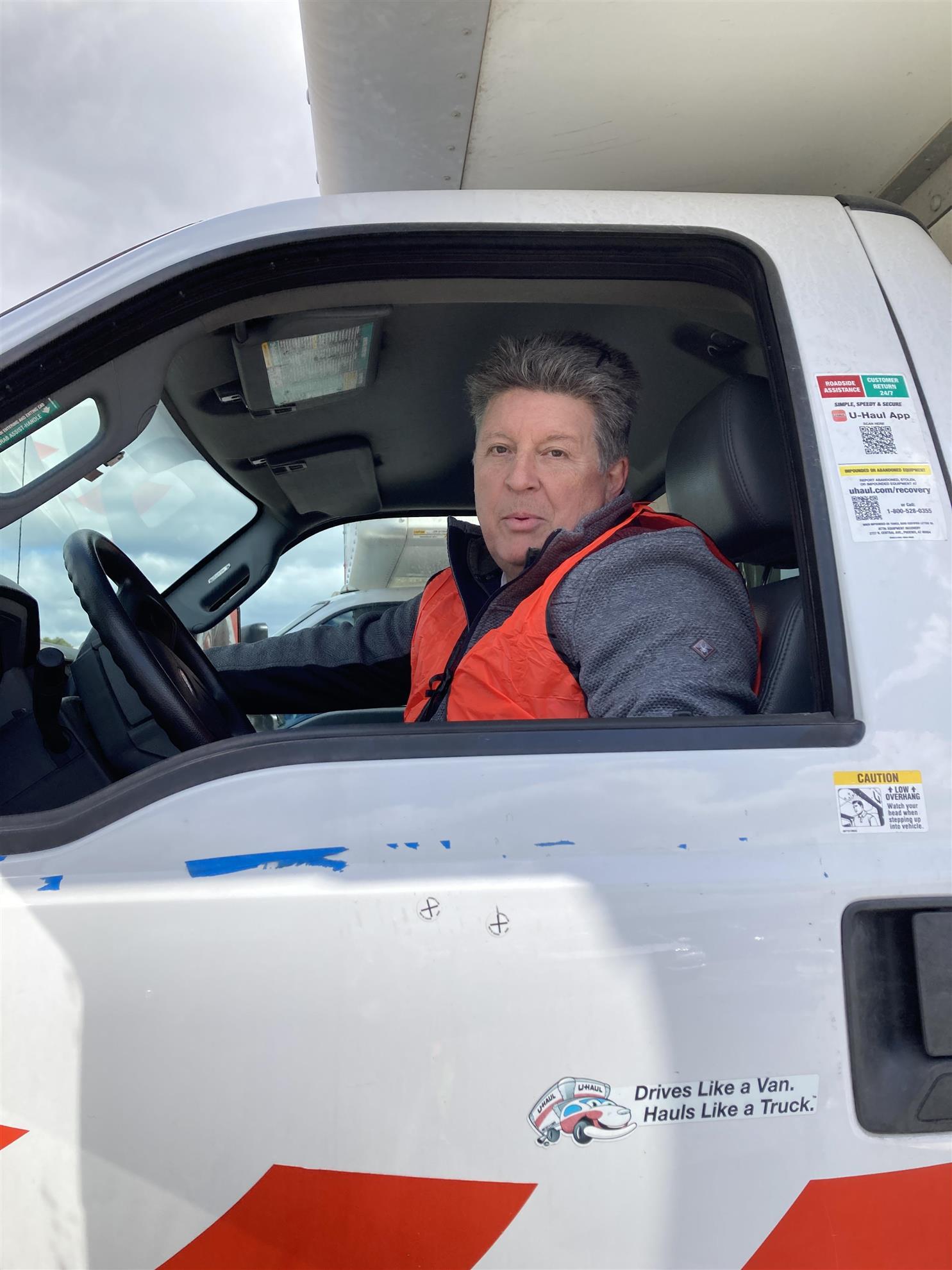
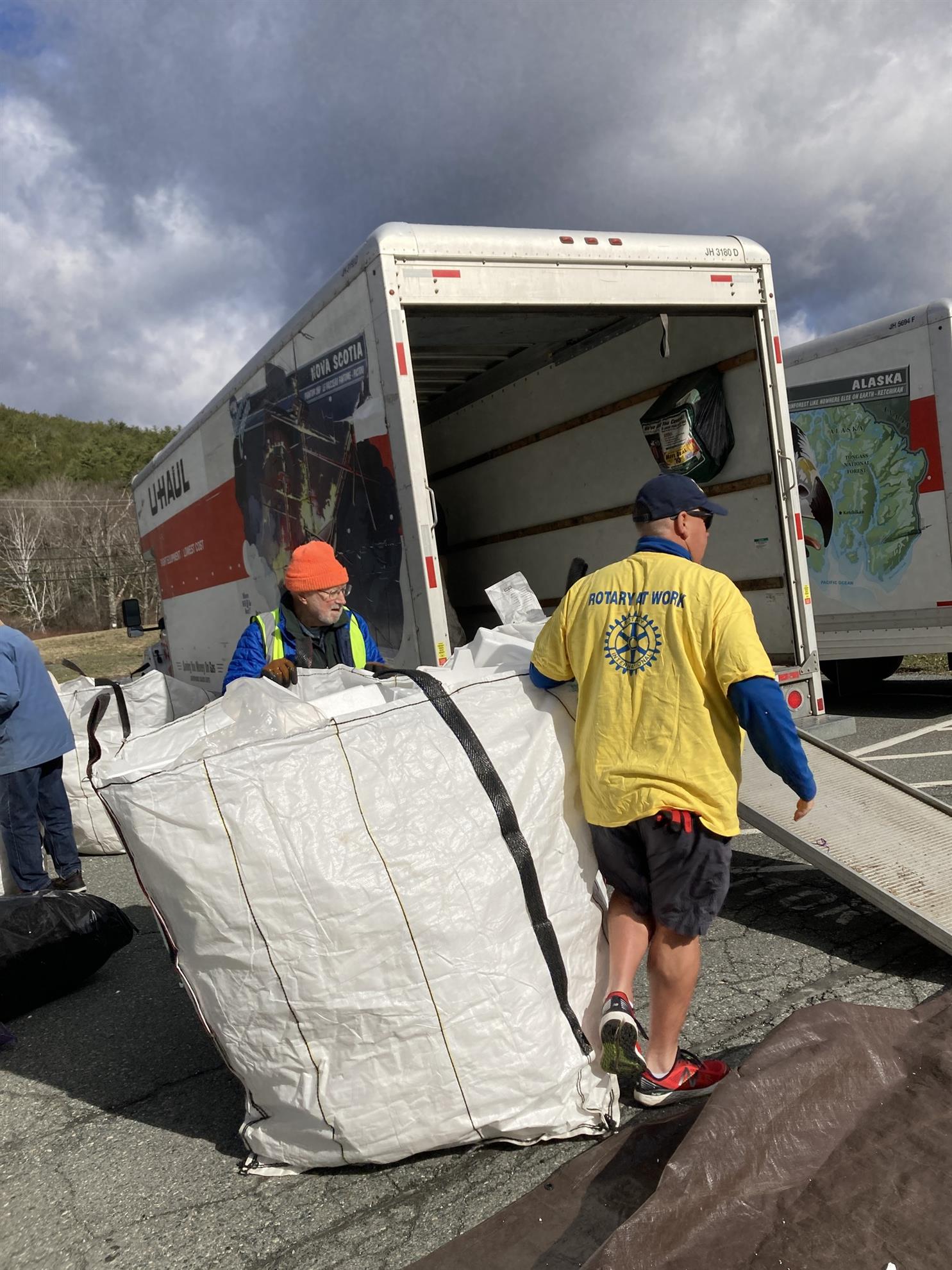
Polystyrene (Styrofoam) collection..."It's a wrap". Four large box trucks full of polystyrene are on their way to Gilford, New Hampshire's recycling center/condenser. Our Rotary Club did this collection on Saturday, April 11, in partnership with Sustainable Lebanon and Casella Waste Systems.
Rotarians attending the meeting in person:
Christina Annas, William Babineau, Marilyn Bedell, Ron Bedell, Bruce Bergeron, Phil Bush, Dean Cashman, Bill Chabot (R), Dave Clarenbach, Hank Clarke, Paul Coats, Dave Crandall, Jim Damren, Mila Dela Pena, Steven Grant, Tim Guaraldi, Tyler Hagan, Andy Jones, Dustin Lester (R), Jane Mason (R), Christian McDonald, Ernst Oidtmann, Bruce Pacht, Travis Page, Nate Reichert, Philip Rentz, Bill Secord, John Stalvey, George Wenz, Cal Wolfe, and John Yacavone.
President Marilyn rang the bell and called the meeting to order at 12:00 p.m.
Recitation of the “4-Way Test of the Things We Think Say or Do” was led by Phil Rentz.
Pianist Ernst led us in singing the “Rotary Welcome Song,” and “If You’re Happy And You Know It, Clap Your Hands“—a kindergarten song that nearly everyone in the room sang with gusto.
June 3, 2026, Thirty-third Bedell Classic Golf Tournament
PRESIDENT MARILYN’S THOUGHT OF THE DAY: May celebrates RI’s Global Day of Service, during which Rotary addresses real needs, as always Lebanon Rotarians will volunteer with Lebanon, Mascoma, and Windsor Interactors at a RISE Against Hunger food-packaging event Friday, May 1, at LHS, preparing 20,000 dry meals to be sent abroad to hungry people.
WEEKLY STATISTICS:
Guests: Eric White, McGee Hyundai.
Birthdays: Bill Secord, April 10.
Wedding Anniversaries: Ernst and Linda Oidtmann 53 years of marriage.
INDUCTION OF NEW MEMBER:Christina Annas and her sponsor Christian McDonald came to the front of the room where President Marilyn inducted Christina into the club. Christina has been a traveling nurse, now working in the APD operating room. Christina’s mother is a Rotarian; they both love to travel.
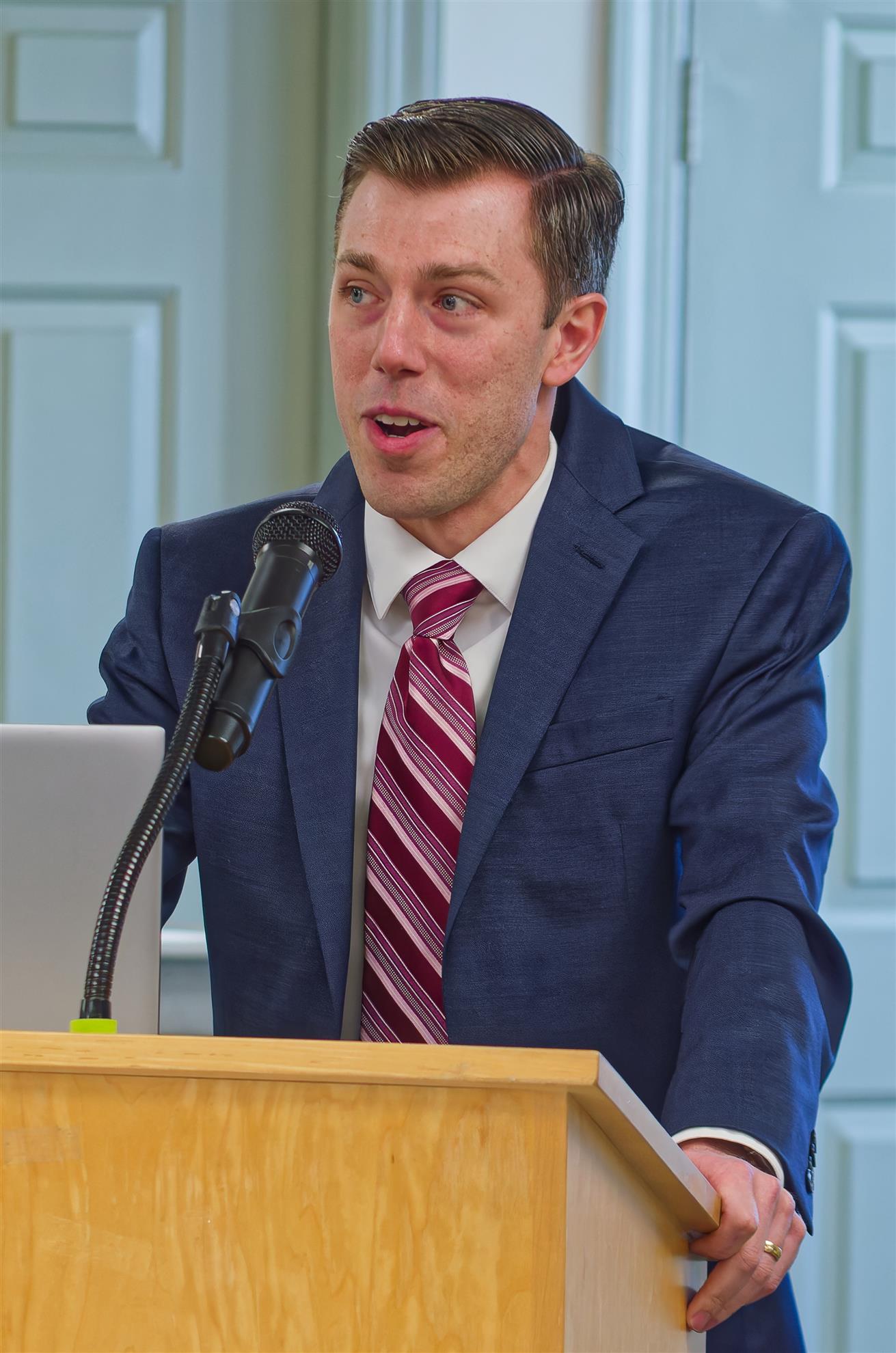
PROGRAM: Andrew “Drew” Bostwick, USAF Captain, ret.
MD Candidate Geisel School of Medicine at Dartmouth.
Topic: Remotely Piloted Aircraft (RPA) Operations—What and How?
Definitions: “Drones” are non-piloted autonomous aircraft; “remotely piloted aircraft” (RPA) have a pilot and a sensor operator at controls that mimic aircraft controls but are located in a stationary location while the aircraft could be half a world away from start to finish of a mission.
Drew’s agenda for today’s talk
Who am I?
What did I do?
How does it work?
What do you think?
Everything in the slide show is accessible online and NOT classified information.
Who is Drew?
Was a Rotary Youth Exchange student in Chantilly, France, and has long been involved in Rotary.
Is now a member of Hanover Rotary.
Was born Salem, Ohio.
Was an AFROTC (Air Force Reserve Officers’ Training Corps) cadet at Kent State University.
Was commissioned into the Air Force; worked on his master’s degree while on tour in Afghanistan.
When he decided he needed additional work to apply for medical school, he attended the University of Florida and the University of Las Vegas while still in the AF.
He was accepted and is now a medical doctor candidate at Dartmouth’s Geisel Medical School.
Drew showed us several photo collages of his life:
As a young student: musical theater, opera, fencing in France.
Pre-commission training photos.
Kandahar Airfield photo of Mq-9 Reaper drone.
Kuwait photos: Went there in Jan. 2020; two weeks in, the pandemic hit and Drew enjoyed an extended six-month tour while studying remotely for his Masters.
Photos after commission: Drew transitioned to teaching others how to use RPAs. Candidates are trained first for the mission, then later trained to do takeoffs and landings.
Photos of Geisel classmates.
Drew’s wife, Melissa, was with him through all deployments; she’s a nurse at D-H; they live in Enfield with their two-year-old son, Dino, Pug dog Arnold, and a Himalayan cat.
What did Drew do?
On active duty starting Feb 2016, Drew gained increasing knowledge leading to increasing levels of responsibility: Flight training, instrument qualification training, mission qualification training, mission control elements, RPA liaison officer, launch and recovery training, launch and recovery elements.
Deployment to Kandahar, Afghanistan in 2019 as launch and recovery instructor upgrade.
Deployment to Ali al-Salem, Kuwait, in 2020.
He experienced difficult emotions while driving to and from work thinking about his job of dropping weapons on human beings.
In Germany as a 2nd lieutenant, he was liaison officer for all RPA operations in Africa, which weren’t all about weapons. He made sure each effort was legal to fly and had flight plans filed; he worked with different countries and their militaries. He coordinated actual people flying and observing and ground parties for the missions. He was also part of high level strategic planning, primarily for the then-Department of Defense, but also flying NATO missions and sometimes for “three-letter organizations” (like CIA & NSA), though the RPA’S spy equipment was not often engaged.
He left the service in 2023 without a flying license since his experience was not considered to be real “instrument flying.”
How do RPA’s work?
RPAs need all the control aspects you would find inside aircraft.
Crew: one pilot, one sensor operator
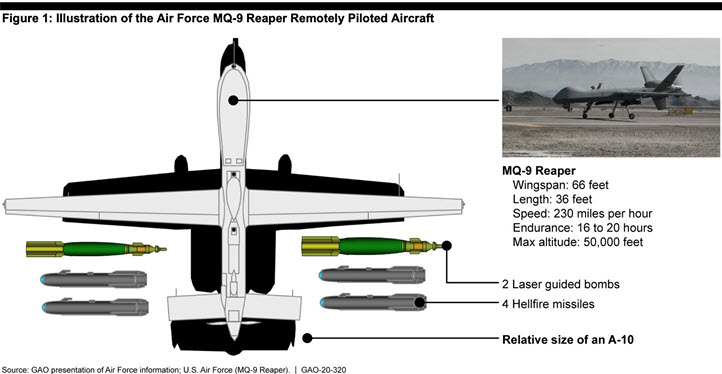
Drew flew the General Atomics MQ-9A Reaper Drone—900 shaft horsepower max, carrying 4 hellfire missiles, 2 GBUs (“Guided Bomb Units are precision-guided, "smart" munitions used by the U.S. military to destroy high-value targets with high accuracy, reducing collateral damage.” Wikipedia). Additional weapons may be subbed in for an external fuel tank.
Altitude—25,000 feet; endurance—up to 27 hours (but in practice, much less); Range—1000 nautical miles (“A nautical mile is a unit of distance used for maritime and aviation navigation, officially defined as 1.852 kilometers or roughly 1.15 statute miles, equaling one “minute,” of latitude along any meridian, allowing for easy calculations on nautical charts.” (Wiki).
Base cost without weapons is ~$16 million; fully loaded, ~30 million each. A loaded and piloted F-35A goes for ~$135 million.
◌ Missions: Close air support, intelligence, surveillance, reconnaissance, combat search-and-rescue.
How did Drew do his work?
He was responsible for LRE (launch and recovery element) = takeoff and landing.
◌ LRE needs a signal to a line-of-sight antenna on the drone.
◌ Once the drone is settled airborne and approaching a loss of line of sight, mission control takes over using satellites to communicate with the weapon; there’s about a two-second delay in those communications.
◌ From Afghanistan, we sent info of takeoff to mission control back in the States. We monitor the flight after mission control takes over to make sure it’s flying properly, then we cut off. On the return, at a certain attitude for landing, they hand control back to us for landing in Afghanistan.
◌ A Reaper protected the recently downed crew member by striking Iranian “military-aged males” believed to be a threat who got within three kilometers of the pilot’s location.
Pros about using RPAs:
Less expensive than manned aircraft.
Deployable to hostile areas with minimal risk to operators.
Long on-station mission time means good continuity of effort.
Cons:
Slow-moving, poor evasiveness.
Long crew hours—maximum flight time 16 hours, though usually don’t go over 8. Drew mentioned lots of time flying over Libya seeing nothing but sand.
Datalinks are very fragile, unreliable.
No feel/haptics—We have a control stick, rudder pedals, etc., all the regular equipment of any aircraft; but not physically feeling anything on the landing makes it harder.
Ethical debate about the use of unmanned weapons—there are regular protests outside the base
Psychological impact on operators—replaying dropping a weapon on humans.
The Big Question: Where does war go from here? What will our enemies do with this tech?
QUESTIONS, COMMENTS
Jane Mason—Drones were a wonderful addition to the Olympics!
Tim—What about the role of drones in recovering the downed pilot?
◌ It was far away, but most of the time we are able to switch out operators, such as for bathroom breaks. Usually, we rotate shifts from days to nights every six weeks.
Dave Clarenbach—laser-guidance of munitions?
◌ It’s done by the non-pilot sensor camera operator, the second person besides the pilot operating the drone. A camera on the Reaper’s bottom has a laser giving guidance that’s programmed to the weapon.
Marilyn—Why are you choosing a career in medicine?
◌ I’ve always been pre-med but never thought I’d actually get there because it’s very competitive and difficult. I missed science while getting my other degrees, but doing RPA work made me wonder what in my life would bring me satisfaction. Doing good for your patients seemed a higher good.
Ron Michaud—How much training is required, and what is currently taught about refusing to follow unlawful order?
◌ Unlawful orders were more difficult to come by when I was flying. Everybody is given training on the Law of Armed Conflict. It’s a tricky ethical issue: while flying over Syria, watching a target, we got called to move to another target. There were 16 people on the ground getting close to the ISIS curfew. We were sent back to our original target, then almost immediately were told to return and drop weapons. I had no intelligence besides seeing 16 “probable ISIS supporters.” I couldn’t tell exactly what weapons they might have been carrying at night. As an RPA pilot, I had to assume the order came from someone with adequate intelligence.
SPEAKER’S BOOK:
Don't Eat Eustace by Lian Cho.
“Today’s Lunch Special: Freshly caught fish.” Eustace is a fish who would prefer to live than be eaten. Bear lives alone in a lighthouse. Bear mends their clothes, sweeps the floors, and catches their own lunch. Today's lunch is Eustace. Eustace would really like to live. (He has a girlfriend after all.) Will Eustace be released back into the sea? Or will he end up in Bear's stock pot?
Bill Secord explained and presented the book to Drew for his signature and placement in the Kilton Children’s Library collection.
SOCIAL EVENTS COMING UP SOON!
Monday, April 20, Galloway Room at Salt hill Pub. “Fireside Chat”—Orientation opportunity for new members, refresher for current members. Appetizers provided by the Club; drinks are on you. Bruce Bergeron and President. Marilyn will lead. Let Marilyn know if you are coming to adjust food quantities.
Lebanon Club Changeover, June 18th, 5:30 p.m., Dwinell Room at Harvest Hill (No meeting at noon).
SERVICE AND OTHER ACTIVITIES
April 11th, Saturday, 9 a.m. - 12:30 p.m. Lebanon Styrofoam Collection. Lebanon High School. Looking for 12-15 volunteers. Drive to Gilford 12-3.
April 21st, Tuesday, 9 a.m. - 11 a.m., Set up tables for 5 Colleges Book Sale at Lebanon High School. Looking for 8-10 volunteers.
April 26th, Sunday, 4 p.m. - 6 p.m., Take down tables for 5 Colleges Book Sale at Lebanon Hight School. Looking for 8-10 volunteers.
April 18, Saturday: District Assembly at Northern Vermont University, Lyndonville. Meet other Rotarians! Learn about what other clubs in the district are doing and what role the district plays in supporting clubs! Third Round of Speech Contest with Lebanon High Student Benjy Madory competing!
June 12-14, 2026, Friday-Sunday:District 7850 Conference at Hotel Estrimont, Magog, Quebec. Widen and deepen your Rotary friendships and network! Lebanon Rotary Club will provide stipends up to $400 to attend; actual amount to be determined based on the number of members who want to attend.
CLUB FUNDRAISERS—ALL HANDS ON DECK NEEDED TO MAKE THESE SUPER SUCCESSFUL!
June 3, Wednesday: Bedell Classic Golf Tournament. It’s time to make your approach to potential sponsors or donations of raffle prizes. Also, possible setup assistance on the afternoon of June 2, Tuesday. Handouts are on the table—unassigned people to approach for sponsorships/ads.
September 5, Saturday of Labor Day Weekend: 2026 Brew Fest.
HAPPY DOLLARS:
Marilyn—Thanked Drew for making time for us in his busy schedule.
George—I will be another great-grandfather, a boy around July 4. First great-grandchild who lives in Bethel, VT, was walking and skiing at 18 months old, saying “I can do it.”
Dave Clarenbach—Open House at Foremost Builders, May 29, Noon-6:00 p.m. at his new offices at 3 Main Street, West Lebanon.
CARD AND CAR WASH RAFFLE:
Tim’s number was chosen and a non-Queen of Hearts card was dragged from the deck.
Mila won the free car raffle at the Enfield Car Wash, thanks to Bruce Bergeron.
President Marilyn rang the Rotary bell at 1:19 p.m., and we ended the meeting with a recitation of RI’s motto:
One profits most who serves best
FUTURE PROGRAMS:
Apr 16: Diana Griffin, AARP
Apr 23: BOD/Classification Talk by Carol Keeffe
Apr 30: Nenia Ballard, Ms. Wheelchair New Hampshire
Program Team for remainder of Rotary year 2025-2026: Hank Clark (Jan, Feb, March) and Dave Crandall (April, May, June).
OUR ANNUAL STYROFOAM DRIVE SPONSORED IN COLLABORATION WITH SUSTAINABLE LEBANON:
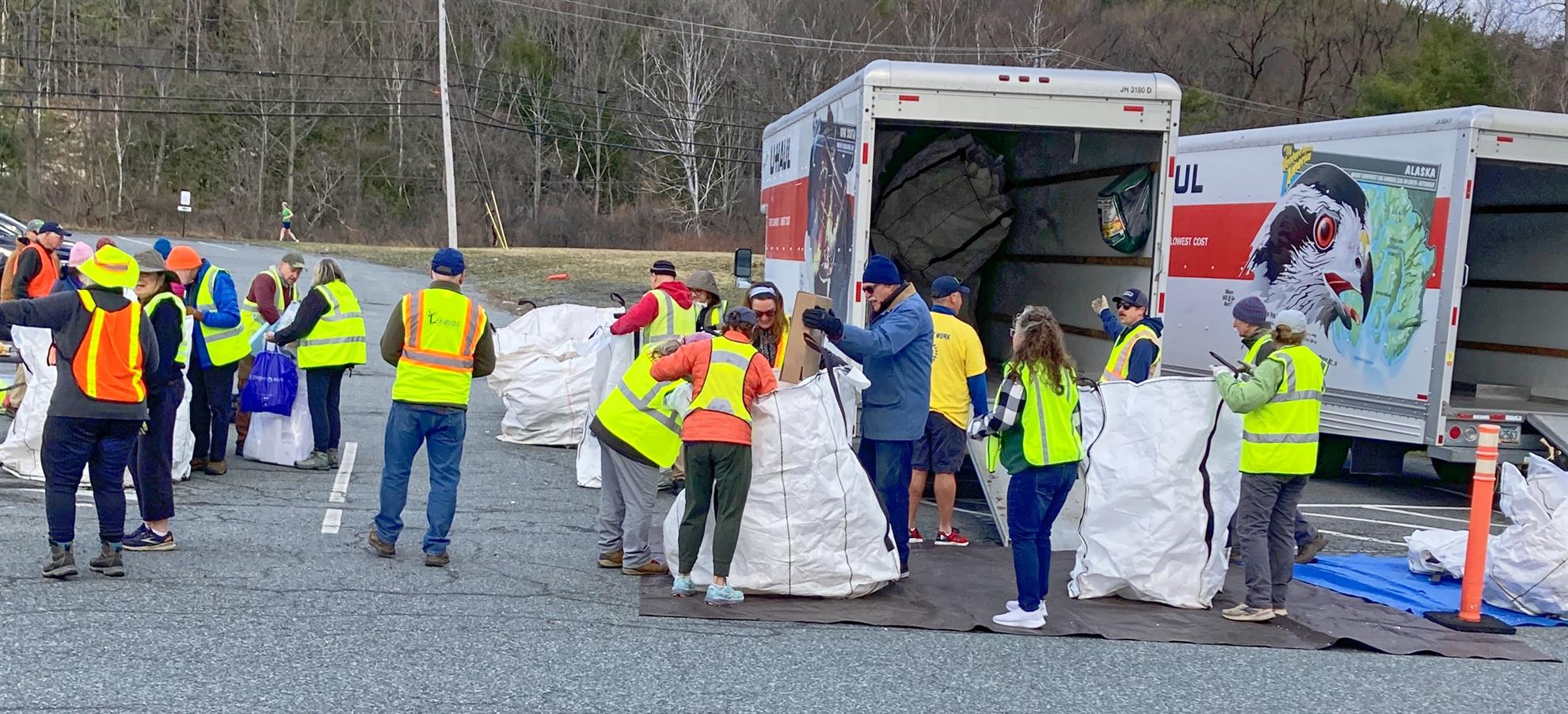
On Saturday, April 11, in partnership with Sustainable Lebanon and Casella Waste Systems,
the Lebanon Rotary help collect four large box trucks full of polystyrene. Volunteers drove the trucks to a recycling center in Gilford, New Hampshire. Besides the Styrofoam, the program collected $2,242.87 in donations from the public—despite the traffic jam!
[Clockwise from top left] Phil Bush attends to the cash donations; Phil Rentz does the heavy lifting; Anna Guaraldi oversees the operation; Bill Chabot bags the loot; Tim Guaraldi is on his way to Guilford; Ernst Oidtmann holds up the operation.
HEY, IT’S SPRING AND TIME TO CHECK OUT THE ROTARY SPRING JACKETS AND VESTS FROM TOP STITCH.

 Today's lunch is Eustace. Eustace would really like to live. (He has a girlfriend after all.) Will Eustace be released back into the sea? Or will he end up in Bear's stock pot?