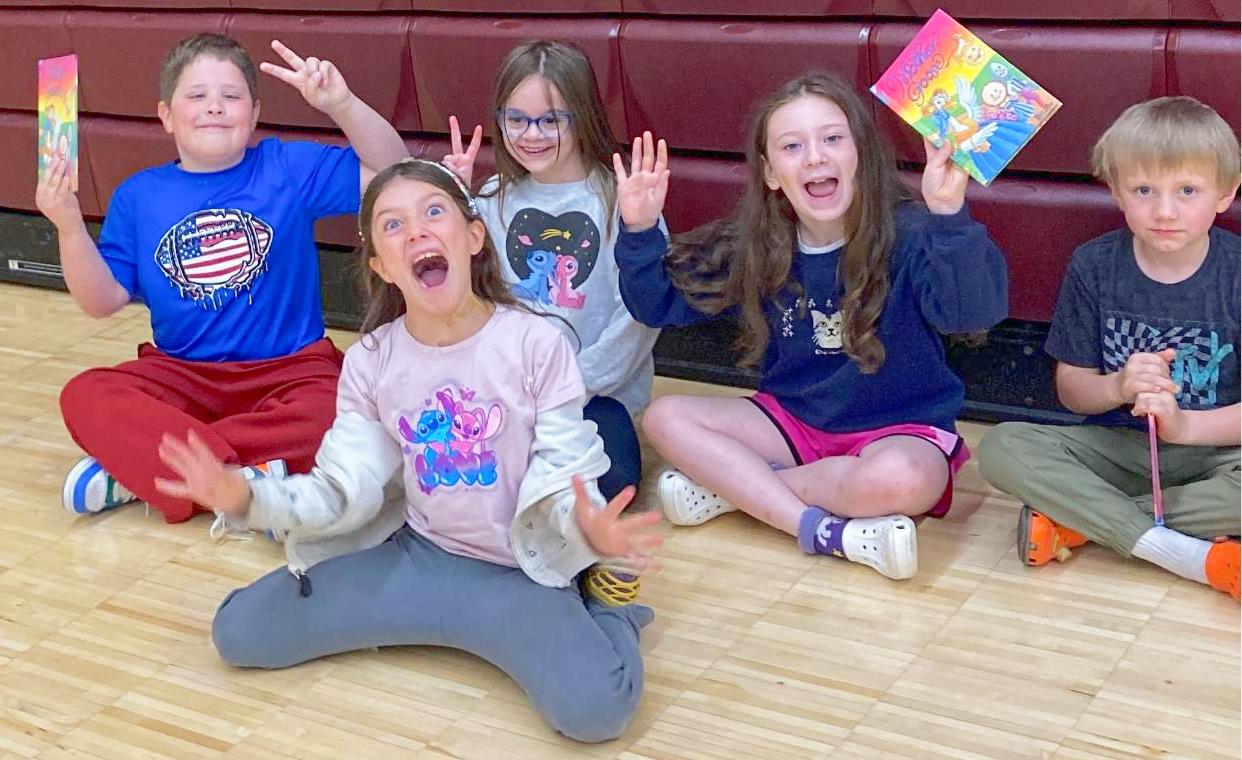
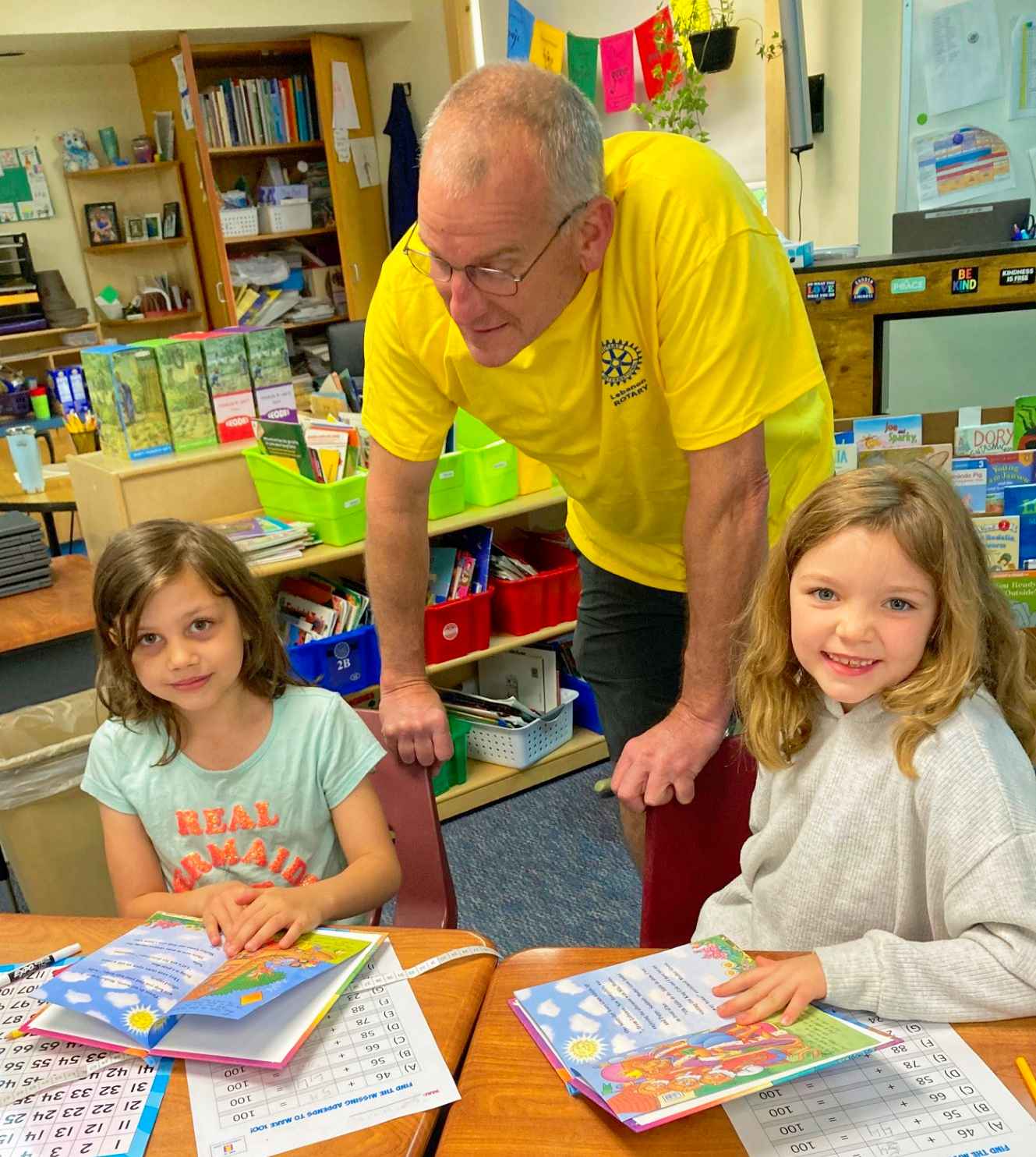
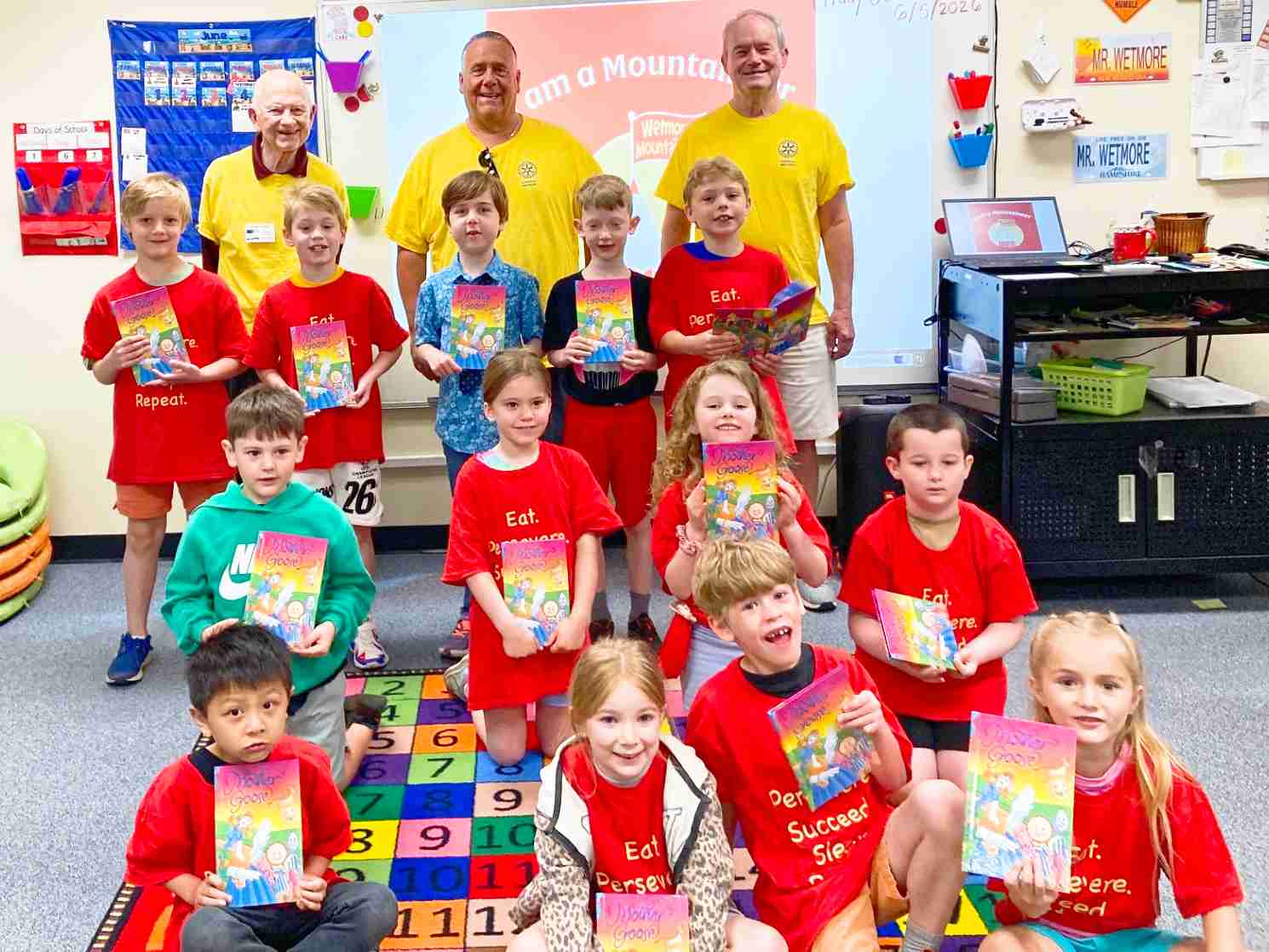
First-grade students at the Hanover Street School show enthusiasm for the personalized books presented to them by members of the Lebanon Rotary Club.
Members in attendance (R=Webex): Marilyn Bedell, Ron Bedell, Bruce Bergeron, Keegan Carpenter, Bill Chabot (R), Dave Clarenbach, Dave Crandall, Jim Damren, Ahmad Haidari (R), Carol Keeffe, Dustin Lester (R), Jane Mason (R), Christian McDonald, Ron Michaud, Ernst Oidtmann, Bruce Pacht, Phil Rentz, Bill Secord, John Stalvey, Steve Whitman, and John Yacavone.
President Marilyn rang the bell and called the meeting to order at 12:02 p.m.
Recitation of the “4-Way Test of the Things We Think Say or Do” was led by John Stalvey.
Songs: Ernst played us through “Rotary Welcome Song” and “Tiptoe through the Tulips,” which received an unexpectedly rousing rendition.
PRESIDENT MARILYN’S THOUGHT OF THE DAY: 50 years ago in 1976, the US celebrated the bicentennial of the country’s founding. Also: Apple started; a device was landed on Mars; punk rock was popular, but so were ABBA, Elton John, and the BeeGees. Average US income was $18,000, regular gas was 59 cents/gallon, first class mail was 13 cents, and the average house sold for $45,000.
WEEKLY STATISTICS:
Visiting Rotarians: Jimmy Brock, remote, from Bermuda. Guests: 0 Birthdays: 0 Wedding Anniversaries: 0
ROTARY ANNIVERSARIES:
Marilyn announced that this month, John Yacavone and Bruce Pacht will achieve 50 years of Rotary membership, all in the same club and still active.
John Yacavone and Bruce Pacht receive a celebratory cake from baker Veronica Bongino and chef Brian Pike.
Marilyn also recognized Steve Whitman’s having joined Rotary 5 years before John and Bruce. Angela celebrates 9 years of membership this month. A special sheet cake was made by the Dwinell Room kitchen to mark the event:
PROGRAM—
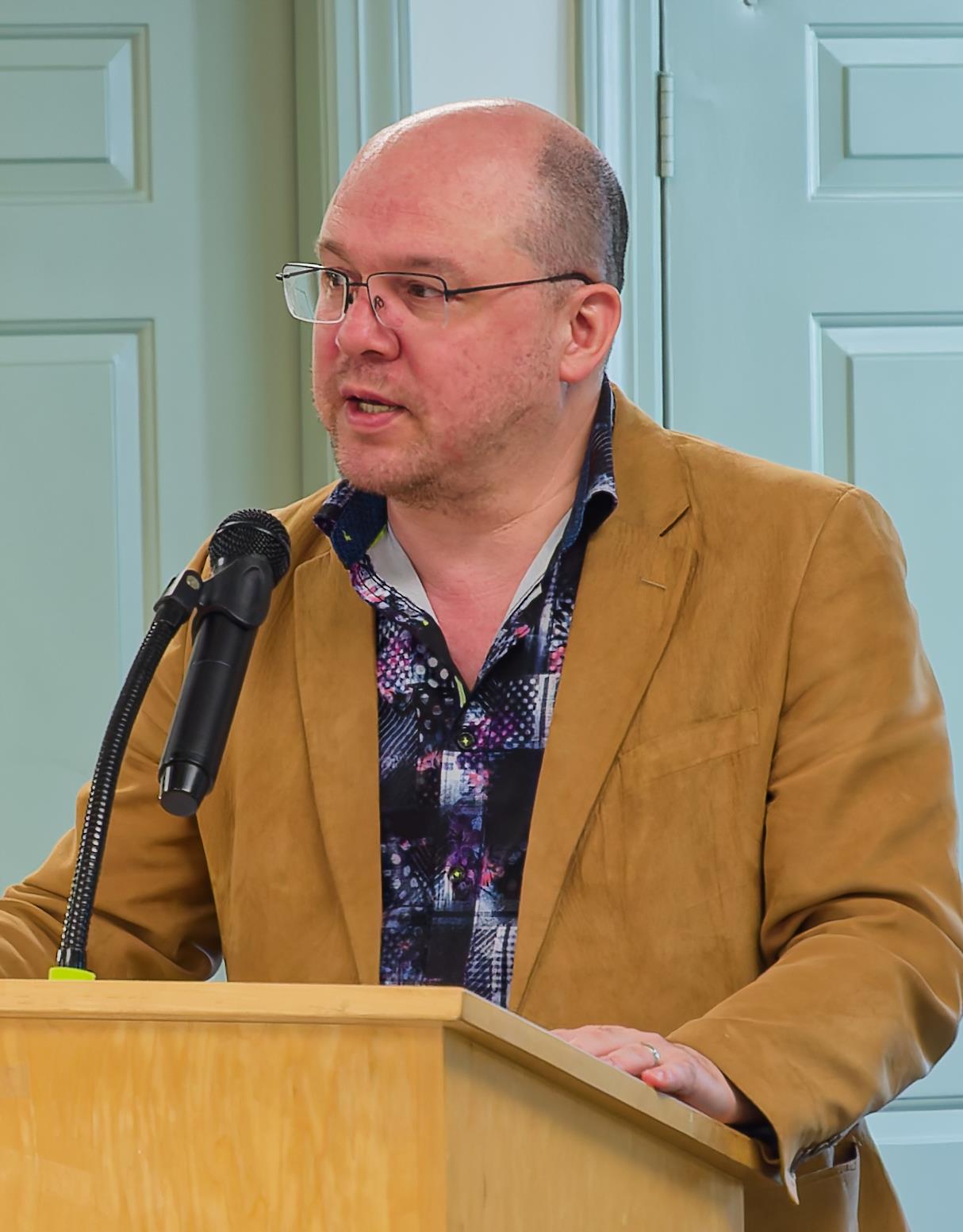
Matthew Olzmann, Dartmouth Professor and Poet
Before his introduction of our speaker, Dave Crandall told a dad joke about Edgar Allen Poe on a walk encountering wooded vegetation, after which a friend pronounced, “poetry.” It’s like the little acorn who grew and grew and one day looked down with realization and said “geometry.”
From Wikipedia: Matthew received his BA from the University of Michigan-Dearborn and his MFA from Warren Wilson College. He has had poems, stories, and essays appear in various publications, such as Best American Poetry, Kenyon Review, New England Review, Salt Hill, Margie, Atlanta Review, Necessary Fiction, Brevity, Southern Review, and elsewhere. He is the author of three poetry publications. In 2012, Olzmann edited Another & Another: An Anthology from the Grind Daily Writing Series along with Ross White. His debut collection, Mezzanines, which won the Kundiman Prize, was published by Alice James Books in 2013. In November 2016, Olzmann published his second collection, Contradictions in the Design, also from Alice James Books. In January 2022, his third book of poems, Constellation Route, was published by Alice James Books. He has received the Kresge Arts Foundation fellowship and a National Endowment for the Arts Fellowship.
Matthew Olzmann is currently an Assistant Professor in the Department of English & Creative Writing at Dartmouth College in New Hampshire, USA. He has lived in White River Junction for the past 10 years.
Matthew Olzmann' talk: “Why poetry can matter”
“Poems were always weird to me,” Matthew said. In school, he read novels and short stories until one week students were handed a packet of poems, about which his teacher said, “Technically, poetry is considered literature, so here, read these.” Matthew read a poem about separating gray stones from white, a motorcycle accident with someone bleeding to death saying, “Help me!” and another person saying, “In a minute, I’m busy.” This felt analogous to what Matthew was seeing in the real world: violence as entertainment. He said that “boredom separates people from the reality of others’ lives.”
He pointed out that, “Compressed devices help me understand complicated things happening in the world around me.” In graduate school he finally remembered that poem, “Amazing Story,” written by Steven Dobyns; the following year, Dobyns came to Matthew’s school to teach, and Matthew started to see poems in a new light.
Merriam Webster’s first definition of “poetry” is “metrical verse.” The second definition doesn’t help much either: “productions of a poet.”
Matthew suggested this: “a language-based art form where form is part of the content.” Of course, this begs the next question: “What is art?”
Suzanne Kay Langer defines “art” as “the practice of creating forms expressive of human feeling.” But then, there are things we don’t necessarily have words for, where discursive language fails and needs a shape.
Poetry can also be a metaphor to depict things I see around me. Poetry “gives feeling a form.”
Matthew circulated four poems, then read one by Hanif Abdurraqib, “It Is Maybe Time to Admit that Michael Jordan Definitely Pushed Off.” He provides a poem for understanding grief. The final phrase is, “I can see every possible ending before we even touch.” There is no specific word for this feeling.
Matthew referenced a definition of art formulated by Viktor Shklovsky. [“Viktor Borisovich Shklovsky was a Russian and Soviet literary theorist, critic, writer, and pamphleteer. He is one of the major figures associated with Russian formalism. Shklovsky's Theory of Prose was published in 1925.” Wikipedia.] He said that humans work mostly on autopilot, only paying attention to some stuff, we tune out a lot. That means that sometimes in our lives, things that are spectacular are taken for granted, things that are terrible we ignore. Art is what makes us pay attention, overcoming the steady process of defamiliarization.
Art presents something in a strange way that forces us to notice the variation in our routine.
Matthew then read Campbell McGrath’s “My Music,” a joyous romp of language through heights and lows that drew murmurs and laughter from the Rotary audience.
Matthew pointed out McGrath’s use of “hyperbolic extreme bragging,” and asked, “Is he talking about music?” Some of the poem is joyful and sounding like a kid, but various small elements in the images present a weary Americana landscape, yet the manner in which they are presented is a sort of wonder. This is presenting ordinary things in an unexpected way.
With characteristic precision, Matthew concluded by pointing out that he finished his allotted time slot of 20 minutes in 19 minutes 45 seconds.
Questions and comments:
Q: John Stalvey:
I don’t like to read poetry, but I love to listen to poetry. My mind doesn’t give poetry the cadences it requires.
Poetry is expressing things we don’t have words for. How does math fit into this? If you speak to a theoretical mathematician, they talk about “beauty.”
Matthew: One math student once told me not liking math was because one wasn’t taught properly. For example, if you want to be a painter because you admired Van Gogh, but you were only allowed to paint fences, you wouldn’t think much of “painting.” If math were taught to you as the beautiful secret key to unlocking an understanding of the universe, you would have thought differently about it.
Matthew’s brother is a cellular biologist who feels that he and Matthew are both asking a lot of the same questions—he on cellular level and Matthew on universal level.
Q: Dave Crandall asked about how AI could affect the world of poetry.
Matthew: I’m too much in the middle for the moment to know, but already it has impacted other writing fields. Publishers are refusing AI-generated pieces, especially from TV writers. The biggest questions involve the use of large language models created by using intellectual property of other people: What are the ethics of using it when we teachers are saying, “Don’t plagiarize!” but we use it?
Q: Bruce Beregeron: How fun is it to have readers interpret your poems differently from what you were thinking when you wrote the piece?
Matthew: With my poems, most of the time folks are in the ballpark, but sometimes there are different ways the poems occur with others. Some publishers ask for submissions of three-to-five poems and then pick one I don’t think was the best one. I have no idea why some of my work gets shared widely on social media and other pieces get crickets. You send our work out into the world, and it develops its own life, connecting with readers but you don’t know where or when.
Q: Marilyn suggested that music is the interface between math and poetry.
Matthew: Some of his friends say that music depends on familiarity and repetition while poetry depends more on surprise and disorientation.
SPEAKERS BOOK: Bill Secord presented A Knot is not a Tangle. Through creation of Persian rugs, a boy learns to create beauty. An artist must make beauty out of chaos, not strive to achieve perfection. Bill said that Marshall McLuhan said Balinese people have a saying: “We have no art—we do everything as well as we can.”
ANNOUNCEMENTS
Lebanon Club Photo: REVO, June 23, Lebanon Rotary, 4:30 p.m. at the Casino. Big check presentation.
Lebanon Recreation, Parks, and Arts is planning events on July 2 and July 4 to celebrate 250 years of the United States’ creation.
July 2—farmer’s market, family friendly entertainment, front porch and a Novo Nordisk-funded fireworks show.
July 4—Special parade this year. Invitation to community organization—classic cars, 11:30. BBQ free in Colburn Park. Lions will do some food. Leb Women’s Club—baked goods.
COMMUNITY SERVICE
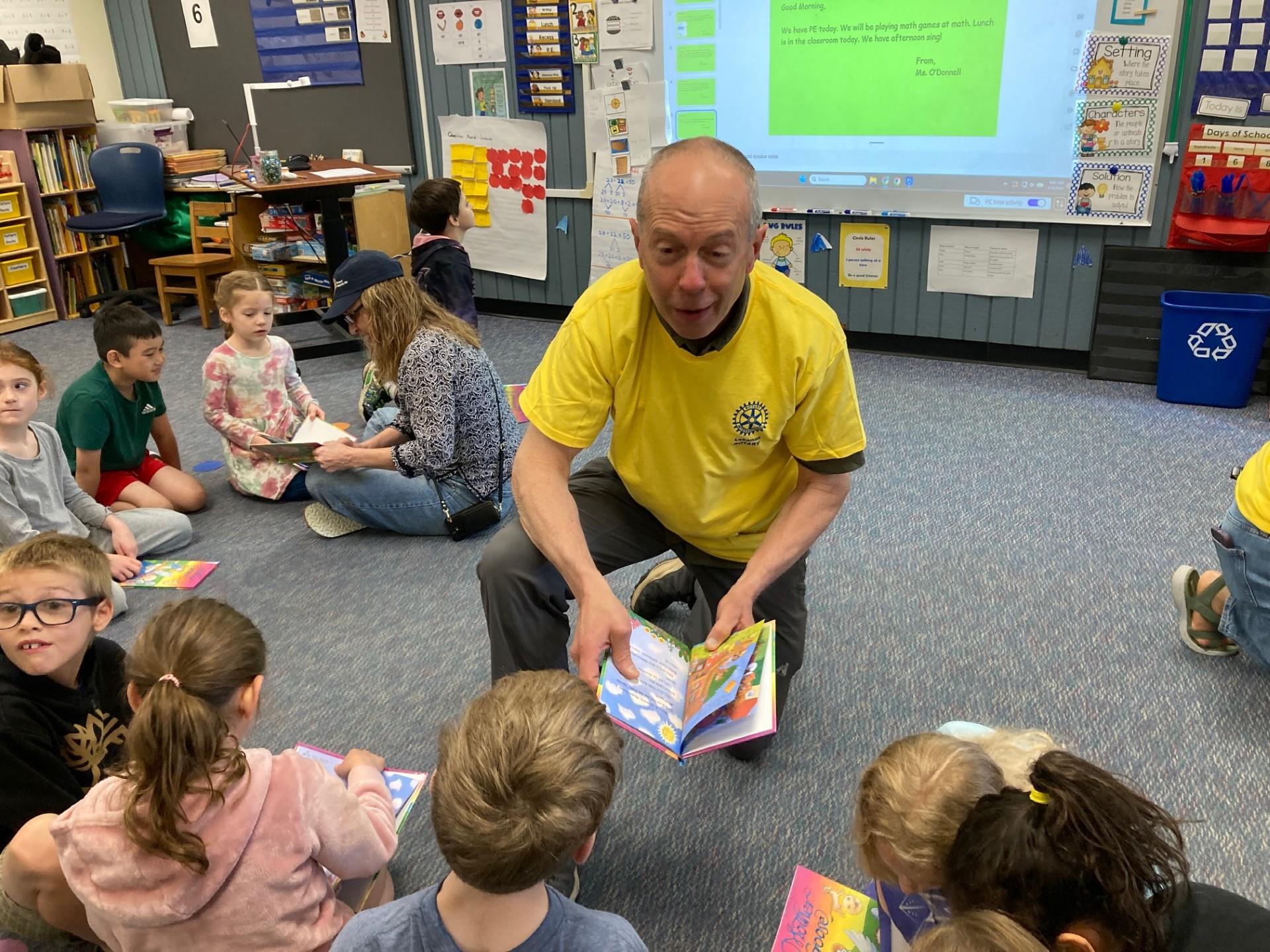
First Grade Reader distribution went well at Hanover Street School; Mt Lebanon Books will be given on Friday morning.
[Above] Students at Hanover Street School receive their personalized books. [More photos below.]
LHS scholarship awards were presented to two students.
Golf tournament was a huge, well-oiled success: perfect weather, rapid and complete setup the day before, excellent lunch, all but two items in the auction were taken. 126 participating golfers were very happy. Marilyn thanked all the volunteers, especially mentioning how quickly set-up went with great participation.
[Above] Golf team members get their instructions from tournament coordinator Bruce Bergeron. [More photos below.]
[Above] The crew that kept the tournament running smoothly—Ernst Oidtmann, Marilyn Bedell, Dave Clarenbach, Travis Page, John Stalvey, John Yacavone, Phil Rentz, Hannah Falcone, Keegan carpenter, Steve Whitman, Bill Chabot, and Bruce Bergeron.
Dave Clarenbach recognized Bruce Bergeron’s inspiring leadership of our Golf Tournament team effort.
MEMBERSHIP
Marilyn will circulate a new membership application.
Shay Barry and other Lebanon Opera House employees are ready to commit to corporate membership.
CHARITIES
Scholarship awards of $2,000.00 each to the following students and institutions of higher learning for 2026:
Lebanon: Georgia Gaffney and Benji Madory Mascoma Valley Regional High School: Adeline Josephson and Ailia Westgate. Ledyard Charter School: Willow Raymond and Landon Bocash
FOUNDATION
If you haven’t yet, please make your annual voluntary donation to The Rotary Foundation no later than June 30. Marilyn suggests trying a minimum donation of $26.50, which would match the inaugural gift to the Foundation at its inception.
Ron Michaud has most generously offered to match new donations dollar-for-dollar.
CLUB SOCIAL EVENTS COMING UP SOON!
Lebanon Club Changeover, June 18, 5:30 p.m., Dwinell Room at Harvest Hill (No meeting that day at noon). Sign up with Ron Bedell—only $20.00 for hearty hors d’oeuvres. 46 are planning to attend. YOU MAY BRING YOUR OWN DRINKS. Beer or wine.
ROTARY DISTRICT 7850 COMING EVENTS:
June 12-14, 2026, Friday-Sunday:District 7850 Conference at Hotel Estrimont, Magog, Quebec. Widen and deepen your Rotary friendships and network
UPCOMING MEETING PROGRAMS
June 11—Classification Talk, Christina Annas and John Stalvey
June 25—Meredith Melendy, our Malouin Teacher Scholarship winner
July 2—Club Meeting Classification talk, James Carroll
July 9—Sylvia Dow Executive Director, Non-profit VISION
July 16—Will Towne (New) Executive Director, Upper Valley Haven
July 23—Lynn Howard Executive Director, Cornerstone Chartered School
August 6—Classification Talk, Tyler Hagan
August 13—Gary Summerton, Photographer August 20—Clara Moses, from Hydrate Marketing August 27—Colby Price, Director of Lebanon Adult Education and Literacy Services (SAU 88)
CLUB FUNDRAISER
September 5, Saturday of Labor Day Weekend: 2026 Brew Fest
HAPPY DOLLARS
Marilyn is happy about the week and all that’s going on.
Dave Crandall and wife were at a nephew’s wedding when their daughter gave Dave a baby outfit as a present, indicating that he was finally going to have a grandchild. Then, further down in the same bag, Dave discovered a second baby outfit! This was notification that his son and partner also are going to provide a grandchild!
Ron Michaud has decided he will not undergo an elective procedure. He decided that at his age, he doesn’t with to risk the potential negative consequences of general anesthesia.
CARD AND CAR WASH RAFFLE
Jim Damren’s ticket #940 was pulled, and the losing 10 of Hearts was drawn.
#939 was held by Ron Michaud, who won this week’s free Enfield Car Wash, courtesy of Bruce Bergeron.
President Marilyn rang the Rotary bell at 1:13 p.m. and we ended the meeting with a recitation of RI’s motto:
One profits most who serves best
Program coordinator for start of Rotary year 2026-2027: John Yacavone (July, August, September).
THE FIRST-GRADE READER PROGRAM:
Hanover Street School
[Above] Christina Annas interacts with book recipients.
[Above] Curtis Payne, Shelly Powers, and John Yacavone hand out the individualized first-grade readers at Hanover Street School.
Mt. Lebanon School
[Above] Sharmila Karki Niroula enjoys the surprise of students upon opening their books.
[Above] Carol Keeffe, Sharmila Karki Naroula, and Bill Cabot interact with the first graders at Mt. Lebanon School.
[Above] Bill Cabot talks with Mt. Lebanon students about their new readers.
[Above] Two first graders share their books with Dave Clarenbach.
[Above] A classroom portrait with Ron Bedell, Jim Damren, and Will Koppenheffer at Mt. Lebanon School.
[Above] A classroom portrait at Mt Lebanon School with Dave Clarenbach, Keegan Carpenter, Ron Bedell, Tyler Hagan, and Marilyn Bedell.
The 33rd Bedell Classic Golf Tournament
[Above] The gatekeepers: Angela Nelson, Marion Steiner, and Bruce Pacht.
[Left] so close to a hole-in-one! [Right] Purcell Property Management won the Bedell Cup.
HEY, IT’S STILL SPRING AND TIME TO CHECK OUT THE ROTARY SPRING JACKETS AND VESTS FROM TOP STITCH.