NH is on the same latitude as the French Riviera on the Mediterranean. Onshore and offshore wind, plus utility scale solar, plus rooftop solar all will help us get where we need to be.
Dan told us about the “Stanford Analysis” pathway to New Hampshire’s NH 100% clean energy transition. It says that onshore and offshore wind will produce 60% of our power with solar at 30%. We will need to transition how we build buildings and what we use for transportation
Q: Paul T asked about impediments to this future.
Dan — primarily government policy. Right now, less than 1% of our energy in NH comes from solar; Maine has passed us. We need laws to revise NH’s “renewable portfolio standard” (“… a regulation that requires the increased production of energy from renewable energy sources, such as wind, solar, biomass, and geothermal. Other common names for the same concept include Renewable Electricity Standard (RES) at the United States federal level and Renewables Obligation in the UK” – Wikipedia)
Dan sees the commitment of NH’s Public Service Company to net zero emissions by 2030 to be a help.
Solar costs
Lebanon has 830 KW of capacity installed across 6 sites. Costs are coming down: there are today dozens of solar-powered schools in NH.
At Dartmouth, installations #17, 18, and 19 are being completed. Cities and towns are getting on board as well.
Transportation is a huge source of warming gases. Dan drives a Chevy Volt as part of his own commitment. Efficiency in battery storage is improving. Clif Below is leading the effort to make battery use more affordable and widespread.
*************************
Questions and Comments
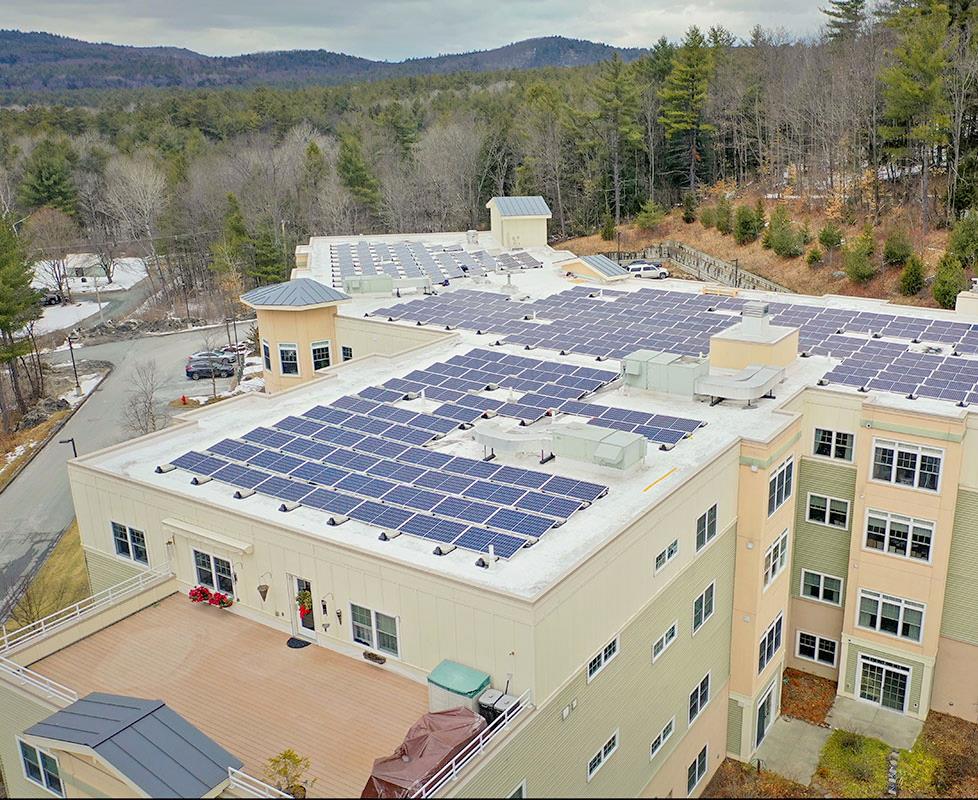
Cindy Jerome — ReVision did an array atop the Woodlands and we’re feeling good about our cost savings.
Solar Array at the Woodlands
Steve Christy: You did a project for Lebanon and recently merged with a company?
Dan Affeldt — about 1.5 years ago we brought Energy Emporium into our fold. Added jobs in Enfield and moved to a larger space.
Steve C asked about ReVision helping with Steve’s fountain project at the Glenwood cemetery, asking if Dan knew Patrick McCarthy.
Dan said he wasn’t aware of the project and would be happy to talk about donating a panel. Email address: Dweeks@revisionenergy.com
Steve Whitman: What about nuclear energy? How significant could nuclear energy be?
Dan — ReVision hasn’t taken a position. I think we should continue producing safe nuclear with appropriate regulations. But given regulations and apart from the opposition to nuclear power, it is today so expensive to build new nuclear capacity that it looks like the writing is on the wall for generation from other sources. Solar will decrease in cost to less than 2 cents per KWH for new construction.
Paul Tierney: Financing?
Dan — It makes most sense for a business to take advantage of the 36% tax credit and depreciate. Not-for-profits and public entities: best solution is usually a power purchase agreement whereby instead of coming up with cash to build, they buy the power from an array at a cost less than from the grid. After 5 years, they would have the option to purchase back from the investment partners; the investors are families and businesses willing to provide capital for a below-market return in order to support solar power.
Bill Secord: 2.5% is a sizable amount of land to use for solar and wind power generation. How do you approach siting issues and gobbling up such acreage?
Dan — I differ from the Stanford analysis. They project 2.5% total because they proposed that nearly half come from onshore wind – that is just NOT going to happen. We are too protective of our ridge lines. Offshore wind studies have shown that in the Gulf of Maine we have 200,000 KWH potential, six times the total energy production of all 6 NE states. The continental shelf allows siting far from shore and the ability to connect into existing coastal population distribution. When we do use land, we try to manage it for vegetation and animal use.
***********************
Bio for Dan Weeks, Director of Market Development