Bruce Pacht introduced our speaker -- the Upper Valley Jewish Community’s Rabbi Mark Melamut: Judaism 101: Being Jewish in the Upper Valley
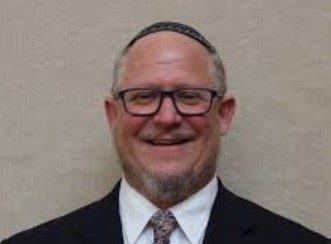
Rabbi Mark Melamut
Photo from the Roth Center for Jewish Life Web Page
Rabbi Mark Melamut joined the Upper Valley Jewish Community in August of 2018. Prior, he was rabbi for ten years at an egalitarian and conservative congregation in San Francisco.
Growing up in Mobile, Alabama, Rabbi Mark attended Jewish summer camp in Utica, Mississippi. He studied business at Washington University, St. Louis, Missouri.
With a Bachelor of Science in Business Administration and a minor in religious studies in hand, he moved to Burlington, Vermont, where he worked at the U.S. Immigration administrative office doing accounting work. The Green Mountains fed his soul for a few years before he decided to pursue a Master of Religious Studies at Yale Divinity School, following which he spent a couple of years in Israel for experience and study before entering rabbinical school.
While at the Reconstructionist Rabbinical College, Mark spent another couple of years studying in Israel. He earned his Master of Arts in Hebrew Letters and received rabbinic ordination in 2008.
Bruce was on the search committee which chose Mark after 10 months of a nationwide search and a couple dozen interviews. They thought he would be a perfect fit, and so far, their choice has been confirmed
Synopsis of Rabbi Mark talk:
This was his first time speaking to a Rotary Club. He enjoyed the “mantra” we repeated at the beginning of the meeting (the 4-Way Test), and he enjoys making new friends.
R. Mark started with an expansion on his bio: “How did I end up with the title “rabbi”?
In Hebrew, “rabbi” means “teacher,“ which is his main function. Of course, there are other roles including leading worship services, ministering at life cycle events, and teaching and studying with folks.
His path to the rabbinate was a long journey of figuring out what would bring more meaning to his life, and what he’s passionate about doing. He did some accounting and has relatives and friends who have found much meaning in that work – but he didn’t.
Mark grew up in the deep south with a strong sense of family but also a vague but persistent sense of being an “other,” a person always a bit on the margins. There were not many Jewish people around, and only 5 kids were in his Sunday school. Mark felt different but didn’t quite know why.
In college, Mark developed a curiosity about religion as a concept – How it frames and gives meaning to our lives. He studied both eastern and western religions.
After college, Mark did accounting in Burlington, but after 2-3 years, he still struggled with the internal question of what to do with his life. He took a Master’s in Religious Studies at Yale Divinity School where he was one of 3 Jewish folks amid 300 others studying. After finishing, he went to Israel to explore his own roots and there he found his commitment.
He attended rabbinical school upon his return where he pursued “the study of being a rabbi”. After completion, Mark lived in San Francisco where he worked part-time, and he and his wife raised their daughter for a couple of years.
So, here is Mark’s “Elevator Speech on Judaism.” He uses the “Idea of three Bs – Belonging, Behaving and Believing, stated in Rabbi Mark’s order of importance.
Belonging: This is defining oneself as any “-ish” -- part of a group where you find your affinity. Step 1 is feeling like you belong to the Jewish people or a Jewish community. Affinity happens in two ways (1) “I feel I’m Jewish,” or (2) having your status conferred by a community – (a) being born of Jewish parents, or (b) choosing to convert to Judaism.
Behaving: Where do we learn Jewish behaviors? Many are the same as anyone trying to be a good person in the world – care for others, acting morally, etc. Of course, there are some Jewish-specific rituals, holidays, and ethics which derive mostly from the Torah, sometimes called “the Hebrew Bible”: (the Five Books of Moses, the books of Prophets, and the Writings).
These are Judaism’s written scriptures. Next comes the Talmud, written down by ancient rabbis from 200-600 CE, and containing the essence of where our behaviors are from. The Talmud interprets the Torah. The ancient rabbis understood our religion would have to be portable.
Believing: There is one essential Jewish belief contained in the prayer called the “Sh’ma” which in English states this: “Hear! O Israel -- the Lord our God is ONE.” Judaism doesn’t assume to know what God looks like or how God appears in the world. In fact, there’s quite a bit of leeway in interpreting the ONEness of God but little else. Some think that even making a positive statement such as, “God is XXX,” is a step toward idolatry; God’s unexplained essence is one-ness. Another essential component of Judaism is the centrality of asking questions to obtain a deeper truth.
Rabbi Mark responded to a question he received before he came to speak. It concerned the Dartmouth campus climate for Jewish students, faculty and staff following vandalism of the menorah on the Green during Hanukkah – its glass lights were shot out by a BB or pellet gun. Mark said he was so far unaware as to whether the perpetrators were found. Several pastors shared concerns with Rabbi Mark; some said “Kids will be kids,” but many of us took it as a hurtful action done to one of our central symbols.
Anti-semitism is “something said or done against a Semitic people.” During the Middle Ages, it took on some particularly virulent forms. When R was about 10 years old, the large, intricate and beautifully engraved 15’ high wooden doors where he attended religious school were vandalized by a giant painted swastika, about half the size of the door. It was his first time ever, after feeling a little different, experiencing defamation of his place of worship. This was more than property destruction; he still can still see the image of red, dripping paint. His family had to educate him as to what it meant. R Mark can only remember 2 or 3 other incidents of anti-Semitism in his personal life. Unfortunately, the feelings don’t go away, even if it’s “just a prank.”
The act at Dartmouth was the first overtly anti-Semitic act in a long time. It reminds us that we are all here for each other, for the good of each other. If it happens to one group, it happens to another.
Part of Rabbi Mark’s mission is to be out and about and share a bit of what Judaism is. Let’s focus on the parts of what it means to be a Jewish person.
QUESTIONS
Cal Wolfe: A lot of us are re-thinking our relationship with the natural world, from control. Within Judaism, is there re-thinking of a relationship to the living and non-living world?
Rabbi Mark: There are many denominations of Judaism. There is a strong connection, and a particular emphasis in Judaism on the current moment in which we live, and how to create a nurturing environment around us in that moment. That perspective includes both the natural world and all of our human neighbors: the Torah says, “You shall love your neighbor as yourself.” Our focus is on the here and how, less about what happens after life.
Rabbi told a brief story about the importance of the “now” in Judaism: A questions was asked: “How should I act if I’m outside planting in my garden and the Messiah stops by my house? Do I finish planting or do I go greet the Messiah. The answer is this: “First finish your planting, and then go greet the messiah.” First pay attention to the world that IS in the moment you exist; then, of course, engage with the Messiah.
As to the “Afterlife” – Writings on it constitute one of the largest entries in the Jewish encyclopedia, mainly because there is little agreement and many perspectives.
Marilyn: What was it like for you in such a small minority at Yale Divinity? And, knowing that Christianity is the dominant religion in US, what makes it difficult for you when so many others have a different belief system.
Rabbi Mark: My Yale experience is crucial to who I am today. I chose the school over Jewish colleges because it was the best way for me to study my roots in comparison with others’ roots. It was stimulating, challenging and rewarding; my study of Christian theology from the very beginning formed important relationships. Such study compelled me to examine what Judaism had top say about the various topics which arose. Sometimes I felt very outside, other times I felt deeply engaged over the two years with other deeply-engaged students.
As to the effect of living under a “dominant” religion – It’s hardest because when I’m fully myself, I stand out, like wearing the yarmulke (skullcap) which leads people to make assumptions about who I am. So, I sometimes wear a baseball cap to avoid pre-dispositions!
Another thought: I never felt, until I went to Israel, what it felt like to be part of the dominant culture. Not being in that situation in the US forces me to engage in dialogue. I believe that’s the best we can do, especially when we come from very different political and religious places.
John Yacavone: What does a Rabbi do in his spare time?
Rabbi Mark: My life is mostly flexible except for Friday preparations for the Sabbath, and Sabbath itself on Saturday. Most of my work time involves meetings and writing. Free time: gardening is my latest favorite--after 3 years of work, the garden is starting to look good. I love being outdoors – hiking, biking, kayaking. I have an affinity for jazz and seek out opportunities to hear live jazz performances. I love to cook, and cannot wait to return to the movies!
Bill Secord – What is the Jewish community like on the Dartmouth campus? How healthy is it and what is their experience?
Rabbi Mark: Even with campus having been nearly all virtual this past year, Jewish student life is fairly robust. The Upper Valley Jewish Community (UVJC) is headquartered at the Roth Center for Jewish Life at Dartmouth, a facility we share with the Jewish student organization, Hillel. The UVJC has about 215 members with folks all over the Upper Valley. Our Sunday school serves about 50 students.
I found a much larger and more robust community here embracing very diverse practices within Judaism; there is lots of dynamism in this community. Mark is the UVJC’s first fulltime Rabbi; Hillel also recently hired its first fulltime Rabbi – these events show the communities’ growth
Jimmy Brock: There seems to be an increase in racism and anti-semitism in US and western world.
Rabbi Mark agreed that anti-Semitism is spiking. Many folks correlate this to what’s going on in Israel. Locally, the UVJC started a group seeking to understand how the UVJC and local Jews individually can we be better allies to those being oppressed, how we might break down barriers of anti-Semitism and racism. I think that building relationships and getting to know each other and seek commonalities is our best course for the future. Still, the outliers on the extremes, will make it hard for the rest of us.
Jimmy Brock: Would you say things are better or worse re: trend of Anti-Semitism – has it reduced or increased? Is this a spike or a change?
Rabbi Mark: I’ve watched the graphs. Today folks are saying we haven’t seen such activity since before WWII. Yet here in the Upper Valley, my kids feel much more positive about their position in their community.
Hank Clarke reflected that anti-Semitism and racism have been there all along, but recent political shifts in the US have brought them raging back.
Book for Children's Collection at the Kilton Library in honor of Rabbi Melamut
The book for Rabbi Melamut is In a Jar by Deborah Marcero.
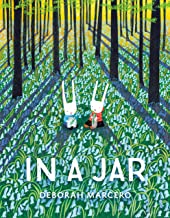
Here's a marvelous picture book, charmingly written and beautifully illustrated, about the power of memory and the magic of friendship.
Llewellyn, a little rabbit, is a collector. He gathers things in jars--ordinary things like buttercups, feathers, and heart-shaped stones. Then he meets another rabbit, Evelyn, and together they begin to collect extraordinary things--like rainbows, the sound of the ocean, and the wind just before snow falls. And, best of all, when they hold the jars and peer inside, they remember all the wonderful things they've seen and done. But one day, Evelyn has sad news: Her family is moving away. How can the two friends continue their magical collection--and their special friendship--from afar?
Llewellyn, a little rabbit, is a collector. He gathers things in jars--ordinary things like buttercups, feathers, and heart-shaped stones. Then he meets another rabbit, Evelyn, and together they begin to collect extraordinary things--like rainbows, the sound of the ocean, and the wind just before snow falls. And, best of all, when they hold the jars and peer inside, they remember all the wonderful things they've seen and done. But one day, Evelyn has sad news: Her family is moving away. How can the two friends continue their magical collection--and their special friendship--from afar?