Jane Mason introduced our speakers Janet Carroll, RN, CEN, SANE-A, SANE-P, Sexual Assault Nurse Examiner (SANE) Program Coordinator and Tori Nevel: Human Trafficking Manager for NH, New Hampshire Coalition Against Domestic and Sexual Violence

Janet Carroll, RN, CEN, SANE-A, SANE-P has been a nurse for 21 years working as an Emergency Department Registered Nurse and is currently the Nurse Manager of the Forensic Nursing Program at Dartmouth Hitchcock Medical Center and a NH Statewide SANE Program Director through the NH Coalition Against Domestic and Sexual Violence. Since she became a Sexual Assault Nurse Examiner in 2005 she has provided hundreds of exams in New Hampshire and Vermont hospitals. In 2014, Janet was able to expand the SANE program at DHMC into a Forensic Nursing program, providing specialized care to patients that have experienced domestic violence, vulnerable adult abuse, human trafficking, interpersonal violence and strangulation. Janet received national recognition and was named the Frontline Forensic Nurse of the Year by the International Association of Forensic nurses in 2019. She also received the Jennifer Pierce-Weeks Award of excellence in 2012 for her work as a SANE in the state of New Hampshire and received the Hands of Hope Award in 2016 in recognition of exemplary medical forensic care to child victims’ of crime.
Tori Nevel is the Human Trafficking Project Manager. Tori began her work in the violence prevention movement as a volunteer direct service advocate at WISE while attending Dartmouth College, where she served as Chair of the Student and Presidential Committee on Sexual Assault and as the Programming Director of The Movement Against Violence. She also interned with Senator Jeanne Shaheen before moving to Mumbai as a Lombard Fellow assisting the Society for Nutrition, Education & Health Action (SNEHA) in establishing and implementing Mumbai’s first crisis hotline. From there, Tori joined the EmancipAction India Foundation as their Research and Technology Manager, where she helped develop and evaluate mental health training for lay caregivers to increase quality and access to services for girls who have been sex trafficked. Tori earned her master’s degree through Erasmus Mundus MAPP, a consortium of European Universities specializing in Public Policy and Development.
Here is an image of what was shared at the end of their presentation.
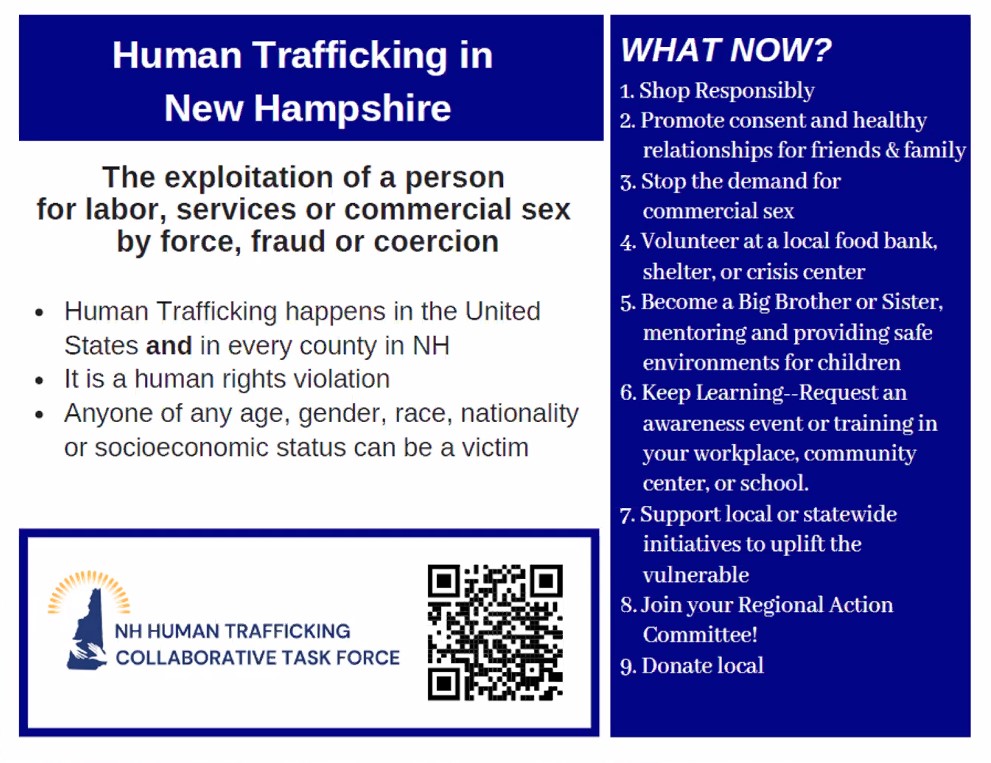
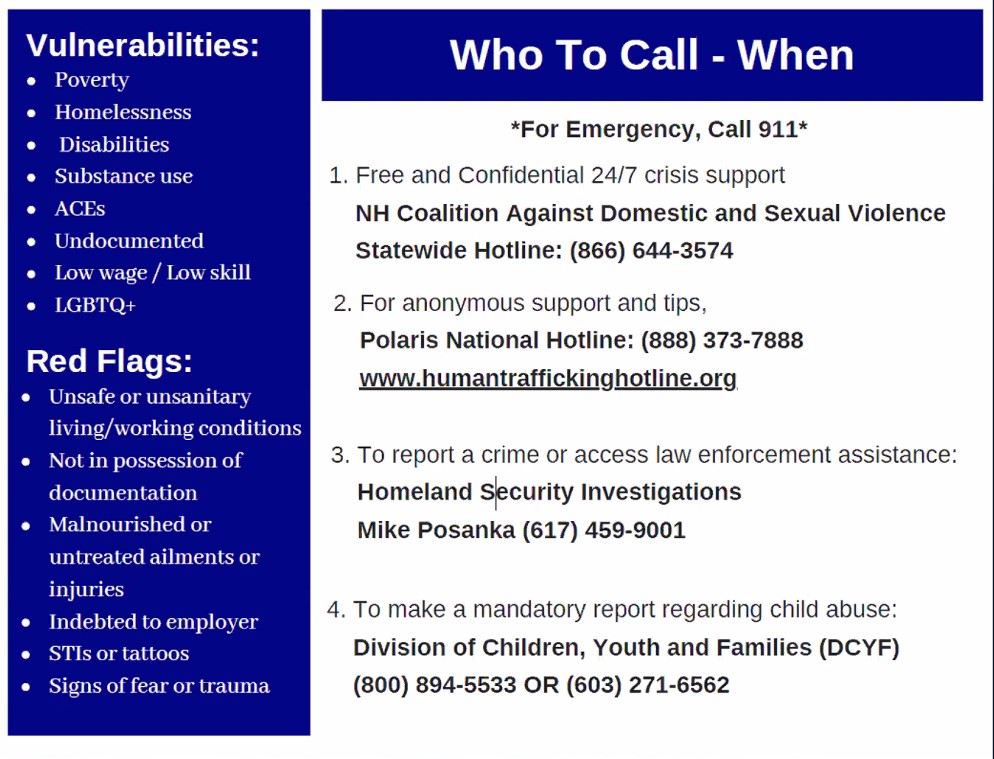
See more by clicking on Read More
SLIDE SHOW: Human Trafficking (HT)
Objectives of the presentation
- Learn the definitions and present 3 NH case studies
- How to identify sex and labor trafficking
- Risk factors
- Explore impact of HT
- How to effect change
What is HT? – Examples: Relatives taking children from village to city forced to work as laborers. Lots of familial trafficking in NH – it’s form of fraud, offering “a good opportunity for your child”; selling children for drug or rent money into sex work.
HT definition: “Recruit, harbor, entice, transport, provide, obtain, maintain persons through force, fraud, or coercion, to obtain labor, services or commercial sex act (“sextortion”).
“A-M-P” Model to analyze what’s happening
- Action – (In NH wasn’t illegal until the early 2000s)
- Means – force, fraud, coercion
- Purpose – involuntary servitude, debt bondage, peonage, sex trade
Under 18 – there is no legal way a person can consent to commercial acts of sex.
TVPA – trafficking victim’s protection act.
NH Cases:
- Bradley O’Dell – 2nd ever prosecuted human trafficking case in US history. Litchfield NH. Documents were withheld, people forced to work.
- Steven Tucker, Manchester last year. Using someone’s substance abuse problem against them, using drug dependence to commit illegal acts. Judgement: 252 months (20+ years!) in Federal prison and restitution to victims.
- Joshua Harwood – Concord. Soliciting students for sex videos, paying them for their videos.
Can intersect with domestic violence, child abuse, etc., but this is a new legal strategy to ensure that justice is brought.
HT affects persons of any gender, sexual orientation, economic class, race, education level, though certain groups are mor vulnerable than others.
Risk factors
- Immigration status
- Homelessness or poverty
- Runaway of missing children
- Juvenile justice/child protection/foster care involvement
- History of sextual abuse/assault
- Mental health ailments
- Gang involvement
- Substance use disorder
- Disability
- Online enticement, even online gaming
- LGBTQ+
Janet is seeing more drug involvement in the trafficking problems she’s seeing as a nurse.
Common industries
- Domestic service in private residences
- Construction
- Agriculture
- Manufacturing
- Service/hospitality (restaurants, clubs, hotels)
- Alternative economies (drug sales, informal day labor)
Tori: If someone agrees to sell drugs, they are committing a crime. If someone is forced to sell drugs, they are considered to be “under duress” and that’s HT. Those in positions of low pay, low skills, low level of education, less monitoring, transience, less interaction with the public are more vulnerable.
Recruitment (can be online)
- Gang-based
- Significant other
- 3rd party
- Family-based
- Survival-based
- Self-managed
Traffickers may
- Meet a victim’s perceived need
- Pose as a friend or significant other
- Use other youth
- Use physical violence
- Use threats and intimidation
- Groom victims
- Use false advertisements or promises
- Exploit a substance use disorder
Red flags – what warning signs might you see?
- Lack of pay or underpay
- Owe employer debt
- Documents withheld
- Physical, verbal, emotional abuse by employer
- Unsafe working conditions
- Constant supervision, restricted freedom of movement
- Lack of knowledge abou whereabouts or a given location
- Signs of stress or trauma: fear, isolation, hypervigilance
Intersection of I-89 and I-91 is a risk factor for our communities.
Red flags for sex trafficking in particular
- Chronic runaways or truants
- Gang involvement
- Having money or expensive things they couldn’t pay for or really young
- Fear, isolation, hyper-vigilance
- Lying about age, false ID lack of knowledge about location
- Multiple or frequent STIs or pregnancies
- Boy/girlfriend much older
- Unexplained physical conditions for age or unexplained injuries, fractures in different stages of healing
Seeing MULTIPLE of the red flags should set off alarms. In NH, we are mandated to report child abuse, elder abuse, and abuse of persons with disabilities. That means, the average person can be liable for NOT reporting observed or seriously suspected abuse.
Technology-facilitated trafficking:
- Bigger since the pandemic – people pretending to be others
- Websites and apps are always changing – examples we see today may be gone tomorrow.
- Facebook, Instagram to get in contact – then pulling victim into other sites to obtain more information to use against them
Warning signs of possible trafficking one might see in a person:
- Emotional, angry agitated or overly sensitive
- Changes in behavior, introverted, withdrawn, isolated
- Attempts to conceal online activity
- Social media accounts that are unknown
- Excessive amount of time online
- Lacking concern for themselves
- Suspicion of drug or alcohol use
Why might it be difficult to ID victims?
- Shame, feeling it’s their fault
- Worry about threats – immigration,
- Isolation
- Retribution
- Brainwashed
- Our own ignorance
- Becomes their “reality” their “normal”
Some potential larger impacts?
- Cycle of poverty, intergenerational trauma, bad individual reputation to overcome
- Financial
- Legal issues
- Immigration issues
- Severe trauma
- Health
- Shelter and other basic needs
- Safety
Also
- Vicarious traumas to service providers and loved ones
- Intergenerational trauma and heightened inequality
- Impact on our economy and society – worldwide $150 billion in profit: one-third from developed world!
Do we want to support companies using forced labor, the cheapest possible ways when other companies treating their people properly cannot compete on price?
What can individuals do to combat trafficking right now?
- Shop responsibly
- Provide consent and healthy relationships for friends and families
- Stop the demand for commercial sex
- Volunteer at a local food bank, shelter or crisis center
- Become a big brother or sister
- Keep learning – request an awareness event or training in your workplace
Lillian Marwa – In Kisii, Kenya we do have a respite center for women and children. We have a private hotline for the women and children.
QUESTIONS:
Will: What is the job of the trafficking task force? Education only? And how big are you?
Tori: Task Force started in 2007 with SB 194 – NH recognized HT problem and said, “Let’s look into it and determine if something could be done.” In 2009, HT was criminalized. Now, task force is focused on handling cases. We have victim advocates and NH State Police Homeland security and Merrimack County police. We constitute about 150 members divided into outreach, law enforcement/prosecution, etc.
Cal: What are you doing by way of prevention in terms of training, information dissemination?
Tori: Federal grant funding restricts how we can use Federal funds. WISE does training in schools about what is consent, what is a healthy relationship. We’ve sent information to prevention educators of sexual and domestic violence and encouraged them to talk about HT as well. We received a request from a private school – we can set up a prevention event like that. Tori feels we need more systemic prevention in the state.
Janet: Our goal within DHMC is to get the correct policies and procedures in place internally, then to reach out to our communities. We have a list of resources that we deliver to folks we suspect could use them.
Cal: Vulnerability of kids over the internet? Is it possible to enlist a research university in creating ways your message can appear unbidden to social media users as ubiquitously as advertisers?
Tori: TF doesn’t have the resources to match businesses advertising their processes. We do as much as we can re: social media. We’ve spoken to Dartmouth, UNH and Plymouth State – maybe we could make a proposal to MIT.
Marilyn: Jane Mason wanted to thank you both for presenting today.