Our speaker today was Rod Smolla, the President of Vermont Law and Graduate School.
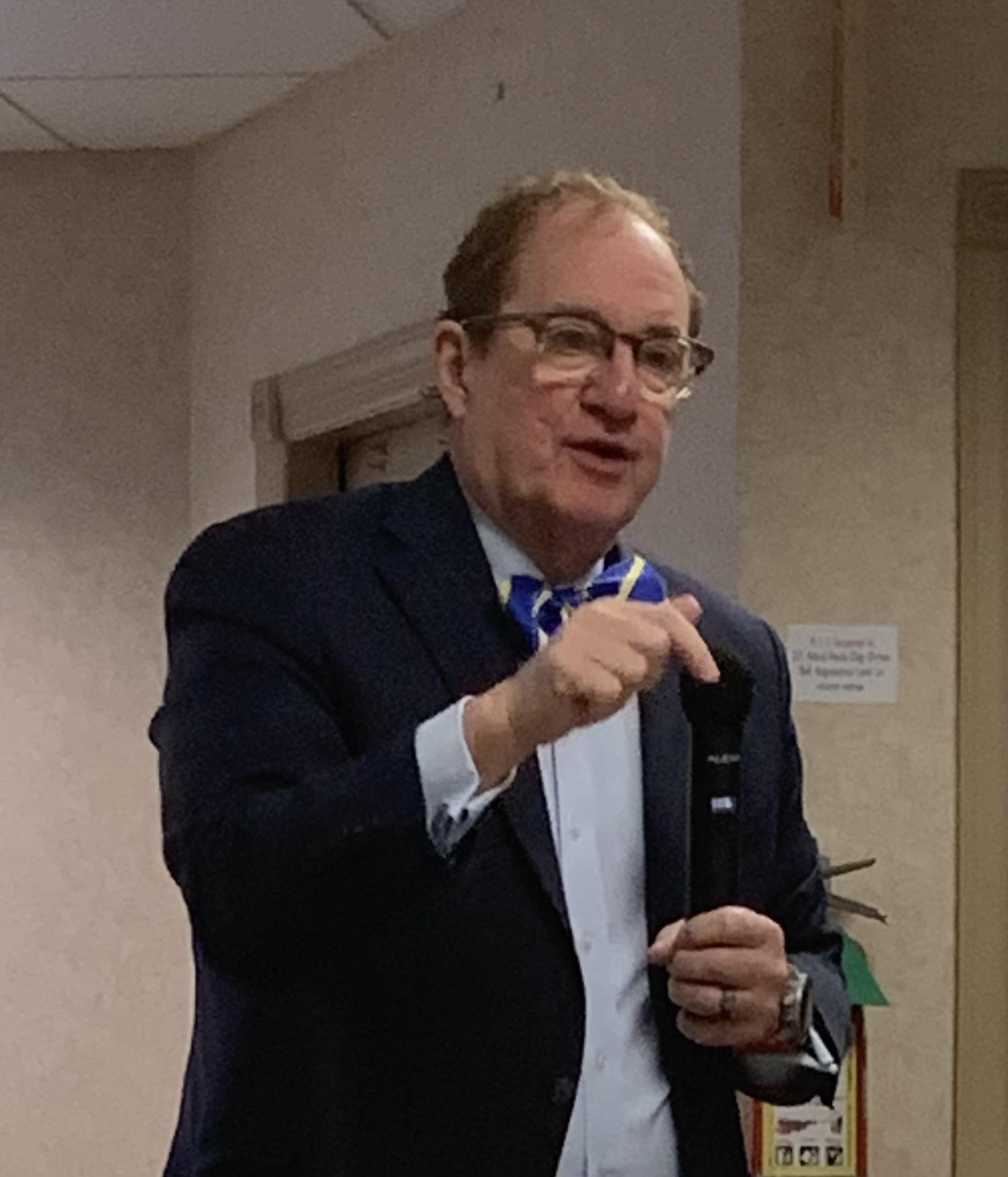
Rod Smolla
President Vermont Law and Graduate School
Rod began his talk sharing his connection to Rotary, and how Rotary was instrumental in connecting him to is wife, Anna, who joined him for his talk today. When he was in Mississippi, he was taking part in a pick-up basketball game. He was a point guard. The guys he was playing with wanted him to formally join their team. The only catch, he would have to join Rotary to be a part of the Rotary team. He joined the club. Once he graduated from Duke, he took a clerkship in Greenville, South Carolina. Once again he was asked to join the local Rotary club. He shared that although he would like to accept the invitation, he couldn’t maintain the attendance requirements. The Club decided that if he would agree to talk to the club periodically on various legal topics, they would waive the attendance requirements. He agreed to accept this as a membership requirement. On his way to a meeting where he was to speak, as he was riding the elevator to the meeting room, he met Anna. She had been invited as a guest…as you can guess the rest is history. Proving you can find love in Rotary.
President Smolla expertise is constitutional Law.
He shared that he would try to give us a 15-minute history of the Supreme Court. He did this by sharing 4 epoch periods of the Supreme Court and how the court has evolved over time.
#1. Founding period of approximately 30 years.
He focused on the court that had John Marshall and Joseph Story as early architects of the court. They had different political beliefs but found ways to come to consensus. They believed that they could read into the constitution items that were not there. They leaned to decisions that favored the federal government, and not the states. They focused on the power of government. They agreed that presidents could be served subpoenas. He sited the case regarding Thomas Jefferson and Aaron Burr. The courts did not focus on race, freedom of speech, women’s rights, civil rights/liberties. They determined that Native Americans did not own their land. They gave discretion to the executive branch of government. They focused on the national economic marketplace.
#2. From year 30ish to 1936
Court decisions moved from elevating the federal government to being more focused on giving rights to states. The approach to interpretation of the constitution turned to a literal approach to constitutional principles. Antitrust law were struck down. The court began to focus on civil liberties and deemed that “separate but equal” was an okay concept. There was limited protection of freedom of speech. People could go to jail for issues of speech. Women still didn’t have rights. Women were restricted from having careers in the law. Capitalism took precedent. The court struck down New York cases about setting minimum wage and limiting the hours of work.
#3. Beginning around the time of the stock market crash/the dust bowl going to 2020.
As new agencies were proposed, the court began to “smack” them down. Roosevelt was upset that many of his new deal ideas couldn’t be implemented. At this time, he began a campaign to add Justices to the Supreme Court. He proposed adding up to 15 Justices, and that once a justices reached 70 years of age, a new justice could be added up to 15. This didn't happen, but over time, “new dealers” were added to court. Decisions the court made began to change. There were more expansive views of the Federal Government. Rulings were made in favor of civil rights and civil liberties. There were robust protection of women’s rights. Many decisions focused on protection of privacy, e.g. Roe v. Wade; LGBTQ+ rights, religion, Miranda rights. Federal agencies could make rules with approval of Congress.
#4. Since 2020.
There has been a retraction of ruling made pre-2020. Limits have been placed on the Executive Branch. The court has favored having Congress make laws, rather than leaving decision to all the “alphabet soup” agencies, e.g. EPA, FDA, OSHA, ATF, CDC, etc. Even though Congress may not be the best content expert for these agencies. Having Congress in charge can result in delays as Congress members are often at odds with each other and won’t make decisions or come to consensus around issues. At this point in time it seems the court tends to believe that laws require respect, but they don’t have to continue to follow them based on precedent.
Final thoughts:
- Should the Supreme Court have a strong code of conduct/ethics? The Supreme Court is the only arm of the justice system that doesn’t have a code of conduct.
- Should the Justices keep in mind how disruptive a decision will be?
- If you have Netflix, you may want to watch the film, Rustin, and focus on the role of Adam Clayton Powell in civil rights movement. Adam Clayton Powell Jr. was an American Baptist pastor and politician who represented the Harlem neighborhood of New York City in the United States House of Representatives from 1945 until 1971
BIOGRAPHY from the Vermont Law and Graduate School web Page
Officially beginning his term as president of Vermont Law and Graduate School on July 1, 2022, Rodney Smolla joined VLGS from Widener University Delaware Law School, where he served as dean and professor of law since 2015.
Previously president of Furman University, and dean at Washington and Lee University and University of Richmond law schools, Professor Smolla has long been a strong advocate for experiential learning, the development of professional competencies, and civic engagement.
Professor Smolla brings to VLGS extensive experience in higher education leadership, with a special focus on strategic and operational planning, enrollment management, and fundraising. After inheriting a nearly $6 million annual operating deficit at Delaware Law School, he will leave the institution with $5 million in budget surpluses, achieved in large part due to dramatic increases in JD enrollment as well as creative revenue generation in non-JD programming.
He has been a faculty member at the William & Mary, DePaul, University of Illinois, and University of Arkansas law schools, and a visiting professor at law schools at Duke, University of Georgia, University of Indiana, Denver University, and University of Melbourne. Additionally, he has served as the director of the Institute of Bill of Rights Law at the College of William and Mary, and senior fellow and project director of the Washington Annenberg Program of Northwestern University. He currently serves as the chair of the AALS Committee on Academic Freedom and Tenure and in 2011 he was appointed by the governor of South Carolina as a commissioner on the South Carolina Commission of Higher Education, which included within its mission the oversight of all of South Carolina’s public universities and colleges, and licensure and programmatic approval for all public and private educational programs within the state.
Professor Smolla has been and remains an active litigator. He is particularly well-known for his representation of American and international clients on matters relating to defamation and invasion of privacy. He is admitted to the Illinois, Virginia, and Delaware bars, and he has participated as counsel or co-counsel in many litigation matters, in state and federal courts throughout the nation. He is a frequent advocate on a wide variety of legal issues, and has presented oral argument in state and federal courts across the country, including the Supreme Court of the United States.
The author of more than 100 articles published in law reviews and other publications, he is a nationally known scholar on matters relating to constitutional law, civil rights, freedom of speech, and mass media, particularly matters relating to libel and privacy. He is the author of five multi-volume legal treatises, all published by Thomson Reuters, updated twice annually: "Law of Defamation; Smolla and Nimmer on Freedom of Speech"; "Rights and Liabilities in Media Content, Internet, Broadcast, and Print"; "Federal Civil Rights Acts"; and, "Law of Lawyer Advertising." Among the many trade and university press books he has authored are "Suing the Press: Libel, the Media, and Power" (Oxford University Press 1986) (won ABA Silver Gavel Award Certificate of Merit); "Jerry Falwell v. Larry Flynt: The First Amendment on Trial" (St. Martin’s Press 1988); and, "Deliberate Intent: A Lawyer Tells the True Story of Murder by the Book" (Crown Publishers 1999), which was made into a television movie by FX, with Timothy Hutton playing the role of Smolla.
A first-generation college student, Professor Smolla received his JD from the Duke University School of Law and his BA cum laude from Yale University.