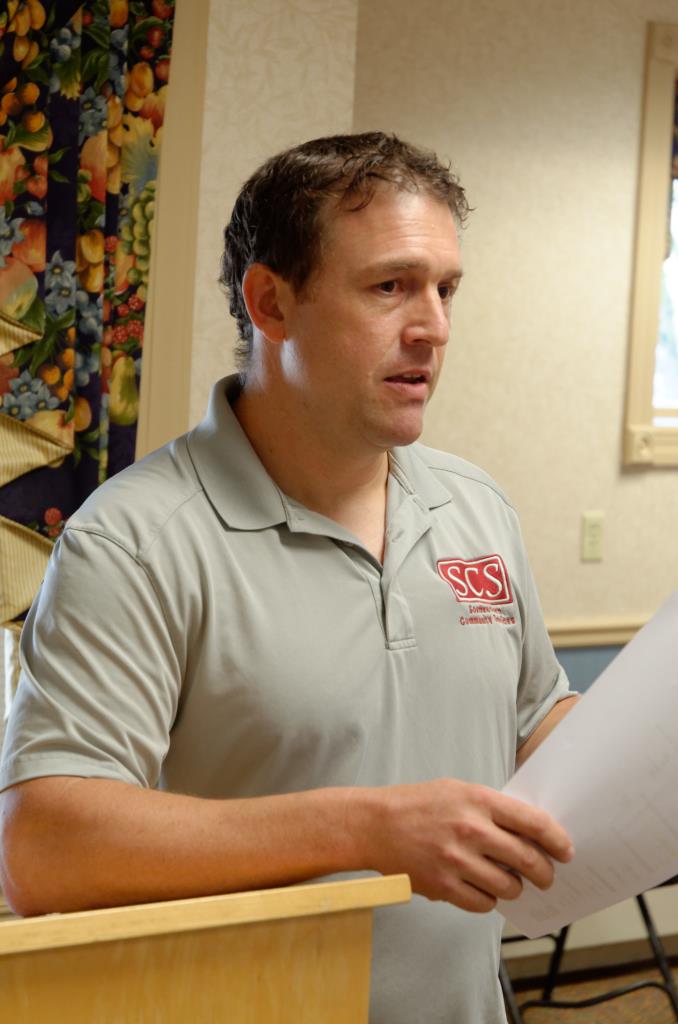
Craig’s remarks:
Craig started is talk by sharing the he has a deep sense of humor because, "I’m a social worker; no one ever comes to me to say, 'Hey, Craig, my life is terrific'.” He shared that those who do this work see tragedy every day. He finds that humor can help him deal with the difficult situations he sees and hears about daily.
He asked us to have a look at some statistics he had placed on our tables. They showed who was homeless and how many in his area plus other demographic information from January to December 2020 for the Claremont area, the closest to Lebanon in his organization’s catchment area. He then shared that he hoped we could have a dialogue about homelessness by having our members ask him questions. It only took a moment for JoAnn Lemieux to start with by asking a question.
QUESTIONS:
JoAnn Lemieux — Do you have dry and wet shelters? JoAnn shared a story about a acquaintance who struggles with alcohol and drug addiction. She is homeless, and finding a totally dry homeless shelter is not something she has found.
Craig — We operate with the goal to provide shelter whenever possible. We don’t hold anything against people, but folks on the sex offender registry cannot be served by us. As long as individuals aren’t taking drugs or drinking alcohol on shelter grounds, we let them in. NH doesn’t haver “dry shelters” because the funding doesn’t allow it. If you are struggling for a place to sleep, we will serve you.
On average, we serve upwards of 42 people per night. Presenting problems include mental illness, substance abuse, various negative physical conditions, and persons of all ages and all genders. We hired a second-shift staff member to supervise during the “naughty hours” of 7-10 pm. These are the hours when drugs and alcohol can find their way into the shelter.
Bill Secord — Why did the percentage of females served rise so dramatically?
Craig — Our partners in spousal abuse prevention had some staffing problems. This may have contributed to a rise in female homelessness. Also, another community partner lost capacity. In general, we do see a trend that single people outweigh families, with men the highest population, though I agree the percentage of women served is rising.
Hank Clarke — You noted a large percentage of adults with zero income. What about the governmental safety nets?
Craig — This is the KEY ISSUE. We are only a band-aid not a long-term solution. We provide EMERGENCY housing. What we are learning is that there is a social breakdown on all sorts of levels. Of the 113 adults we serve 102 have a disabling condition. This is not “pulling oneself up by your bootstraps,” These are folks who don’t have bootstraps or who cannot do the pulling themselves. Most alcoholism we see is secondary to a primary disabling condition. Mental health problems are the primary conditions associated with homelessness from our perspective.
If you haven’t worked for several years, you may not qualify for social security assistance. Or, you may not want the stigma of entering a mental health facility. Sometimes, it can be almost insurmountable to apply for assistance. And then, even if you get $800 a month, you cannot rent a single bedroom in Keene for that amount. We just had a Central Square building previously housing many of our folks where the rents increased to more than $1,000/month – obviously impossible to rent on $800/month.
There used to be a state aid called “APTD” [Aid to the Permanently and Totally Disabled] which apparently is no longer. The SSI program has rules that make it so that you cannot ever make enough to get on your feet. SSDI (Social Security Disability Income) requires that you have done 40 quarters of work; then, you can get around $1300-1400/month.
NH Municipal Organization article, State Cuts Squeeze Local Welfare Budgets
The New Hampshire legislature made a substantial change in the eligibility requirements for APTD (Aid to the Permanently and Totally Disabled) cash benefits, the state disability assistance program, that may result in an influx of applicants for local welfare assistance over the next several months. Under RSA 167:27, no person who is receiving APTD cash assistance from the state is eligible to receive local assistance except medical and surgical assistance. (Receipt of APTD medical assistance only does not disqualify a person from local assistance. See Smith v. Franklin, 159 N.H. 585 (2010).) Included in HB 2, the "trailer bill" to the state's budget bill that passed at the end of June...read more at https://www.nhmunicipal.org/town-city-article/state-cuts-squeeze-local-welfare-budgetshttps://www.nhmunicipal.org/town-city-article/state-cuts-squeeze-local-welfare-budgets
Rudy Fedrizzi — What is the effect of the eviction moratorium going away?
Craig — It’s a double-edged sword. There is some good in having a reasonable eviction rate – evictions open apartments. With the moratorium, we’re seeing an increased length of stay. Average was 58 days in 2019, and that was “smokin’ fast”. In 2020, stays lengthened to an average of 130 days and it’s getting longer. NHPR said that NH is working up to only a <1% rental vacancy rate. With higher vacancies, competition forces landlords to lower their prices. Today, if you cannot afford a unit, you have no place to go.
We have been using the “NH Emergency Rental Program.” We’ve been paying out $100-125,000 each month, paying current and back rents. Half of Craig’s program needs the rents to keep running and the other half goes out to pay landlords.
Rudy Fedrizzi — What effect have you seen from the national Build for Zero program? Is it a pipedream to eliminate homelessness altogether?
Craig — The idea modified to become “almost zero.” The government put up a huge amount of money to help homeless veterans. Homelessness will never totally disappear. The key is to balance the number of new homeless persons entering the system with previously homeless persons becoming housed. We need enough resources to get people involved right away when they come in. Also, permanent housing programs need to be better funded.
Ernst Oidtmann — Prevention question: What’s the educational level of your clients? How many years of education have they had, and would it help to keep kids in schools?
Craig — We have no such statistics. We used to track a lot of “causes” for folks coming into the shelter, then US Department of Housing and Urban Development proclaimed a focus on “Housing First” — because it doesn’t matter what a person’s level of education or level of drunkenness is. We know that other parts of the system are failing. In the old days when we did track education, it averaged about 8th grade.
Ernst Oidmann — Vaccination rate of your clients?
Craig — More than USA – about 95%. NH did an “incredible” job, eventually. They gave us pamphlets and videos, trained us in conversations. We snuck in our staff – 10% of each release of vaccine was allotted to the “vulnerable” population, so we sent our staff to clinics.