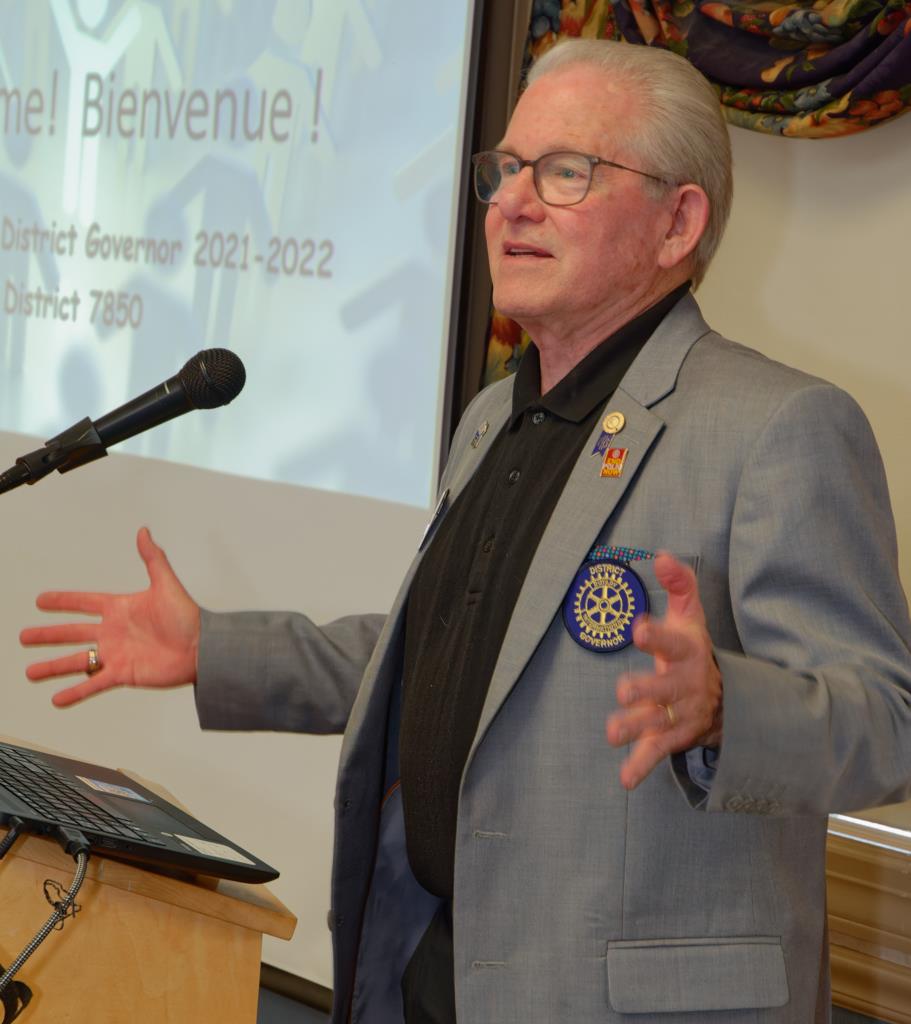
DG Mike Carrier
DG Mike Carrier focused his remarks on Rotary Internationals new vision statement and four major priorities. He hoped by the end of his talk we would have a better understanding of the role each club has in enacting each of the priority areas. He provided a 30,000 foot view of Rotary, and then shared a personal story of how Rotary created change in his life.
Mike reflected on his belief that Rotary International is the premier international service organization that continually works to change and safe lives her at home an around the globe. Rotary's vision is:

Mike asked us to focus on the words that are capitalized, TOGETHER PEOPLE CREATE CHANGE. It is his belief that our clubs will create positive change in their communities, and in turn, each of us will see change in ourselves. It is the changes we make that add value to our Rotary membership. He then moved on to Rotary four priority areas. For Rotary to be successful in this century we need to:
- Increase Our Impact. To be people of action we need to become effective problem solvers. He believes we demonstrated this as we have worked on strategies to eradicate polio.
- Expand Our Reach. To be people of action we must inspire others. Through our work at home and around the globe, we should be able to bring in more members to RI.
- Enhance Our Partnerships, To be people of action, we must strive to understand the needs of others. We are encouraged to create partnerships with like-minded organizations in our communities. Many hands will make light of the work. All of the work to eradicate polio wound not have been possible with partnerships with UNCEF, WHO and the CDC. Rotarians must continue to establish effective partnerships to do bigger and more effective projects.
- Increase our Ability to Adapt. People of action are inventive and entrepreneurial and resilient. Think of all the changes that have happened in our clubs as a result of Covid-19. We have the ability to change and adapt, and we must continue to reshape Rotary to make it a stronger service organization.
Rotary’s core values represent the guiding principles of the organization’s culture, including what guides members’ priorities and actions within the organization. Values are an increasingly important component in our action planning because they drive the intent and direction of the organization’s leadership. Our core values include fellowship, integrity, diversity, service and leadership.
After reminding us of Rotary's vision, priorities and values, DG Mike shared his personal journey of understanding how clubs can make a difference here at home and around the globe. For Mike he came to understand this on service trip to Nicaragua. His club in New Jersey in partnership with a club in Plattsburg, NY traveled to Nicaragua to see a global grant project they supported to put in 150 latrines in a village. In the process of doing their tour of the latrine project, they learned of even more projects that were needed in this community, especially helping to complete the construction of two classrooms, and to install new latrines for ones that hadn't been functioning for years at the school. Of note, this was for a school that was named after our founder, Paul Harris. His club committed to do the projects at the school. He knows that as a result of the grants they did in Nicaragua, Rotary is changing and saving lives.
As DG Mike completed his talk, he challenged the Rotary Club of Lebanon to reflect on our hopes and dreams for changing and saving lives in Lebanon. We shouldn't worry about failures, but worry about not doing service that is needed. He assured us that during his term in office, he and the district's leadership team is available to help us succeed. As the James Taylor song lyric goes, Just call out my name, and I'll be there to help your club.
Short Bio For Mike Carrier
Michael Carrier, District 7850
Plymouth Rotary Club, NH
Mike first joined the in the early 1980s. When he moved to Ramsey, New Jersey, in May, 2001, he rejoined as a member of the Bergen Highlands/Ramsey Rotary Club where he served as its President in 2006-2007. He then served for three years as an Assistant Governor in District 7490. “Retiring” to New Hampshire in 2010, Mike transferred his membership to the Plymouth Rotary Club and served as its President in 2012-2013. He served in District 7850 as a member of the Foundation Committee and as Assistant Governor (2018-2021).
Born and raised in Pasadena, California, Mike attended the United States Air Force Academy, earning a B.S. degree in Political Science. Following graduation, he served on Active Duty for five years with various intelligence organizations in Dayton, Ohio, and Karamursel, Turkey. In September, 1974, he began studies at Princeton Theological Seminary where he earned a Master of Divinity and, upon graduation, was awarded a fellowship to study Reformation History in Edinburgh, Scotland. Ordained to ministry in the Presbyterian Church (U.S.A.), Mike has served congregations in Scotland, New Jersey, California, Colorado and New Hampshire, as well as serving as the Rocky Mountain Regional Director for Church World Service, the International Relief and Development arm of the National Council of Churches. He currently serves the New Hampshire Conference, United Church of Christ, as a Search and Call Consultant, assisting congregations in their search for new pastoral leadership.
Kilton Library Children's Collection Book
The book for Mike Carrier is Maria Sibylla Merian: Artist, Scientist, Adventurer by Sarah B. Pomeroy and Jeyaraney Kathirithamby.

A 2018 Moonbeam Children's Books Gold Award Winner!
In 1660, at the age of thirteen, Maria Sibylla Merian (1647-1717) began her study of butterfly metamorphosis—years before any other scientist published an accurate description of the process. Later, Merian and her daughter ventured thousands of miles from their home in the Netherlands to the rainforests of South America seeking new and amazing insects to observe and illustrate.
Years after her death, Merian’s accurate and beautiful illustrations were used by scientists, including Carl Linnaeus, to classify species, and today her prints and paintings are prized by museums around the world. More than a dozen species of plants and animals are named after Merian.
The first Merian biography written for ages 10 and up, this book will enchant budding scientists and artists alike. Readers will be inspired by Merian’s talent, curiosity, and grit and will be swept up in the story of her life, which was adventurous even by today’s standards.
With its lively text, quotations from Merian’s own study book, and fascinating sidebars on history, art, and science, this volume is an ideal STEAM title for readers of all ages and interests.
In 1660, at the age of thirteen, Maria Sibylla Merian (1647-1717) began her study of butterfly metamorphosis—years before any other scientist published an accurate description of the process. Later, Merian and her daughter ventured thousands of miles from their home in the Netherlands to the rainforests of South America seeking new and amazing insects to observe and illustrate.
Years after her death, Merian’s accurate and beautiful illustrations were used by scientists, including Carl Linnaeus, to classify species, and today her prints and paintings are prized by museums around the world. More than a dozen species of plants and animals are named after Merian.
The first Merian biography written for ages 10 and up, this book will enchant budding scientists and artists alike. Readers will be inspired by Merian’s talent, curiosity, and grit and will be swept up in the story of her life, which was adventurous even by today’s standards.
With its lively text, quotations from Merian’s own study book, and fascinating sidebars on history, art, and science, this volume is an ideal STEAM title for readers of all ages and interests.