Round One - District 7850 Speech Contest

Kimball Union Academy Rotary Club Speakers
Libby Kotei-Fearon
Our first speaker is Libby Kotei-Fearon, a junior at Kimball Union Academy. She hails from Accra, Ghana, in the western part of Africa. She is a STEM Scholar and outside of academics her interests include: singing, being a part of the annual winter musical, soccer, softball, taking leadership roles in the form of proctoring and clubs and being a part of the Campus Activity Board. At the end of speeches, Libby went on to tell us that she was a shy, timid student who has grown into a social butterfly at KUA. She is committed to helping new students to having some of the opportunities she has had to grow through a variety of experiences; and work to develop confidence. She plans to attend college in the USA. Bruce Pacht asked both students what food they missed from home, and what food in the USA has become a favorite. Libby described the food she misses is a bean and rice dish (Waykee). She is now very fond or Sushi.
Jintao Yue
Up next, we have Jintao Yue, also a junior at KUA. Jintao’s from Tianjin, China, and he has great passions in acting, singing, video-production, and public speaking; above all, he is very dedicated to being a global citizen. Following his talk, Jintao shared he loves performance arts and looks for opportunities, like our speech contest, to find his voice. He reinforced that he lover the performing arts and public speaking. He believes he will stay in the USA for college. Again, Bruce Pacht asked both students what food they missed from home. Jintao is missing dumplings. He then shared that he really likes cheeseburgers and onion rings.
Libby and Jintao used the Rotary 4-Way Test as the foundation of their speeches.
This is a short excerpt from Libby Kotei-Fearon:
Well, during the summer of 2020, I was fortunate enough to have worked with a company called Suit up Corporation. One of their core values is to train young adults to nurture their talents in marketing, design, and strategy. In groups of five to seven students, we had to work together to strategize, market, and design a new product for a company in four days. Throughout my five-week stay with Suit up, I discovered my love for marketing, made friends with teens who are as ambitious as I am, and became an ambassador for Suit Up. This program did not only prove to be beneficial for me, but for all the participants who put their heart and soul into their projects and learned a skill that would give them an edge in college.
Local Rotary Clubs could also do the same for their students. Firstly, they could partner up with teachers, entrepreneurs, medical personnel, music instructors, and many more to organize online programs in different fields of interest for students. It could range from a program in the field of music theory to a program in linear algebra. Every week, students would be grouped based on their interest to collaborate on a project. That would be the Rotary’s way of fostering new friendships but at the same time helping their students to cultivate the spirit of collaboration. Secondly, keeping in mind the core values of the Rotary Club, students will still be encouraged to do what they can to aid the less fortunate in their communities.
Students in the same locality could meet in small working groups of three to four students to maximize social distancing. Students would make food packages to hand out to the less privileged in their community. They would also educate their society on the importance of doing their part in contributing to the fight against COVID-19.
This is a portion of Jintao Yue's speech:
“Loser!” “Sissy!” “Boys will be boys!” “Pink is a girl’s color!” “Dude, you’re still a virgin?” “You cry during movies?” … According to a survey done by non-bullying.gov, more than 61% of young men aged 18 to 24 living in the United States have heard those phrases. Toxic masculinity, a term coined by professor Shepherd Bliss in the 1980s, was first used to dissociate negative traits from positive aspects of masculinity. As the Good Men Project defines it, “Toxic Masculinity is a narrow and repressive description of manhood, designating manhood as defined by violence, sex, status, and aggression.” Have you ever witnessed a man making sexist jokes to women, or a man being unwilling to show his emotions because he believes it demonstrates weakness and femininity? If so, you just witnessed behaviors of toxic masculinity…
… Perhaps actions of toxic masculinity are in response to a world rapidly changing to benefit more than just males. By trying to maintain the power of patriarchy, toxic masculinity reassures men’s dominant position in society while excluding groups such as gender non-conforming people and women. But just like the term has suggested, toxic masculinity can be extremely toxic to the development of our society. By limiting the definition of masculinity, we are limiting the possibilities of our own future, which creates no benefit to us at all. So where do we go from here? Professor John Pryor, in an article in The Atlantic says, quote “Toxic masculinity can be diminished if the social setting has no normative pressure to do it. While trying to prevent the fixed judgments towards a gender, we should also realize that people with a mix of positive masculine and feminine psychological traits are more flexible, competent, and mentally healthy than their masculine or feminine counterparts.” Unquote. Imagine the potential for building goodwill and better friendships in a world where we embrace positive masculine traits. I am going to work towards this goal, and I hope that the Rotary Club can help everyone achieve this end.
Both students challenged us in different ways to consider the role of Rotary in supporting students at this moment in time. We congratulated them on being a part of this event.
We also learned that when it comes to exploring colleges, both are doing most of their visits virtually.
Our judges will be meeting on another Zoom meeting to select the winner of this round of the speech Contest.
Kilton Library Children's Book Donation
The book this week for Libby Kotei-Fearon and Jintao Yue is Bear Goes Sugaring by Maxwell Eaton III:
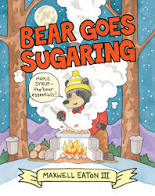
Did you know that it takes forty gallons of sap to make one gallon of maple syrup? "How many pancakes can I eat with that gallon?" wonders Dog.
Every step of the process of making maple syrup is covered in this sweet (but never saccharine) informational picture book by Maxwell Eaton III, the creator of the popular "Truth About" series. It begins with Bear assembling the tools she'll need for the project, continues with a discussion of the types of maples found in the area and why sugar maples are best for tapping, then on to drilling, tapping, evaporation and at the end of the process, real maple syrup and best of all, PANCAKES!
Along the way there are hilarious asides from increasingly ravenous Dog and Squirrel, making this a book as funny as it is informative. Helpful back matter and suggestions for further reading complete the package.
Every step of the process of making maple syrup is covered in this sweet (but never saccharine) informational picture book by Maxwell Eaton III, the creator of the popular "Truth About" series. It begins with Bear assembling the tools she'll need for the project, continues with a discussion of the types of maples found in the area and why sugar maples are best for tapping, then on to drilling, tapping, evaporation and at the end of the process, real maple syrup and best of all, PANCAKES!
Along the way there are hilarious asides from increasingly ravenous Dog and Squirrel, making this a book as funny as it is informative. Helpful back matter and suggestions for further reading complete the package.