Wally Cole offered our invocation to a relatively sparse crowd, although Mark Bring and Keith Olson joined us virtually. Our Student Guests from the High School, all seniors, were introduced by Dave Johnson. Isaac Maack is the son of Greg and Jody, plays football and basketball and has not decided between going out for track or golf; he is considering attending one of three colleges next year. Nolan Wedll's parents are Ben and Amy and he plays hockey, is on the student council and has been a dance participant as well. Nolan is going to pursue an engineering degree at UMD. Matthew Tuel is the son of Rachel and Patrick, participates in soccer, swimming and track and plans on attending the U of M at Morris.
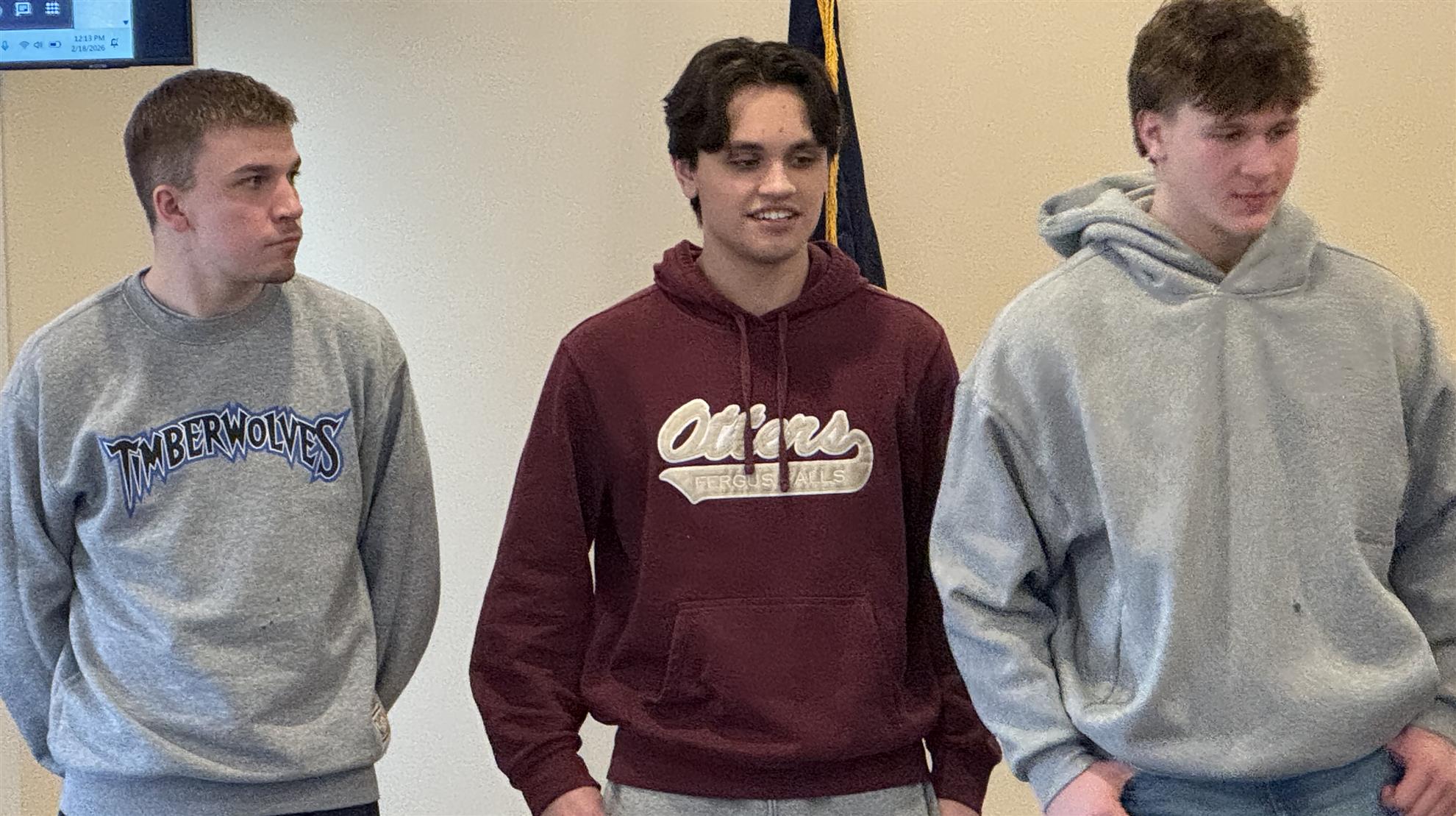
President Ryan started out the bragging to tell us his daughter had a writing assignment to describe how different communities went about fixing their problems and one of her subjects was the need for day care in Fergus Falls and the upcoming Pioneer - Habitat for Humanity undertaking. He also said he and his wife had a great time retreating to their cabin for four days and that he had plans to attend a UND - St. Cloud State hockey game. This writer talked about a chapter for a book on real estate transactions he had finished working on just before the meeting started and of being happy to be done with that. Lisa McFarland paid for missing a few meetings, saying she was with her dad who had open heart surgery and that he was recovering well. Mary Pettit talked about the Home & Garden Show being put on by Leighton Media at the Bigwood Event Center on March 13th and 14th and that Trilogy Real Estate was going to be participating. She also bragged about Nolan, one of our Student Guests, indicating he is quite the dancer and, I believe, suggested his participation may in part have been influenced by a girl friend who also dances.
Lois Josefson Russell introduced our speaker for the day, John MacFarlane, relating some of her own recollections that concluded by appropriately describing him as a "pivotal presence in the growth of Otter Tail Power." Lois then called upon Cody Odland with whom she worked to present programs on the history of our community during February, with Cody moving the day's presentation forward and introducing John. John was president of Otter Tail Power from 1982 to 2002 and led the company through a significant effort at diversification and its ultimate transition to OTP Corporation. But John took us back to the beginning, with the company formed in July of 1907 by four individuals, led by Vernon Wright. He was the one who had the vision to harness the Otter Tail River for electricity. At the time, 25 years after Thomas Edison's first electrical distribution system in New York, most communities had their own electrical systems and they were not interconnected. On April 1, 1909, the first energy came out of Dayton Hollow Damn, now known as Broken Down Damn and the company proceeded to build more damns. Its first transmission line ran to Wahpeton and the next to Morris, reaching as far west to the Missouri River Basin north of Bismarck in the early 1920's. Things were really tough from 1932 to 37, principally because of the nationwide drought, and Otter Tail stopped paying dividends for the first and only time. Dividends resumed in 1938 and the company has not missed a quarterly dividend, nor have dividends been decreased, since then. The 1940's were another period of expansion, adding three or four communities and also what was called the "Interstate Properties" - U.S. Highway 2 north to the Canadian line. The demand for electricity really went up after World War II and the company went about building generation facilities. Cy Wright became president in the 1950's and he wanted to build a general office but said the company wouldn't built it in a town that it did not serve; that led to OTP purchasing the City's distribution system in 1953. The general office was built in 1955 and still stands on Mill Street, attached to and north of the River Inn. Hoot Lake II and III, 53½ megawatts and 80 megawatts respectively, were built, with the latter being the last steam generated electric plant the company built on its own.
John described 1961 as a watershed year in the company's management as until then Vernon Wright or his two sons had served as its presidents. In April of 1961, Al Hartl took over, a military man, described as authoritarian and loud of voice in approach. That same month, Bob Bigwood, head of personnel, went to UND and interviewed graduating engineering students for employment, with John the only one hired from the school at the time. In 1969 OTP joined a group building a huge transmission line from Winnipeg to Grand Forks, as the Canadians were developing hydro on rivers that drained the center part of the continent. Otter Tail Power bought a lot of the power, at a very good rate, for quite a while. In 1975 the Big Stone plant came online, with OTP having a 50% interest, with the other half shared by two other utility companies. In 1975, Bob Bigwood became president. In the 70's the Lakehead pipeline was being constructed with pumping stations that demanded electricity located about every 25 miles. For a time, Lakehead was purchasing up to one-fourth of OTP's electricity. Then came the oil embargo, with gas prices jumping from 75 cents in 1975 to $1.50 in 1980. In 1981 the Coyote station near Beulah, N.D. went online, owned by four companies including OTP. That year Bob Bigwood also announced an orderly transition in the company's leadership, with John becoming president in 1982. That was a difficult year for the electric utility industry as it had been averaging a growth rate of between five and seven percent a year but that declined to around two percent with the national emphasis on conservation. That was a big problem for investor-owned utilities since if you were not selling more energy, it was difficult to increase profits. During the 80's the utilities attempted to ring every nickel and dime out of their companies. One thing Otter Tail did was to buy back stock so there were fewer shares on which to pay dividends. Like other similarly situated companies, it also looked to acquisitions and diversification to survive. While OTP could have been purchased, that was not the route chosen and instead OTP looked for good investments, buying its first four companies in 1981. At that time, if it could generate $100,000 for its bottom line, that would return a penny in dividends to each outstanding share of stock. In about a decade's time roughly 35 companies were purchased and by 1994 16% of earnings were from non-electric companies.
2006 was the first year the company's earnings went over one billion dollars, with $300 million attributable to the electrical side and the rest to non-electric endeavors. John retired from the presidency in 2002 but stayed on as chairman of the board until 2011. John Erickson succeeded him and at the same time the corporate structure was changed. Before then, the regulators were having fits, always worried the company was using funds generated by its electrical operations to subsidize its subsidiaries. Things went well until 2008, when the recession started, and the failure of one of its subsidiaries, DMI (it made wind towers for generators). This happened because the Chinese took over the wind tower industry, wiping it out in the U.S. because, at the time, you couldn't import raw steel, but you could ship in finished products. OTP pulled back some on its diversification and things straightened out pretty quickly. By 2010 everything had stabilized. After John Erickson retired in 2011 Jim McIntyre served as interim president for three years, until the company selected as its next president another person who graduated from UND.
John said the company has three constituents: the customers, the shareholders and the employees, all of which are recognized in its mission statement. Specifically, its mission is to produce and deliver electricity as reliably, economically and environmentally responsible as possible to the balanced benefit of its customers, shareholders and employees. OTP's customers probably have the lowest electrical rates in the country, something we can all appreciate. John concluded his prepared remarks by stating he was glad he spent his career here, as are all of us. In responding to a question from Buzz Lundeen, John recalled meeting Henry Kissinger at a missile site outside of Langdon, ND, when John was serving as mayor of the town and Kissinger flew in by helicopter (the first arriving helicopter was full of his security detail) to see, as he said, "what I am going to trade away."


