|
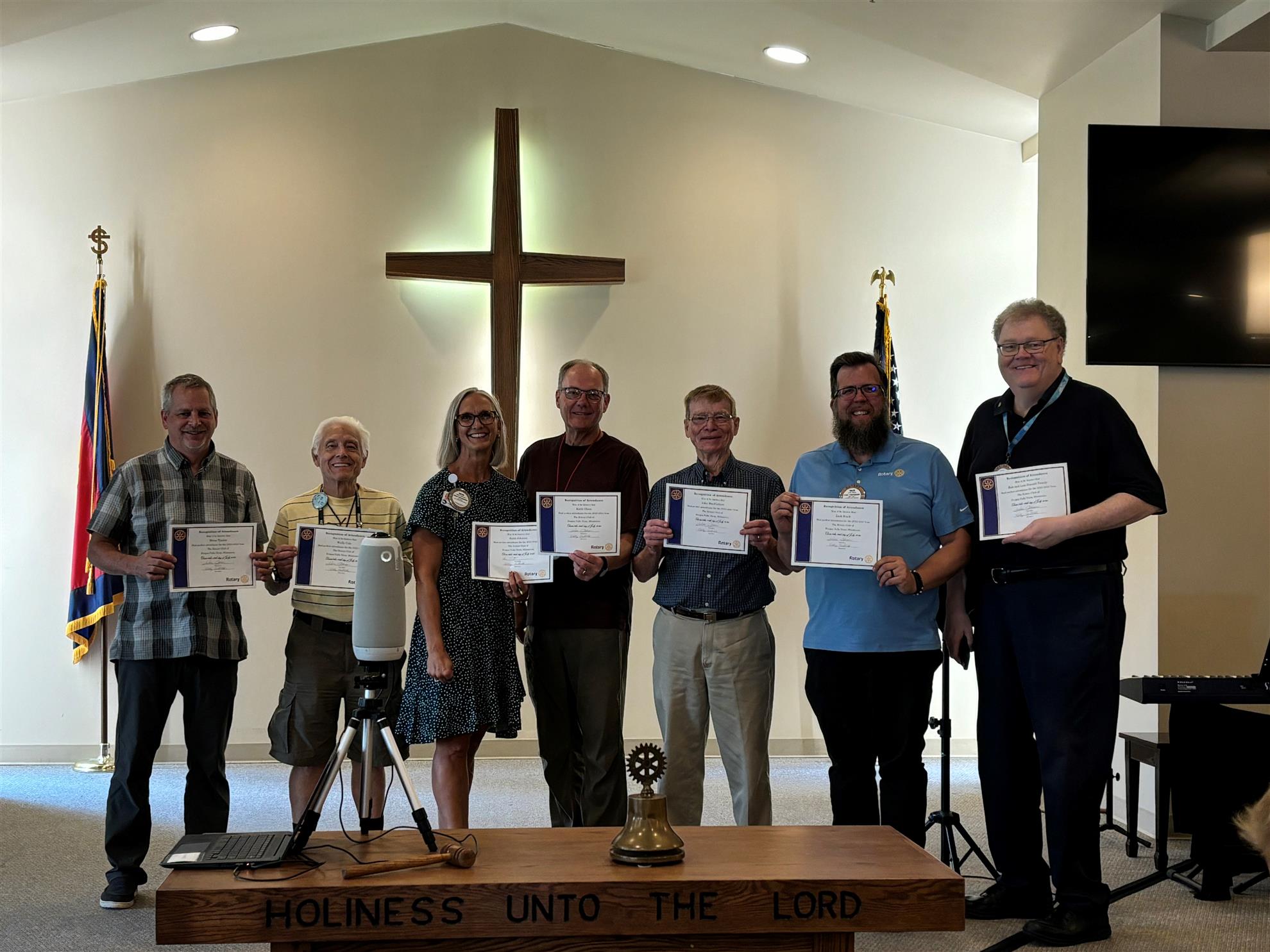
Tim H. offered our invocation. We had a couple guests: John M. introduced his grandson-in-law, Will Holtz, hailing from Rochester, with a master's from the University of Minnesota in finance, a former member of Duluth Rotary Club 25, and now going through the on-boarding process at our local Wells Fargo Bank. Steve A. introduced his wife, Yan Menghui, who will be in this area for about six weeks before returning to New York City. President Katie wished Brian T. a Happy Birthday and Brian told us of all the people related to him by marriage (only one) and blood who celebrate their birthday the day before he will (has) on July 12th. Kathy A. reported on all those with excellent attendance during the 2023-24 Rotary year and President Katie thanked her for keeping these records. Those who made almost all of our meetings (or made up somewhere) were Hal L. (40 meetings), Steve A. (47), Dave J. and Deb M. (48), Buzz L. (49) and Kathy A., Steve L. and Matt S. (50). Perfect attenders included Cody O. (since joining last October), Wally C., Katie J., John M. Keith O., Lois J and Bob R. (with their family membership), Zack S., and Brian T. There was a Rotary Minute Plus Quiz based on the July Rotarian and last week's program and one table (out of three) got their question answered correctly -- this year's Rotary International theme is the Magic of Rotary. We were told peaches are scheduled to arrive on Monday August 19th. [After the club meeting, the Board met and because the prices of the peaches have gone up this year, the decision was made to make presales at $45 a lug, with those purchasing at the truck paying $50.] Steve A. led off the bragging, celebrating his wife's presence, being able to drive their 57 Bentley to the meeting and getting a spark out of the 34 Bentley. Lisa M. paid for missing last week and to acknowledge one daughter who is in Costa Rica and another who performed in the marching band. Mary P. contributed for missing a few meetings, as did Mark B. and Tim H. This writer marked off a circle on his new Fine and Brag card so he could say he too was glad that Steve's wife was in town because it puts Steve in a better mood. John M. introduced our speaker, Chris Hyslop, the youngest son of Patricia and Charles, a 1986 grad of Fergus High, holding a master's from the Kennedy School at Harvard, and now living in Missoula, Montana with his wife and two teenage daughters. Chris taught school for two years in Rothsay, then went on to the Peace Corps, serving two years in Kazakhstan, and since then has worked for various humanitarian organizations, including 15 years at the United Nations, spending time in many countries where the conditions were not good. He was retired until asked to help in Israel after the October 7th attacks by the Hamas. Chris said that it is a struggle to say something intelligent about what is going on in Gaza, as everything is disputed. Gaza is only 141 square miles in size, which would be about the area from Fergus to Clitherall, and then up to Otter Tail Lake and back to Fergus.; as another comparison, Minnesota's Ramsey County is 152 square miles in size. Facts that are contested include the number of Israeli's killed on October 7th (one figure is 1,200), the number of Palestinians killed since then (one figure is 37,000) and the number of Palestinians in Gaza (one figure is 2.2 million). Presently in Gaza, about 80% of the buildings have been destroyed or damaged and most people have been displaced from their homes. Chris said that a saying in Africa applies to what is now going on in the Mideast: "When two elephants fight, it is the grass that suffers." He also quoted Stalin to sum up the frustration with how the situation can be seen by people of Stalin's ilk: one death is a tragedy, and one million deaths is a statistic. What is going on was described as a maelstrom, with everyone having an opinion and believing they are right and others are wrong. The project Chris is working on is to increase humanitarian aid going into Gaza, but there is opposition to that in the humanitarian community, with critics feeling like the proponents have an agenda. He described a shift in how people approach things -- where we are accustomed to having people exhorting us to act or not, now the approach seems to be to say everything is so difficult that nothing can be done about it. Chris said that message is emanating from troll farms in North Korea, Russia and here in the U.S. Chris challenges the notion that the situation is complex, as the problem is the war and the solution is peace; the solution to inhumanity is humanity. Chris tries to avoid the phrase "two-state solution," as it gets the same sort of reaction as saying "defund the police." He sees the real issue as an idea enshrined in the universal declaration of human rights -- the Gaza people need the right to define themselves. The biggest issue in Gaza right now is the widespread famine, lacking both food and potable water. The borders into Gaza are heavily controlled by Israel. Before October 7th, there were 500 truckloads of stuff crossing the border into Gaza on a daily basis and since October 8th, the average is down to 100. As always, Chris provided an insightful, thought-provoking presentation and thanks must go to John M. for arranging the program. |



.png)