|
Kathy gave our invocation. Dave Johnson called on our Student Guests from Hillcrest to introduce themselves. Ella Starzl participates in hockey, soccer and track, is a member of the National Honor Society and plans to attend Concordia next year and major in kinesiology. Rylyn Krinse (sp?) is also in three sports and plans on attending M State next year. Hayden Knick's parents are Jeremy and Andrea, but my apologies as I wasn't writing fast enough to get anything else down about her. Dominick Beving plays football and basketball and is on the student council, with plans to attend an on-line Bible college next year. 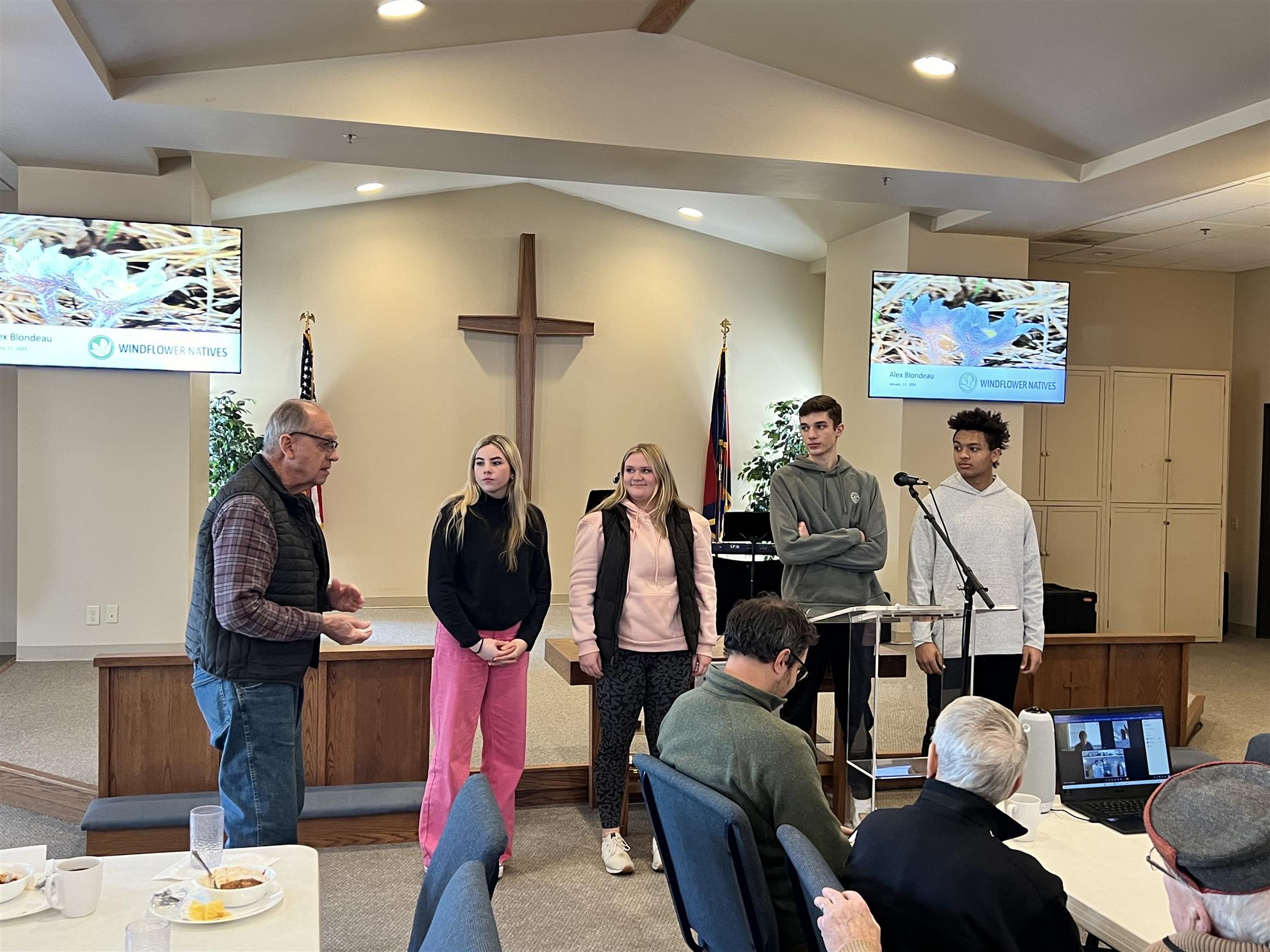 There was a Rotary Minute based on the January Rotary magazine with one of three tables answering their question correctly; anyone sitting at the other tables who was not wearing a Rotary pin (not the badge) had to contribute a dollar. There was also a plug for helping out at the Rotary speech tournament this coming Saturday, the 27th. Brags and fines started out with Lois J. thanking Hal L. for covering everyone at her table who could not answer the Rotary Minute question and was not wearing a Rotary pin. Dave J. contributed $5, happy with her new hearing aids he received through Lake Region. John M. was mindful of his wife's death one year ago and thanked club members for their support. Lois introduced Alex Blondeau as an artist, craftsman and thinker of deep thoughts. Alex wrote of himself (at Lois' request) that he was born in the latter part of the 20th Century, attended college in central Minnesota, received a doctorate in theology from Luther Seminary, built his family home here in Fergus Falls with the help of YouTube and was a meter reader for Otter Tail Power for four years. Alex told us of his journey to starting his own business, called Windflower Natives. About ten years ago he was out for an April run in what is now known as Ferber Park on a cold day and stopped to tie his shoelaces, seeing a flower at his feet. This prompted the question, "Who Are You," the flower speaking to him and beginning a process that has lasted to this day. Further background included his father Tom, a teacher here in town for 30 years, who was an active outdoorsman that would take Alex hunting, but Alex did not enjoy hunting but did enjoy the time with his father and the exposure to the outdoors. Alex said Fergus became a place he loved and desperately wanted to leave, falling in love with the North Shore and the mountains. Alex's father passed away a few months after Alex and his wife's first son was born and he had to ask himself why, if everything we are given is taken from us, how does one go forward. He spent nine to ten years studying philosophy and theology but bailed on his path to macadamia, looking for a sense of hope and connection. That is when he began building their Fergus Falls home and became a meter reader, a job he loved, describing it as spending 12 hours a day walking in small towns and meeting many furry friends. On his route, he would notice flowers growing in the ditch, which flowers changed month to month, year by year; people whose meters he read started referring to him as the guy digging around in ditches. Alex's homesite includes 2½ acres on which he started a reforestation project, which began by burning off the old growth. Alex described this annual ritual as one he loves but for which his wife leaves town. Thoughts of starting a native greenhouse began crawling into his head, but he had never had any experience with one. Others, aware of his desire, suggested he talk to a John Digre (?) who had such a greenhouse in Enderlin, North Dakota, but also warned him he would need at least one hour for such a conversation. It was two. This then is how it came to be that Alex went to work for John and the United Prairie Foundation in the summer of 2001, utilizing an old combine to harvest native seed. Since the purity of the seed is very important the first step in the process is to cut down all weeds. Alex then showed us a map of Minnesota with the western and southern portion highlighted, indicating that he has experienced new ecological habitats on a continuing basis throughout the area, describing them as "national park level ecosystems." Along with his appreciation, however, has come a sense of sadness, realizing that close to 99% of Minnesota's tall grass prairie has been lost over the years. Only one to two percent of it is left, either on rocky hillsides or in ditches, and that which remains is under incredible stress. He then shared why we should care about what is being lost, describing it as a resource that draws in carbon and burys most of it in the ground. It also helps avoid flooding, telling us that a native prairie can absorb up to nine inches of rainfall in an hour without runoff. Those plants that grow on it also provide pollinator support. But more than anything, he suggested we should care "because it has nothing to do with us." Alex compared the native prairie to a night sky full of stars, with his "wild places" and the stars showing up where we are and enriching our lives. So Alex started his business, harvesting and selling prairie flower seeds, recognizing the tension between saying they have nothing to do with us and then putting a price tag on them. His website is windflowernatives.com and Alex sells his produce at our local farmer's market and the one in St. Paul. He is now working with U.S. Fish and Wildlife to increase the functionality of the seeds and continues to work annually with John. Alex described his work as "the most integrated thing I have done in my life," returning to Ferber Park every year but not yet having seen that same flower from which his journey began. He concluded by telling us that prairies may not be what we use but they are a part of what we are. There was a spiritual nature to the presentation that was not to be missed. Thank you, Alex! |



.png)