
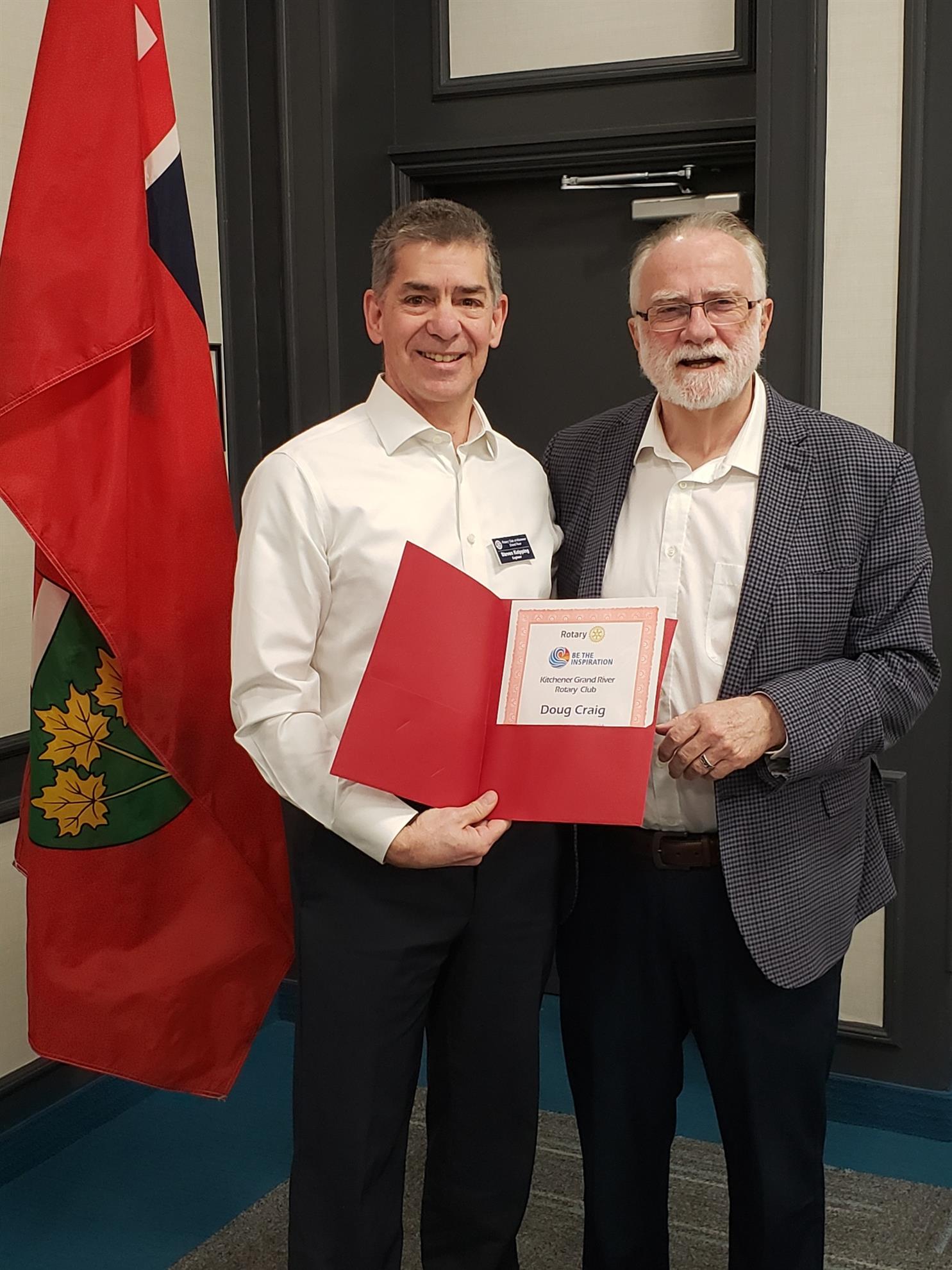
We were joined at our meeting of April 16 by Doug Craig, past mayor of Cambridge to discuss the current issue of Municipal Reform/Amalgamation.
As background, the province of Ontario is currently conducting a Regional government review of the governance, decision-making, and service delivery functions of 8 regional municipalities (including Waterloo Region) and Simcoe County. This review is being conducted by an advisory body of 2 commissioners (one of which is past Waterloo Regional Chair Ken Seiling).
Mr. Craig is a 40 year resident of Cambridge and schoolteacher by profession. He has been active in municipal and regional politics since 1976 serving as Alderman, Municipal Counsellor, Regional Counsellor and Mayor along with a being a member of a multitude of committees and boards.
Doug first moved to Cambridge 1 year after the 1973 creation of the Region of Waterloo which included the amalgamation of the towns of Hespeler, Preston the village of Blair and city of Galt into the city of Cambridge. This amalgamation is something that is still talked about almost 50 years later and residents still often refer to themselves as living in the old community names such as Hespeler as opposed to the city of Cambridge. This view of amalgamation provides unique perspective that the current debate should not about amalgamation but should actually be another comprehensive regional review.
In March 1979, the last review of Waterloo Region was completed by W.H. Palmer. The Palmer report (a copy of which, Mayor Craig still has and refers to) was a comprehensive analysis on the effectiveness specifically of the Region of Waterloo. For the Palmer report, which took over a year to conduct, a large staff interviewed every counsellor and mayor of each of the municipalities, conducted many public meetings and wrote a 348 page report that had over 100 recommendations specific to the Region of Waterloo (a copy of which is available here: http://www.ontla.on.ca/library/repository/mon/25006/38188.pdf).
In contrast, the current review is being conducted on a total of 9 separate regions (a total of 82 municipalities) by 2 commissioners. There are no public meetings and most of the data is being collected using online surveys and thru private meetings with the mayors. This review which started in January 2019 is to be completed in the summer of 2019. There is unlikely to be a public review and the overall process does not seem comprehensive or proper.
In Craig’s eyes it seems that the current Regional review has no merit as it’s scope is so broad, the timeframe so short and the minimal data and resources available to conduct the study make it appear that the conclusions have either been prewritten or will be so broad as to ignore the specific circumstances present in Waterloo Region. It seems that this study is a very deliberate push towards some form of municipal amalgamation instead of a proper review of the effectiveness of Regional governments.
Amalgamations are often pushed as money saving opportunities, but the reality is that it reduces the number of politicians (with a resultant reduction in access for the public) it often saves no money and will not result in a reduction in taxes. Political Science studies have determined that the economies of scale are different with each service provided and at a population of 100,000 you actually get negative economies of scale. You can see this in the Toronto amalgamation example which was predicted to generate $350M in annual savings but in actual fact generated almost no discernable reductions in spending.
A study focused on Regions and Municipalities with an aim towards fiscal improvements seem to be targeting the wrong level of government as the regions and municipalities already have balanced budgets in comparison to the current Ontario provincial budget which predicts a deficit of $13.5B and has an accumulated debt of $350B. The apparent inability to balance the province’s books has the appearance of lacking accountability and the focus on the review of Regional effectiveness looks like an attempt to push blame and public attention elsewhere.
It appears that the public doesn’t understand the implications of amalgamation as there would be changes everywhere, from new health cards, new street names, elimination of duplicates services and addition of services where none are demanded (eg. The townships which currently have volunteer fire departments would be forced to have professional fire departments as part of amalgamation). Thru amalgamation you would lose the ability to customize your services to your resident’s needs as the standardization of services is a core principle of amalgamation. Where today there is choice: Waterloo-University feel, Kitchener-vibrant downtown, Cambridge-heritage, the townships-rural life; an amalgamation would tend to homogenize these differences. What’s lost to the public is that the cities and townships already work together and there isn’t fantastic improvements available just thru amalgamation.
In conclusion, Craig is convinced that this is not a proper review and just a push to an already preordained amalgamation plan. The report will likely not be made public an the results will be forced upon us with the unfortunate result that no-one will likely accept it. Our region already performs well economically and the existing municipal structure gives us already the best bang for our buck!
Good government is not necessarily efficient and efficient government is not necessarily good!
