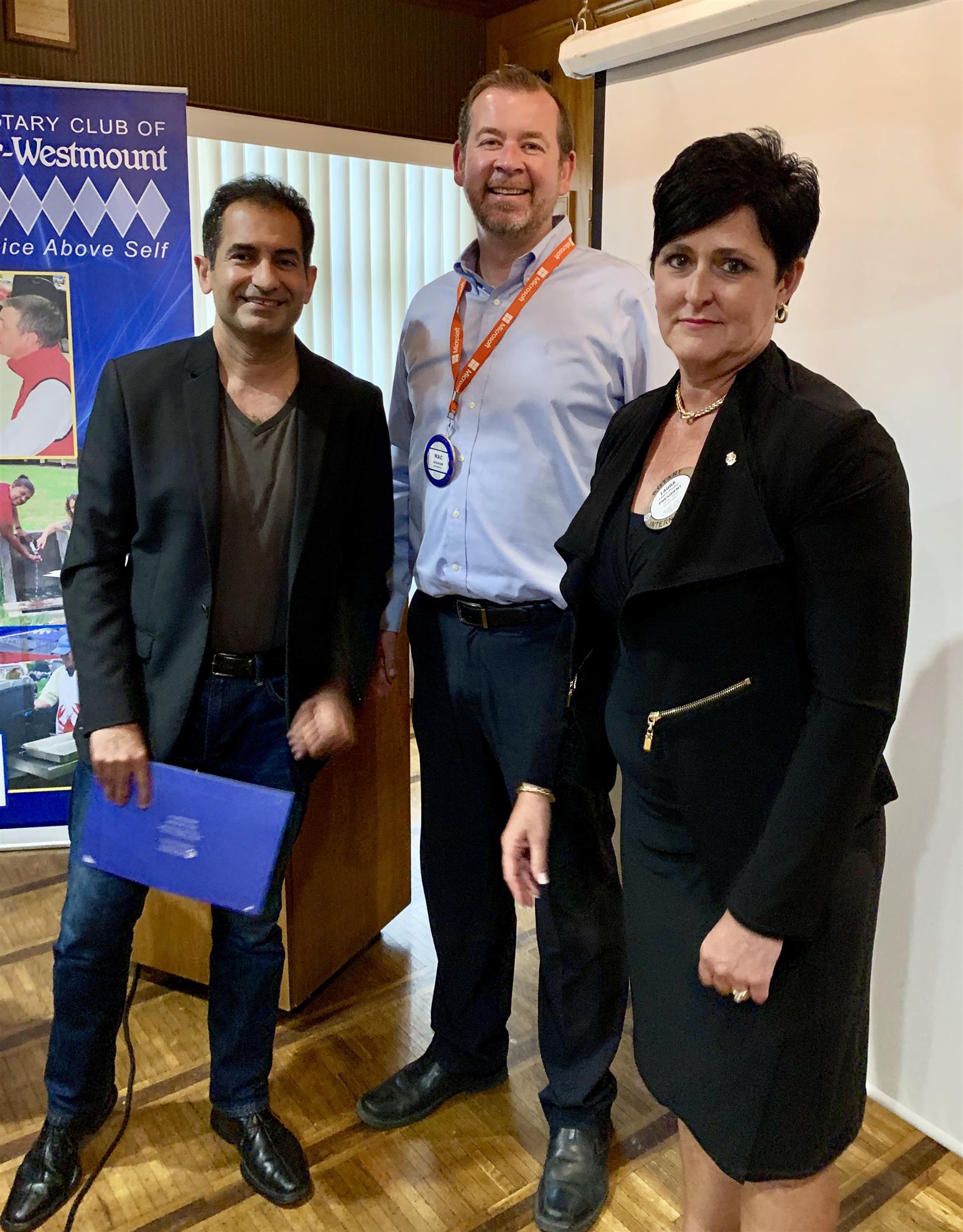
Mac Graham and President Laura thank guest speaker Dr. Omar Hakim.
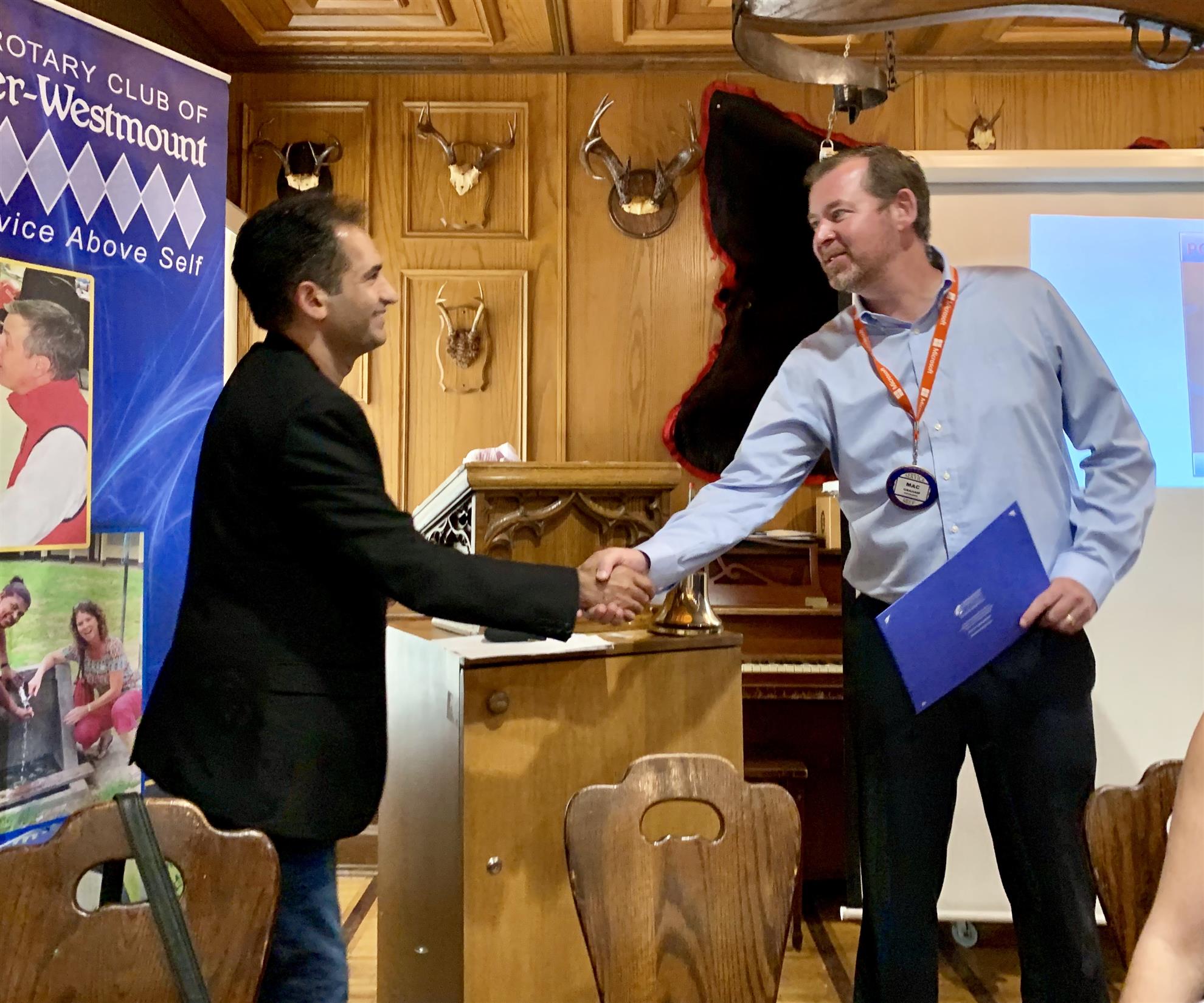
Mac Graham presents Dr. Omar Hakim with the Gift of Sight certificate.
Announcements:
Birthdays: No birthdays
Anniversaries: Everton Wilmot, Brad Enns
Members:
Jerome Freiburger has established a challenge to find 25 blood donors in honor of his personal 25thblood donation. Members can sign up for any day, just let Jerome know that you have donated as part of his challenge.
Chris Wilk announced that there are 13 spots left to sign up for Bingo to the end of year. At least 20 people have not volunteered yet and need to let Chris know when they can cover a shift.
Troy Stuebing announced that at next week’s meeting (Aug 28) the first sign up for Crown & Anchor shifts will be held. Members need to cover 2 shifts and prime times go quickly.
Guess the Member: Laura gave three clues and it took less than 30 seconds for Graham Gardner to identify Ed Simon as the mystery Rotarian.
50/50 – pot was $429.00. Karin Voisin, Jack Kinch, and xxxx (sorry can’t remember 3rd) all tried and were unsuccessful. Pot continues to grow.
Speaker:
Andrew Williams introduced Dr. Omar Hakim, Ophthalmologist. Dr. Hakim practices from the TLC Clinic at the University of Waterloo as well as having clinics in other cities in southern Ontario. He has been providing laser eye surgery and cataract surgery since 1994 and along with many distinguished honours is an adjunct profession at the University of Waterloo School of Optometry.
Dr. Hakim spoke to the issue of cataract surgery by answering three questions: What is a cataract, how is it treated, and what are the options to consider when thinking about surgery.
A cataract is a lens behind the pupil of the eye, which can become cloudy as a natural process of aging. The cloudiness causes vision to become dim, or fuzzy, or distorted. Although a natural process of aging cataracts can also have contributing factors from family history, diabetes, smoking, and some drugs. Surgery has progressed over the years and correction of cataracts is a fairly routine procedure now. The surgery involves inserting a probe into the eye to remove the cataract and then replace it with an implant lens. Dr. Hakim showed a video of actual cataract eye surgery, which caused a few members to be a bit squeamish, but demonstrated the steps of the procedure.
The current trend is for people to have cataract surgery much earlier than previously. Previously many would wait until much later in life when their sight was compromised. Now it is being considered much earlieer by individuals and as a preventative option. Older patients now will often choose cataract surgery over laser eye surgery since laser eye corrections do not address the potential for still getting cataracts and requiring further surgery. Cataract surgery is a permanent correction. It can also be a correction for either near sighted or far sightedness. However it can only fix one issue and individuals may still require glasses for the other. There are pros and cons to either selection and it is an individual choice dependent on life style and what is important to the person.
In all cases, this surgery has evolved to a safe and routine procedure that is providing many good options to people.
True Story....
Sol had lived a long life, which was drawing to its end. As his family surrounded him on his deathbed, he asked to see his optometrist.
"Optometrist?" they asked. "Why in the world do you want to see your optometrist?"
"Just get him for me."
So they go get Dr. Kaplan, who, on seeing Sol about to depart this life, asked, "Sol, it pains me to see you like this. What can I possibly do for you?"
Sol opened his eyes slightly and said, "Doc, before I go, there's one thing I have to know. Which one was clearer - A or B?"