|
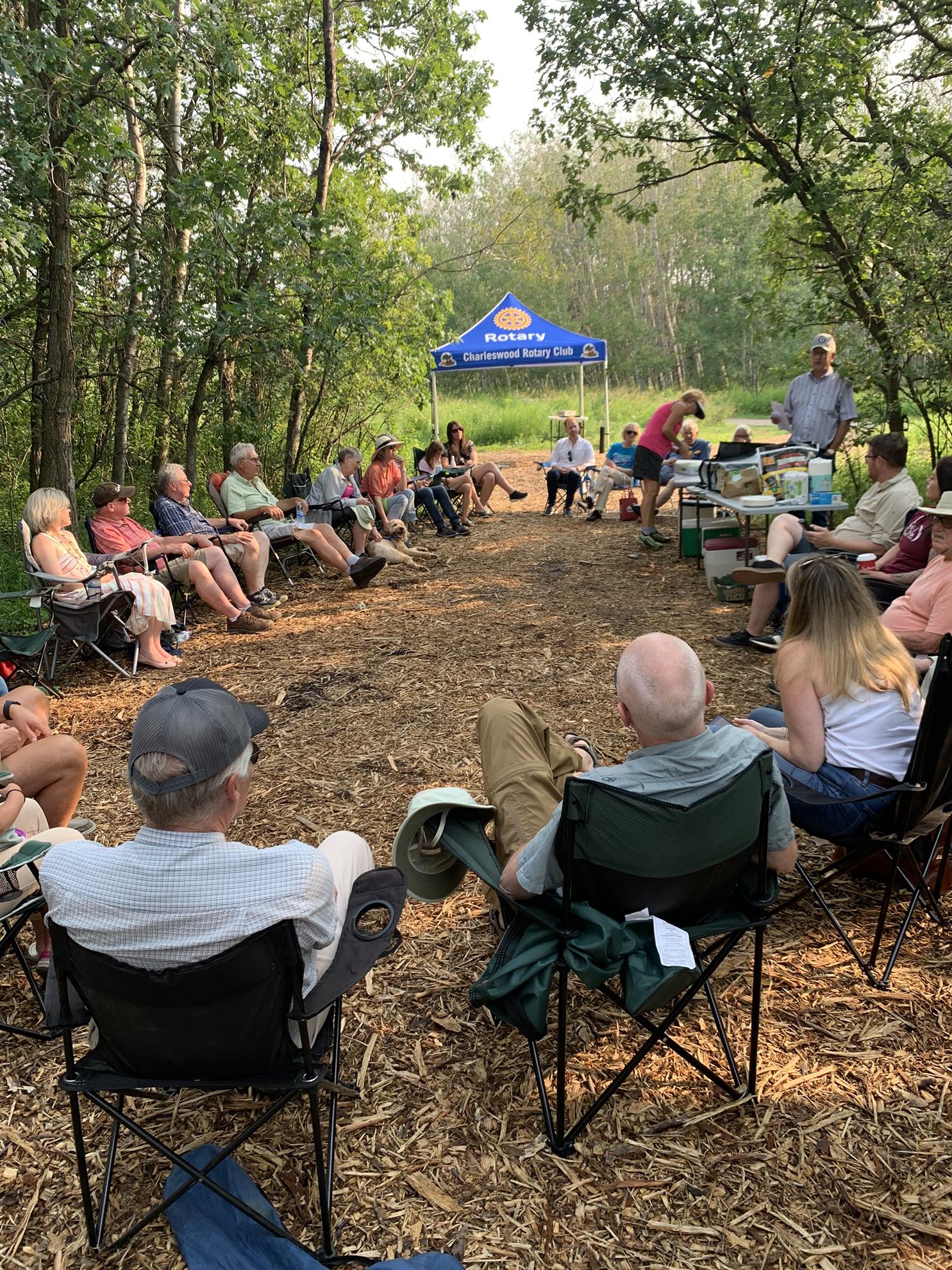 Thank you to Jack Wilson as Chair of the forest who described the activities this far. The Charleswood Rotary club has been Stewards of the forest for over 34 years. Thank you to Jack Wilson as Chair of the forest who described the activities this far. The Charleswood Rotary club has been Stewards of the forest for over 34 years.
- The club has one of the longest working agreements of any volunteer organisation with the City of Wpg, Natural Services Dept.
- Assiniboine forest is one of the largest urban forest in Canada, with some 730 acres of area. Consisting of two parts. Approx. 200 acres between Grant Ave. & Roblin Blvd. and 530 acres to the south being the main forest.
- Some 18 kms of trails, six paved and unpaved trails, plus numerous unofficial trails. Linked with the Harte Trail, Fort Whyte and Assiniboine Park.
- In a planning study completed by the Charleswood Rotary club in 2017 /18 recorded some 170,000 visitors annually through four main entrances. Visitors come from all over the city, Manitoba and Canada.
- The Assiniboine forest is a carbon sink for Winnipeg.
Summary of work completed in the past - Construction of the Eve Werier pond boardwalk
- Support the Green Team annually since 1991
- Land reclamation for municipal waste disposal site clean-up and restoration
- Restoration of compromised natural drainage along Shaftesbury
- Chalfont & Grant parking lot development
- In 2000 the first front gate development and roadway sign was installed
- Sponsored thistle control program
- Installed initial trail wayfinding signage
Current plans Based on a 32 month planning study completed in late 2017 /18 by the Charleswood Rotary Club, in conjunction with the City of Wpg Natural Services Dept. and the Province of Manitoba. A path forward was determined based on this extensive study. Summary of forward plan: Accessibility to more of the forest for all. There are currently some 18 kms of trails in the forest. This distance comprises some six main trails. Of these two are hard surfaces suitable for all forms of accessibility. The Charleswood Rotary Club is planning to expand a hard surface trail leading back from the Eve Werier Pond. This includes replacing a chipped trail with a hard limestone trail suitable for all. The Class B preliminary estimate to upgrade the current chipped trail from the pond area is $400,000.00. There is another trail called the Preston Trail, which runs the length of the forest approximately one km. on the east side of the Assiniboine Forest. Future plans are to have one of the current chipped trails which joins the Preston Trail with a limestone hard surface. The upgrades to these trails would then allow visitors with mobility issues, visitors pushing strollers etc. to have access to virtually all aspects of this beautiful forest. - Upgrade of both Street and trail signage. This also will include signage for the north forest section.
- Refurbishment of the Chalfont entrance to the forest.
- Development of a natural school educational area and restroom facilities.
- Develop a prototype of an eco-friendly parking area on the east side of the forest. In this development to facilitate parking lot runoff instead of into the city's storm sewer system, and enhancement to a nearby pond to attract additional waterfowl. This work to be completed in partnership with Ducks Unlimited.
Since COVID, The forest has seen a significant increase in visitor traffic. This has placed additional pressure on the Chalfont parking area. Resulting in increased times visitors are parking on Chalfont on both sides of Grant Ave. This increased visitor traffic is also causing greater pressure on a small portion of Assiniboine Forest located adjacent to the Chalfont parking area. In creating a new parking area on the east side of the forest, will assist in spreading the visitor traffic out over a greater portion of the forest thus helping in its preservation. Thank you to Michael Dudar Co-Chair of the forest committee who provided a short history of the forest and some of the natural forest habitat. 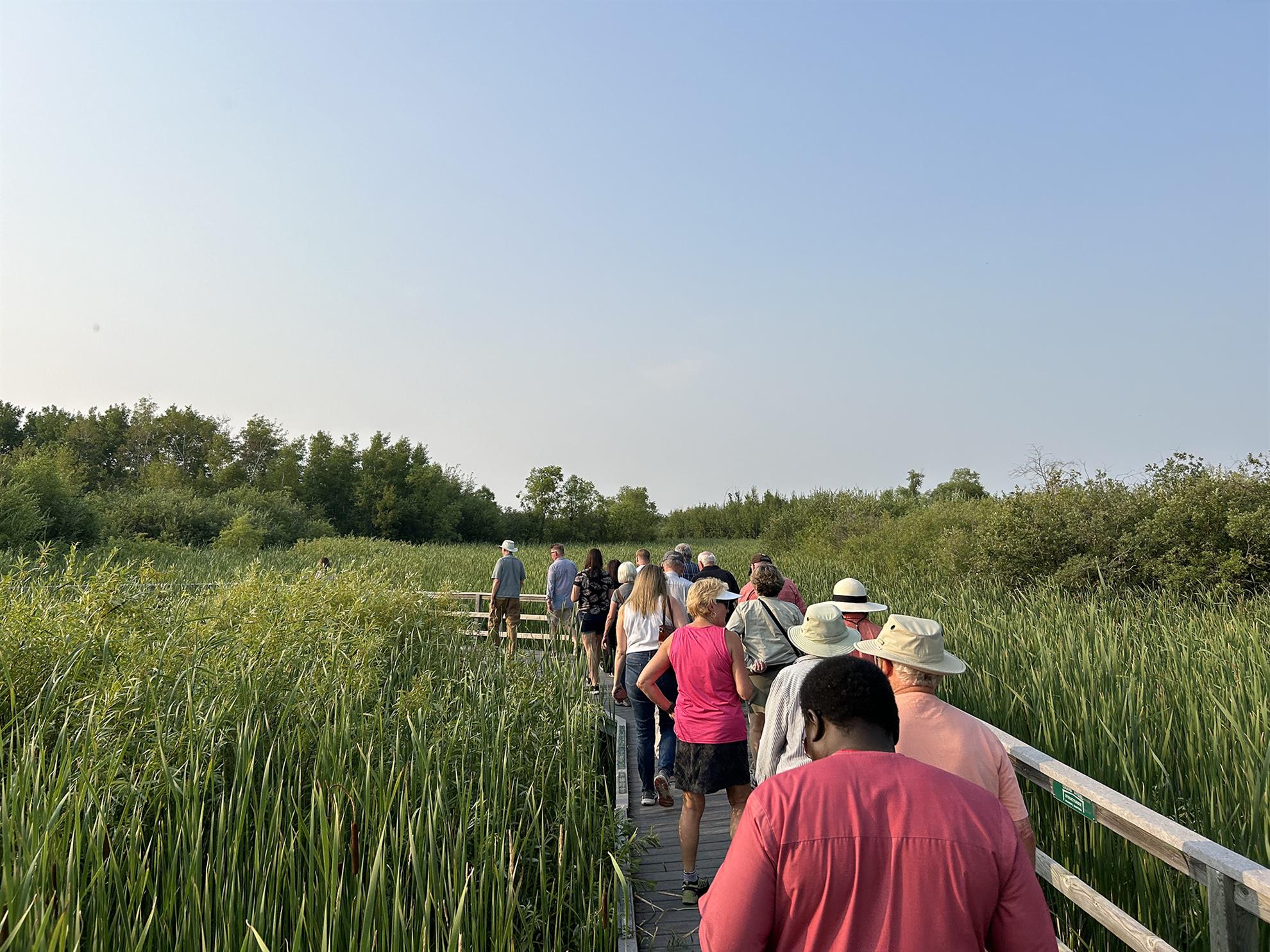 From prairie to forest: Assiniboine Forest was once an open prairie grassland. From prairie to forest: Assiniboine Forest was once an open prairie grassland.
In past centuries, an enormous tall grass prairie ecosystem stretched out in both directions beyond the tree-lined banks of the nearby Assiniboine River. This diverse, wildflower-dotted landscape was subject to frequent wildfires, and home to herds of roaming bison whose grazing kept the trees at bay and the prairie thriving. In the 19th century, bison populations began a steep decline, and area wildfires were increasingly suppressed to protect the growing nearby residential population. Most open prairie that remained was gradually overtaken by aspen and oak forests, which were able to establish and thrive in the absence of natural controls. Anishinaabe (Ojibwe), Ininew (Cree), Dakota, and Red River Métis peoples are the original inhabitants and stewards of this land. The forest provides an opportunity for Indigenous groups to apply traditional ecological knowledge and a connection to the prairie, forest, and wetland ecosystems which are home to culturally important plants and animals. Plans to develop this land into housing began as early as 1910 when Winnipeg and the surrounding areas entered a phase of rapid growth. Road cuts intended to be residential streets were established throughout the forest in the 1920s, many of which still exist today as walking trails. Economic troubles in the 1930s temporarily halted development. Local residents continued to use the forest for recreation, and some areas were used as a refuse dump until the mid-20th century. A movement to protect Assiniboine Forest began in the 1960s, led in part by City Councillor Bernie R. Wolfe. His efforts, along with those of individual citizens and advocacy groups like the Assiniboine Park Centennial Committee, resulted in Assiniboine Forest’s designation as a municipal nature park in 1973. Since 1991, Rotary Club of Winnipeg - Charleswood members have acted as Stewards of the Forest in partnership with the City of Winnipeg’s Naturalist Services Branch. This collaboration is the City of Winnipeg’s longest ongoing natural area partnership, and the two organisations proudly work together to manage Assiniboine Forest as a healthy, natural ecosystem for years to come. Habitat Highlights Tall Grass Prairie: An endangered habitat within Assiniboine Forest Assiniboine Forest used to be a more open landscape. Historical aerial photographs show that much of the park was once a vast grassland, where roaming bison and frequent wildfires kept meadows clear of trees. Over time, aspen trees spread into and overtook large sections of the prairie. Pockets of tall grass prairie populated by plants like big bluestem, meadow blazingstar, prairie sage and sweetgrass remain scattered throughout the forest. These grasslands support a diverse range of wildlife: try to spot monarch butterflies and bumblebees among the wildflowers; mammals like deer and foxes foraging for food; and birds of prey circling high above. In Manitoba today, human development has fragmented the tall grass prairie into small remnant patches: less than 1% of its original extent remains. Assiniboine Forest boasts approximately 15 hectares of prairie habitat, or 5% of its total area. Aspen Forest: A community of trees or a single organism? Trembling aspen are fast-growing trees that form dense and sometimes enormous ‘stands’ by sending out shoots from their root systems. These shoots expand outward, sprout, and grow into genetically identical new trees that remain connected to the parent plant underground, forming one giant plant. Trembling aspen are short-lived and fast-growing, and are typically the first trees to spread into open meadows. Look and listen as the leaves of the aspen canopy ‘tremble’ in the wind, providing dense cover for a wide range of wildlife. You might spot deer, coyotes, squirrels, and woodpeckers sheltering among the trees. Oak Forest: The oldest and most resilient trees in the woods. Bur oak are tough trees that are well adapted to our extreme climate. Oak trees have thick bark that insulates them from the heat of wildfires, and waxy leaves that help reduce water loss during droughts. They are anchored by a strong taproot and extensive lateral root system that can withstand heavy winds and draw water from deep underground. The bur oak is named for the rough, bur-like bristles on the cap of its nutrient-rich fruit, the acorn. Acorns are an important food source for a wide range of wildlife that make their home in the forest. The broad canopy of a thriving oak forest also protects a diverse understory of food-bearing shrubs, including saskatoon, wild plum, and hazelnut. Thank you to LeeAnn Mytz who took care of the arrangement and planning of providing food and refreshments for the assembled members along with the forest tour arrangements and tour guides. After speeches, the members and guests toured the forest. President Elect David Soper, thanked the members and guests for this special meeting on behalf of the club in support of Assiniboine Forest. |

.png)